Lone Pine Orders in Class Action, Mass Tort and Products Liability - - PowerPoint PPT Presentation

lone pine orders in class action mass tort and products
SMART_READER_LITE
LIVE PREVIEW

Lone Pine Orders in Class Action, Mass Tort and Products Liability - - PowerPoint PPT Presentation

Lone Pine Orders in Class Action, Mass Tort and Products Liability Litigation Bringing and Defending Pre Trial Motions Regarding Bringing and Defending Pre-Trial Motions Regarding presents presents Exposure, Causation and Damages A Live


slide-1
SLIDE 1

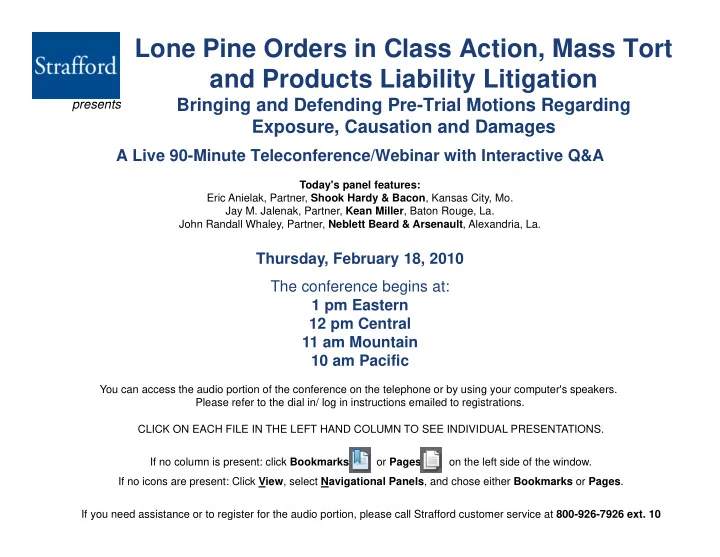
Lone Pine Orders in Class Action, Mass Tort and Products Liability Litigation

Bringing and Defending Pre Trial Motions Regarding

presents

Bringing and Defending Pre-Trial Motions Regarding Exposure, Causation and Damages

presents

A Live 90-Minute Teleconference/Webinar with Interactive Q&A

Today's panel features: Eric Anielak, Partner, Shook Hardy & Bacon, Kansas City, Mo. Jay M. Jalenak, Partner, Kean Miller, Baton Rouge, La. John Randall Whaley, Partner, Neblett Beard & Arsenault, Alexandria, La.

Thursday, February 18, 2010 The conference begins at: 1 pm Eastern p 12 pm Central 11 am Mountain 10 am Pacific

CLICK ON EACH FILE IN THE LEFT HAND COLUMN TO SEE INDIVIDUAL PRESENTATIONS. You can access the audio portion of the conference on the telephone or by using your computer's speakers. Please refer to the dial in/ log in instructions emailed to registrations. If no column is present: click Bookmarks

  • r Pages
  • n the left side of the window.

If no icons are present: Click View, select Navigational Panels, and chose either Bookmarks or Pages. If you need assistance or to register for the audio portion, please call Strafford customer service at 800-926-7926 ext. 10

slide-2
SLIDE 2

For CLE purposes, please let us know how many people are listening at your location by

  • closing the notification box
  • and typing in the chat box your

company name and the number of attendees.

  • Then click the blue icon beside the box

to send.

slide-3
SLIDE 3

Lone Pine Orders in Class Action, Mass Tort and Products Liability y Litigation

An Overview of Lone Pine Orders

Eric Anielak Sh k H d & B L L P Shook, Hardy & Bacon, L.L.P. February 18, 2010

slide-4
SLIDE 4

Outline of Presentation

 What Are Lone Pine Orders?  Purpose of Lone Pine Orders  Courts’ Authority  Elements of the Typical Lone Pine Order  Factors That Prompt Their Use  Use of Lone Pine Orders by the Courts  Cases Suited for Lone Pine Orders

2

slide-5
SLIDE 5

What Are Lone Pine Orders?

 Lore v. Lone Pine Corp.,1986 WL 637507, No. L-33606-85 (N.J. Super. Ct. Law

  • Div. Nov. 18, 1986)

Multiple plaintiffs sued 464 defendants, alleging water from Lone Pine Landfill caused personal injuries and declining property values.

 Case management order required plaintiffs to present basic  Case management order required plaintiffs to present basic

facts supporting their claims, including:

for personal injury claims, expert reports supporting each plaintiff’s claim of injury and causation, and

for property damage claims, expert reports supporting claims, including timing and degree of damage as well as causation

 When plaintiffs failed to comply with the court’s order, the court

dismissed with prejudice dismissed with prejudice.

3

slide-6
SLIDE 6

What Are Lone Pine Orders?

 Case management tool  Requires plaintiffs to define their claims and

to demonstrate expert evidence supporting those claims early in the litigation those claims early in the litigation.

4

slide-7
SLIDE 7

Purpose of Lone Pine Orders

 Designed to help courts define the issues,

narrow the scope of discovery, and gain t l l liti ti t l control over complex litigation at an early stage.

 Separating the “wheat” from the “chaff”

5

slide-8
SLIDE 8

El t f th T i l L Pi Elements of the Typical Lone Pine Order

 Lone Pine orders require plaintiffs to provide expert

evidence to the court or defendants supporting evidence to the court or defendants supporting essential elements of their claims:

– specific causation

product identification

– date of exposure

method of exposure

– product identification – product exposure – method of exposure – injury, disease, or damage

 The orders include a deadline by which plaintiff must

y p submit the required expert evidence.

 Finally, the orders usually include a penalty for non-

compliance such as dismissal of the action compliance, such as dismissal of the action.

6

slide-9
SLIDE 9

El t f th T i l L Pi Elements of the Typical Lone Pine Order (cont.)

 Causation can be the most onerous burden in a toxic tort

case.

 Lone Pine orders often require plaintiffs to submit affidavits

from medical or other experts on the issue of causation.

 Some courts require these experts’ testimony to meet

So e cou ts equ e t ese e pe ts test

  • y to

eet Daubert or Frye standards of admissibility.

 Other courts require only a minimal showing of some kind of

scientific basis for their claims. See In re Vioxx Prods. Liab. Litig., 557 F. Supp. 2d 741, 744 (E.D. La. 2008) (plaintiff need only make minimal showing consistent with Rule 26).

– Fed. R. Civ. P. 26 reports – Other affidavits or reports

7

slide-10
SLIDE 10

A h i f L Pi O d Authority for Lone Pine Orders: Statutes and Rules of Procedure

 Trial courts cite procedural rules and statutes giving

them broad discretion to manage caseloads and them broad discretion to manage caseloads and discovery as authority for entering Lone Pine orders.

– Fed. R. Civ. P. 16(c) (court may adopt special

( ) ( y p p procedures to eliminate frivolous claims and manage complex cases) Fed R Civ P 26 (authority to manage and limit

– Fed. R. Civ. P. 26 (authority to manage and limit

discovery)

– Fed. R. Civ. P. 11 (attorneys must have

( y evidentiary support for allegations) Acuna v. Brown &

Root, Inc., 200 F.3d 335, 340 (5th Cir. 2000)

8

slide-11
SLIDE 11

A th it f L Pi O d Authority for Lone Pine Orders: State Statutes and Rules

 Many states have procedural rules or

t t t l t th F d l R l statutes analogous to the Federal Rules, including 11, 16, and 26. St t l t t t id t i l t b d

 State rules statutes provide trial courts broad

authority to manage complex cases:

California: Cal Standards Jud Admin § 19(h)

– California: Cal. Standards Jud. Admin. § 19(h) – New York: N.Y. C.P.L.R. §§ 602, 3103.

9

slide-12
SLIDE 12

A th it f L Pi O d Authority for Lone Pine Orders: Courts’ Inherent Authority

 Both federal and state court decisions have

cited trial courts’ inherent power to manage their dockets as authority for issuing Lone Pine orders Pine orders.

10

slide-13
SLIDE 13

Factors That Prompt Use of Lone Pine Orders

 “In crafting a Lone Pine order, a court should strive

to strike a balance between efficiency and equity. Lone Pine orders may not be appropriate in every y pp p y case, and even when appropriate, they may not be suitable at every stage of the litigation.” In re Vioxx

  • Prods. Liab. Litig., 557 F. Supp. 2d 741, 744 (E.D.

g , pp , (

  • La. 2008).

 Courts consider a number of factors in determining

whether to issue Lone Pine orders whether to issue Lone Pine orders.

11

slide-14
SLIDE 14

F t Th t P t U f L Pi Factors That Prompt Use of Lone Pine Orders

 Courts consider:

– The number of parties involved – Number of claims / causes of action involved – The stage of the litigation

 See In re Vioxx, 557 F. Supp. 2d at 744.

– Insufficient pleading

 See, e.g., Atwood v. Warner Elec. Brake & Clutch Co., 605 N.E.2d 1032, 1037 (Ill.

  • Ct. App. 1992)

– Circumstances indicating plaintiffs’ claims lack merit – Availability of other procedures

 See, e.g., In re Digitek Prod. Liab. Litig., MDL No. 1968, 2010 WL 86170 (S.D. W.Va.

Jan 8 2010)

  • Jan. 8, 2010).

– Particular needs of the case

12

slide-15
SLIDE 15

Use of Lone Pine Orders

 California, Illinois, Montana, New Jersey, New York, Texas, and

Wisconsin have approved Lone Pine orders in reported d i i decisions.

In Texas, appellate courts have granted writs of mandamus when trial courts refused defendants’ requests for Lone Pine orders. See In re Mohawk Rubber Co., 982 S.W.2d 494, 499 (Tex. Ct. App. 1998); In re Zenith Elecs Corp of Texas No 13 04 00420 CV 1998); In re Zenith Elecs. Corp of Texas, No. 13-04-00420-CV 2004 WL 2367236 (Tex. Ct. App. Oct. 21, 2004).

 Countless courts in other jurisdictions have undoubtedly issued

Lone Pine orders in unreported cases.

 The orders have frequently been used by federal district courts.

Many cite to Acuna v. Brown & Root, Inc., 200 F.3d 335 (5th Cir. 2000), wherein the Fifth Circuit endorsed the use of Lone Pine

  • rders.

13

slide-16
SLIDE 16

Examples

 In re Vioxx Prods. Liab. Litig., 557 F. Supp. 2d 741 (E.D.

La 2008)

  • La. 2008)

 In re Digitek Prod. Liab. Litig., MDL No. 1968, 2010 WL

86170 (S.D. W.Va. Jan. 8, 2010)

 Ramirez v E I du Pont de Nemours & Co

No 8:09-CV-

 Ramirez v. E.I. du Pont de Nemours & Co., No. 8:09-CV-

321-R-33TBM, 2010 WL 144866 (M.D. Fla. Jan. 8, 2010)

14

slide-17
SLIDE 17

Cases Suited for Lone Pine Orders

 Lone Pine orders may be useful for any litigation

that:

– involve multiple plaintiffs – involves multiple theories of recovery; – involves novel theories of injury or causation; or – requires expert scientific/medical testimony.

 These orders are often appropriate for:

– Mass Torts – Environmental and Toxic Torts – Chemical Exposure Cases – Complex Products Liability Cases

15

slide-18
SLIDE 18

Jay M. Jalenak, Jr. KeanMiller One American Place 301 Main Street, Suite 1800 Baton Rouge, LA 70801 Tel.: 225.382.3438 Cell: 225 907 3263 Cell: 225.907.3263 Direct Fax: 225.215.4038 web site: www.keanmiller.com

slide-19
SLIDE 19

Defense perspective

Lone Pine orders require plaintiffs early in the litigation to:

p p

(1) Specifically define their alleged injuries and/or damages; and (2) Demonstrate at the early stages a prima facia level of (2) Demonstrate at the early stages a prima facia level of evidentiary support for key components of their claims, usually causation of damages.

2

slide-20
SLIDE 20

Defense perspective

Lone Pine orders are designed to assist in the management of

p p

g g complex issues and potential burdens on defendants and the court in mass tort litigation, essentially requiring plaintiffs to produce a measure of evidence to support their claims at the outset. Steering Committee v. Exxon Mobil Corp., 461 F.3d 598, 604 n. 2 (5th Cir.2006); Acuna v. Brown & Root Inc., 200 F.3d 335, 340 (5th Cir.2000)

3

slide-21
SLIDE 21

Defense perspective p p

Traditional Rationale: Lone Pine orders ensure that unsupported claims will not Lone Pine orders ensure that unsupported claims will not consume the resources of the parties or the judiciary. M B dl S ki More Broadly Speaking: Lone Pine orders are an effective case management tool to assist the courts in defining issues, narrowing the scope of discovery, and g , g p y,

  • therwise getting control of complex litigation at the earliest possible

stage of the litigation.

4

slide-22
SLIDE 22

Whatever perceived burdens Lone Pine orders place on the plaintiffs Whatever perceived burdens Lone Pine orders place on the plaintiffs must be weighed against the burdens protracted litigation will impose on the court system and the defendant. Lone Pine orders do not, as plaintiffs often argue, unfairly require the plaintiffs to prove their case before proceeding with the lawsuit. They merely require plaintiffs to define their claims clearly and to demonstrate merely require plaintiffs to define their claims clearly and to demonstrate that there is some competent evidentiary support to justify proceeding with time consuming, burdensome, and complex litigation.

5

slide-23
SLIDE 23

Lone Pine orders enforce the plaintiff’s burden in civil litigation. Plaintiff's burden of proof: Plaintiff s burden of proof:

  • 1. Fault

2. Causation 3. Damages

6

slide-24
SLIDE 24

Lone Pine orders simply require production of that which plaintiffs ought Lone Pine orders simply require production of that which plaintiffs ought to have obtained before filing suit points to a problem that is all too common in complex litigation – a vague petition followed by onerous discovery requests and time consuming litigation as the plaintiffs attempt to use “discovery” to do that which should have been done before suit was filed. The “reasonable inquiry” requirement of Rule 11 is not simply window dressing – it is a real obligation, and the Lone Pine order can be used to enforce it. “The [order] essentially required that information which plaintiffs should have had before filing their claims pursuant to Fed. R.Civ.P. 11(b)(3).”

  • Acuna et al v Brown & Root et al

200 F 3d 335 (5th Cir Acuna et al. v. Brown & Root, et al., 200 F.3d 335 (5th Cir., 2000).

7

slide-25
SLIDE 25

In re Vioxx Products Liability Litigation, 557 F.Supp.2d 741,744 (E.D. La. 2008), the Court stated that it was “not requiring that Plaintiffs provide expert reports sufficient to survive a Daubert challenge or even provide d t h ill t tif t t i l R th th C t i i i Pl i tiff and expert who will testify at trial. Rather the Court is requiring Plaintiffs to make a minimal showing consistent with Rule 26 that there is some kind of scientific basis that Vioxx could cause the alleged injury.” The court ultimately dismissed the claims for failure to comply with the Lone Pine order. In re Vioxx Products Liability Litigation, 2009 WL 1158887 (E D La April 28 2009) 1158887 (E.D. La., April 28, 2009).

8

slide-26
SLIDE 26

Lone Pine orders are perfectly consistent with the principles espoused in the Federal Judicial Center’s Manual for Complex espoused in the Federal Judicial Center s Manual for Complex Litigation. The Manual recognizes and encourages courts to use “... the numerous grants of authority that supplement the court’s inherent power to manage g y pp p g litigation.” (Manual for Complex Litigation, Fourth, §10.1.) One of these specific grants of authority is Federal Rule Civ. Proc. 16(c)(12) which encourages courts to adopt “special procedures” to 16(c)(12), which encourages courts to adopt special procedures to manage appropriate cases. It provides:

(c) Subjects for Consideration at Pretrial Conferences. At any conference under this rule consideration may be given, and the court may take appropriate action, with respect to * * * (12) the need for adopting special procedures for managing potentially difficult or protracted actions that may involve complex issues, multiple parties, difficult legal questions, or unusual proof problems....

9

slide-27
SLIDE 27

Lone Pine orders are perfectly consistent with the principles espoused in the Federal Judicial Center’s Manual for Complex espoused in the Federal Judicial Center s Manual for Complex Litigation. The Manual recognizes that effective judicial management is “active” and “substantive.” (Id., at § 10.13.) ( § ) The management should be “active” in the sense that the judge will anticipate crucial issues before they arise “... rather than await passively for counsel to present them ” (Id ) for counsel to present them. (Id.) It should be “substantive” by allowing the court to become familiar with the key substantive issues at an early stage so that the court can make informed rulings on issue definition and narrowing. (Id.) To accomplish this, the court should seek specific information and require the attorneys at the earliest possible stage to “ describe the require the attorneys, at the earliest possible stage, to ... describe the material facts they intend to prove and how they intend to prove them.” (Id., at § 11.33.)

10

slide-28
SLIDE 28

Lone Pine orders are perfectly consistent with the principles espoused in the Federal Judicial Center’s Manual for Complex espoused in the Federal Judicial Center s Manual for Complex Litigation. The Manual recognizes that the best time to adopt “special procedures” to manage potentially difficult or protracted litigation is during the very g p y p g g y early stages. “Judicial supervision is most needed and productive early in the litigation.” (Id., at §10.1.) One of the key components of effective litigation management is a plan One of the key components of effective litigation management is a plan that requires the early identification of the key material facts and legal issues that will dictate the direction of the litigation. As recognized by the Manual, “[t]he sine qua non of managing complex litigation is defining the issues in the litigation. The materiality of facts and the scope of discovery (and the trial) cannot be determined without identification and definition of the controverted issues ” (Id at §11 31 ) identification and definition of the controverted issues.... (Id., at §11.31.)

11

slide-29
SLIDE 29

Lone Pine orders can facilitate resolution Lone Pine orders can facilitate resolution. An effective response to a Lone Pine order communicates to the defendant and to the court that the plaintiffs have “done their homework” and are prepared to present an effective case. This can foster early and meaningful alternative resolution methods that might not otherwise be undertaken until long after the parties have spent considerable time and undertaken until long after the parties have spent considerable time and money.

12

slide-30
SLIDE 30

Abbatiello v Monsanto Co 569 F Supp 351 (S D NY 2008) Abbatiello v. Monsanto Co., 569 F. Supp. 351 (S.D. NY, 2008) Multiple defendants were sued for damages caused by their manufacturer of PCB’s. A modified Lone Pine order was put in place, p p which required defendants to submit to limited written discovery before plaintiffs would be required to submit expert affidavits establishing a prima facie case of causation of damages. Plaintiffs, after seeking several extensions for their affidavits, moved to modify the CMO to initiate discovery as to only one of several affirmative defenses of defendants. The Court rejected the proposed modification. Until plaintiffs established the prima facie case of causation, there was no reason to initiate this costly discovery and no reason to limit discovery to one issue which costly discovery and no reason to limit discovery to one issue which would not be dispositive.

13

slide-31
SLIDE 31

McManaway v KBR Inc F R D 2009 WL 4061581 (S D McManaway v. KBR, Inc., ___ F.R.D. ___, 2009 WL 4061581 (S.D. Ind, Nov. 20, 2009) National guardsmen and private citizens alleged to have been exposed to sodium dichromate while working to restore a water plant in Iraq. Defendants sought a Lone Pine order to require expert proof of injuries and general and specific causation The Court was skeptical of such and general and specific causation. The Court was skeptical of such

  • rders and their use in place of the procedural safeguards of summary

judgment. N th l th C t d b t b itt d b U S Nevertheless, the Court was swayed by a report submitted by a U.S. Army Center for Health Promotion and Preventive Medicine report which evaluated 137 of the 161 potentially exposed guardsmen and found no significant levels of toxin in their blood. g

14

slide-32
SLIDE 32

McManaway v KBR Inc F R D 2009 WL 4061581 (S D McManaway v. KBR, Inc., ___ F.R.D. ___, 2009 WL 4061581 (S.D. Ind, Nov. 20, 2009) The court issued a Lone Pine order requiring expert disclosures on 1) evidence/medical findings of each plaintiff on detectable amounts of sodium dichromate being found in blood or tissue; or in the absence , shall address how a judge or jury can conclude that any medical conditions sustained by a plaintiff can be said to have been caused by conditions sustained by a plaintiff can be said to have been caused by the exposure. The court did not order that the failure to provide such evidence would lt i i di t di i l I t d th t d d th t h result in immediate dismissal. Instead, the court ordered that such a failure, combined with a successful motion for summary judgment, would be considered as to whether plaintiffs should bear the costs and fees incurred by defendants in seeking a summary judgment. y g y j g

15

slide-33
SLIDE 33

Burns v Universal Crop Protection Alliance 2007 WL 2811533 (E D Burns v. Universal Crop Protection Alliance, 2007 WL 2811533 (E.D. Ark., Sept. 25, 2007) 82 cotton farmers filed suit against 5 herbicide manufacturers under theories of strict liability, negligence, breach of implied warranty, and violation of the Arkansas Deceptive Trade Practices Act, for alleged cotton crop suffered damage from exposure to Defendants' herbicides. D f d t ht L Pi d i i h l i tiff t id tif Defendants sought a Lone Pine order requiring each plaintiff to identify the amount of each defendants’ product claimed to be transported to their crops, the individual harm claimed, and the facts relied upon by experts. e pe ts The proposed modified order permitted a period of discovery of plaintiff’s affiants as well an opportunity for motions challenging the sufficiency of plaintiff’s proof of product identification and exposure. p p p p

16

slide-34
SLIDE 34

Burns v Universal Crop Protection Alliance 2007 WL 2811533 (E D Burns v. Universal Crop Protection Alliance, 2007 WL 2811533 (E.D. Ark., Sept. 25, 2007) The Court agreed and issued the order: “Arkansas law requires a plaintiff asserting any theory of product liability to show a causal link between the alleged product defect and alleged injuries. Additionally, where several defendants' products may have produced injury, a plaintiff must introduce sufficient evidence that exposure to a particular must introduce sufficient evidence that exposure to a particular defendant's product was a substantial factor in producing the injury.” Arkansas, like many other jurisdictions, has not adopted a “market share” approach to causation. s a e app oac to causat o

17

slide-35
SLIDE 35

Alternative to Lone Pine orders Alternative to Lone Pine orders. Limited discovery before entry of the Lone Pine order. Initial discovery limited to causation, followed by an option for summary judgment judgment.

18

slide-36
SLIDE 36

Jay Jalenak is a partner in the Baton Rouge office of Jay Jalenak is a partner in the Baton Rouge office of Kean Miller. He joined the firm in 1990 and practices in the litigation group. Jay represents clients in toxic tort litigation, commercial and business litigation and personal injury defense. Jay has particular experience in the defense of area industrial facilities class action warranty asbestos industrial facilities, class action, warranty, asbestos, welding rod, toxic tort, premises, products liability and hearing loss claims, and regularly represents major businesses. f Jay is a Past President of the Baton Rouge Bar Association. 19

slide-37
SLIDE 37

Lone Pine Orders in Class Action, Mass Tort and Products Liability Litigation Tort and Products Liability Litigation

Thursday, February 18, 2010

J R Whaley J.R. Whaley

jrwhaley@nbalawfirm.com 1-800-256-1050

slide-38
SLIDE 38

Lone Pine Orders: The Plaintiffs’ P ti Perspective

J.R. Whaley

jrwhaley@nbalawfirm.com 1-800-256-1050

2

slide-39
SLIDE 39

Plaintiff’s Perspective p

  • A Lone Pine order is a tool for the defense

A Lone Pine order is a tool for the defense.

  • Expect to see them in mass tort cases,

environmental class actions environmental class actions.

  • Expect to see them in cases with unique

li bili d i l i liability and causation claims.

  • How should plaintiff counsel deal with a

request for a Lone Pine order?

J.R. Whaley

jrwhaley@nbalawfirm.com 1-800-256-1050

3

slide-40
SLIDE 40

How To Defeat Lone Pine Request q

  • Show how your defendant doesn’t want to

Show how your defendant doesn t want to follow the rules.

  • Show history of Lone Pine orders.

Show history of Lone Pine orders.

  • Show how Lone Pine orders have been used in
  • nly limited situations.
  • nly limited situations.
  • Distinguish those situations from yours.
  • Don’t expose yourself to a Lone Pine request
  • Don t expose yourself to a Lone Pine request

in the first place.

J.R. Whaley

jrwhaley@nbalawfirm.com 1-800-256-1050

4

slide-41
SLIDE 41

Federal Rules

  • No guidance in the Federal Rules for a “Lone

No guidance in the Federal Rules for a Lone Pine” order.

  • What the Federal Rules do establish are

What the Federal Rules do establish are mechanisms for gathering and testing evidence at appropriate stages through motions to dismiss, discovery, motions for summary judgment or Daubert.

  • “How about we just follow the rules?”

J.R. Whaley

jrwhaley@nbalawfirm.com 1-800-256-1050

5

slide-42
SLIDE 42

Established Procedures Provide All The Protection Defendants Require To Defend Against Alleged Frivolous Claims.

  • Rule 11

Rule 11

  • Rule 12(b)(6)

l 26( ) i O d

  • Rule 26(c) Protective Order
  • Rule 56 Motion for Summary

Judgment

J.R. Whaley

jrwhaley@nbalawfirm.com 1-800-256-1050

6

slide-43
SLIDE 43

Established Procedures Provide All The Protection Defendants Require To Defend Against Alleged Frivolous Claims.

  • Rule 12(b)(6):

– A complaint that merely states a legal theory and vaguely states the elements of a claim does not sufficiently state a plausible claim for relief. (Twombly) “[T]h t t th t t t t t ll f th – “[T]he tenet that a court must accept as true all of the allegations contained in a complaint is inapplicable to legal conclusions.” (Iqbal) – To survive a motion to dismiss the complaint must present a To survive a motion to dismiss, the complaint must present a story “plausible” enough to convince a judge that the plaintiff actually stands a reasonable chance of proving the claims asserted in the complaint. (Iqbal) – “Rule 8… does not unlock the doors to discovery for a plaintiff armed with nothing more than conclusions.” (Iqbal)

J.R. Whaley

jrwhaley@nbalawfirm.com 1-800-256-1050

7

slide-44
SLIDE 44

Established Procedures Provide All The Protection Defendants Require To Defend Against Alleged Frivolous Claims.

  • Rule 56:

u e 56:

– “Summary judgment is useful device for unmasking frivolous claims and putting swift end to meritless liti ti ” Q i S M d l N i hb h d litigation.” Quinn v. Syracuse Model Neighborhood Corp., 613 F.2d 438 (2nd Cir. 1980). – “The purpose of a motion for summary judgment is p p y j g not to preserve legal arguments for appeal, but to eliminate useless trials on undisputed issues ” Flynn v Sandahl 58 F 3d 283

  • issues. Flynn v. Sandahl, 58 F.3d 283

(7th Cir. 1995).

J.R. Whaley

jrwhaley@nbalawfirm.com 1-800-256-1050

8

slide-45
SLIDE 45

Established Procedures Provide All The Protection Defendants Require To Defend Against Alleged Frivolous Claims

  • Rule 56:

Rule 56:

– In particular, the “[s]ummary judgment procedure is properly regarded not as a disfavored is properly regarded not as a disfavored procedural shortcut, but rather as an integral part

  • f the Federal Rules as a whole, which are

designed ‘to secure the just, speedy and inexpensive determination of every i ’" C l C 477 U S action.’" Celotex v. Catrett, 477 U.S. 317, 328, quoting Fed. Rule Civ. Proc. 1.

J.R. Whaley

jrwhaley@nbalawfirm.com 1-800-256-1050

9

slide-46
SLIDE 46

How Lone Pine Orders Started

  • Lore v. Lone Pine Corp. is a New Jersey state district court case.
  • It involved numerous plaintiffs who were suing 464 defendants for

personal injury and property damage associated with a landfill.

  • It was unclear from the pleadings which defendants the plaintiffs

were claiming were responsible for which injuries were claiming were responsible for which injuries.

  • Additionally, some of the plaintiffs were claiming damage

to their properties despite being up to 20 miles away even though the Environmental Protection Agency had issued though the Environmental Protection Agency had issued reports finding that any contamination from the landfill was confined to the landfill itself and its immediate vicinity. Th f d i i h i l

  • The court found it necessary to issue the special case

management order. See Lore v. Lone Pine Corp. 1986 N.J. Super. LEXIS 1626, *1‐2. (N.J. Super. Ct. 1986).

J.R. Whaley

jrwhaley@nbalawfirm.com 1-800-256-1050

10

slide-47
SLIDE 47

Lone Pine Orders In Other Contexts

J.R. Whaley

jrwhaley@nbalawfirm.com 1-800-256-1050

11

slide-48
SLIDE 48

Lone Pine Orders In Other Contexts

  • Morgan v Ford Motor Co 2007 U S Dist

Morgan v. Ford Motor Co., 2007 U.S. Dist. LEXIS 36515 (D. N.J., May 17, 2007).

  • In Morgan the plaintiffs alleged personal
  • In Morgan, the plaintiffs alleged personal

injury and property damage resulting from defendants’ dumping of hazardous materials defendants dumping of hazardous materials at a landfill.

J.R. Whaley

jrwhaley@nbalawfirm.com 1-800-256-1050

12

slide-49
SLIDE 49

Lone Pine Orders In Other Contexts

  • The defendants sought an order requiring

The defendants sought an order requiring each plaintiff to specify his or her alleged injuries and produce basic facts substantiating injuries and produce basic facts substantiating the causes of such injuries through various affidavits before any other discovery had affidavits before any other discovery had

  • ccurred.

J.R. Whaley

jrwhaley@nbalawfirm.com 1-800-256-1050

13

slide-50
SLIDE 50

Lone Pine Orders In Other Contexts

  • In ruling against the issuing of a Lone Pine

In ruling against the issuing of a Lone Pine

  • rder in Morgan, the Court held that “the

parties must be given an opportunity to parties must be given an opportunity to conduct discovery and contest the reasonableness of their adversary’s experts ” reasonableness of their adversary s experts.

J.R. Whaley

jrwhaley@nbalawfirm.com 1-800-256-1050

14

slide-51
SLIDE 51

Lone Pine Orders In Other Contexts

  • Defendants are not entitled to file what

Defendants are not entitled to file what amounts to a summary judgment motion without first allowing the party opposing the without first allowing the party opposing the motion a chance to conduct discovery. Morgan at *37 citing Hines v Consol Rail Morgan, at 37 citing Hines v. Consol. Rail Corp., 926 F.2d 262 (3d Cir. 1991).

J.R. Whaley

jrwhaley@nbalawfirm.com 1-800-256-1050

15

slide-52
SLIDE 52

Lone Pine Orders In Other Contexts

  • The use of a Lone Pine order is the exception

The use of a Lone Pine order is the exception and not the rule. See In re Vioxx Prods. Liab. Litig 557 F Supp 2d 741 744 (E D La May Litig., 557 F. Supp. 2d 741, 744 (E.D. La. May 30, 2008).

J.R. Whaley

jrwhaley@nbalawfirm.com 1-800-256-1050

16

slide-53
SLIDE 53

Lone Pine Orders In Other Contexts

  • When deciding whether to issue a Lone Pine

When deciding whether to issue a Lone Pine

  • rder, it is important that the court “strike a

balance between efficiency and equity” In re balance between efficiency and equity. In re Vioxx Prods. Liab. Litig., at 744.

  • “Lone Pine orders may not be appropriate in
  • Lone Pine orders may not be appropriate in

every case and, even when appropriate, they may not be suitable at every stage of the may not be suitable at every stage of the litigation.” Id.

J.R. Whaley

jrwhaley@nbalawfirm.com 1-800-256-1050

17

slide-54
SLIDE 54

Lone Pine Orders In Other Contexts

  • In Vioxx the court found that a Lone Pine

In Vioxx, the court found that a Lone Pine

  • rder was proper but it also noted the unusual

circumstances warranting the court’s circumstances warranting the court s decision.

  • The case had already been in the state courts
  • The case had already been in the state courts

for over seven years and the MDL for over three three.

J.R. Whaley

jrwhaley@nbalawfirm.com 1-800-256-1050

18

slide-55
SLIDE 55

Lone Pine Orders In Other Contexts

  • An enormous amount of discovery had taken

e o

  • us a ou t o d sco e y ad ta e

place.

  • The defendants had produced over 22 million

p pages of documents and hundreds of depositions had been conducted.

  • Six bellwether trials and 14 others had taken

place, and thousands of pre‐trial motions had been decided been decided.

  • The case was no longer in its “embryonic stage.”

J.R. Whaley

jrwhaley@nbalawfirm.com 1-800-256-1050

19

slide-56
SLIDE 56

Lone Pine Orders In Other Contexts

  • “[A]t this advanced stage of the litigation, it is not

[ ]t t s ad a ced stage o t e t gat o , t s ot too much to ask a Plaintiff to provide some kind

  • f evidence to support their claim . . . “
  • “[I]n the present case, a Lone Pine order may not

have been appropriate at an earlier stage before di h d t k l i littl any discovery had taken place since little was known about the structure, nature and effect of Vioxx by anyone other than perhaps the Vioxx by anyone other than perhaps the manufacturer of the drug.”

J.R. Whaley

jrwhaley@nbalawfirm.com 1-800-256-1050

20

slide-57
SLIDE 57

Lone Pine Orders In Other Contexts

  • Lone Pine orders are generally used in mass

Lone Pine orders are generally used in mass tort or class action litigations, not those involving two parties and one injury involving two parties and one injury.

  • “Lone Pine orders are designed to handle the

complex issues and potential burdens on complex issues and potential burdens on defendants and courts in mass tort litigation ” Acuna v Brown and Root Inc 200 litigation. Acuna v. Brown and Root Inc., 200 F.3d 335, 340 (5th Cir. 2000).

J.R. Whaley

jrwhaley@nbalawfirm.com 1-800-256-1050

21

slide-58
SLIDE 58

Lone Pine Orders In Other Contexts

  • Acuna was a mass, toxic tort case.
  • Approximately 1,600 plaintiffs were suing over 100 defendants for a

range of injuries, as well as durations, intensities and types of exposure to toxic substances occurring over a span of up to forty years years.

  • Neither the defendants nor the court were on notice from the

plaintiffs’ pleadings as to which diseases were being claimed as injuries or which facilities were alleged to have caused those injuries.

  • As a result, the court issued a Lone Pine order requiring the

plaintiffs to produce expert affidavits with basic evidence such as the injuries suffered by the plaintiff the material or substances the injuries suffered by the plaintiff, the material or substances causing the injury, the facility thought to be its source and the dates

  • r circumstances and means of exposure.

J.R. Whaley

jrwhaley@nbalawfirm.com 1-800-256-1050

22

slide-59
SLIDE 59

What Is The Big Picture? g

J.R. Whaley

jrwhaley@nbalawfirm.com 1-800-256-1050

23

slide-60
SLIDE 60

Is It Right For Your Case? g

  • “The issue is not whether a court can require [the

q [ plaintiffs] to make a prima facie showing; the issue is whether a court should.” McConnell, at *4 (emphasis in the original) (emphasis in the original).

  • While Federal courts may be vested with

authority to use additional tools, in extraordinary circumstances, to assist it in handling inordinately complex issues that impose special burdens on the parties the question is whether the facts the parties, the question is whether the facts even remotely present such circumstances.

J.R. Whaley

jrwhaley@nbalawfirm.com 1-800-256-1050

24

slide-61
SLIDE 61
  • “The basic purpose of a Lone Pine order is to identify and cull

t ti ll itl l i d t li liti ti i l potentially meritless claims and streamline litigation in complex cases involving numerous claimants [and defendants]” Baker v. Chevron USA, Inc., 2007 WL 315346, *1 (S.D. Ohio Jan. 30, 2007) and In re Vioxx Prods. Liab. Litig., 557 F. Supp. 2d at 744. g , pp

  • In order to justify such a departure from the ordinary course of

procedure, the defendant must establish that the case presents special circumstances such as multiple defendants or l i tiff ti t ti ll b d di i plaintiffs presenting potentially burdensome discovery issues; multiple injuries and possible causes; well‐grounded suspicion of meritless claims; or unusual proof problems.

J.R. Whaley

jrwhaley@nbalawfirm.com 1-800-256-1050

25

slide-62
SLIDE 62
  • In the relatively few cases where Lone Pine orders have been used, these

special circumstances were always present special circumstances were always present.

  • See Claar v. Burlington Northern R.R. Co., 29 F.3d 499, 500 (9th Cir. 1994)

where the court noted that a Lone Pine order was issued “out of concern that plaintiffs might not be able to demonstrate a causal connection b h k l h l d h ” between their workplace chemical exposure and their injuries”.

  • In re: Silica Prods. Liab. Litig., 398 F.Supp. 2d 563 (S.D. Tex. June 30, 2005)

where the court used a Lone Pine order to sift through and dismiss unscreened claims where 10,000 plaintiffs filed over 100 state and federal , p suits.

  • McConnell v. Pacificorp Inc., 2008 U.S. Dist. LEXIS 53949, *11 (N.D. Ca.,

June 12, 2008) where the court refused to issue a Lone Pine order after surveying prior case law where Lone Pine orders had been issued in the surveying prior case law where Lone Pine orders had been issued in the past and noting that none of those “unusual proof problems” were present in the current matter. J.R. Whaley

jrwhaley@nbalawfirm.com 1-800-256-1050

26

slide-63
SLIDE 63

Before Suit Is Filed, Consider Whether You Are Exposed To A Lone Pine Request Are Exposed To A Lone Pine Request

  • Multiple defendants?

Multiple defendants?

  • Multiple plaintiffs?

l l di ?

  • Unclear pleadings?
  • Unique damages claimed?
  • Unique causation claimed?

J.R. Whaley

jrwhaley@nbalawfirm.com 1-800-256-1050

27

slide-64
SLIDE 64

What Can You Do Before Suit Is Filed To P F A L Pi O d ? Prepare For A Lone Pine Order?

  • “Bad facts (and bad pleadings) make bad law”

Bad facts (and bad pleadings) make bad law.

  • Be prepared.

E t – Experts – Is less more?

  • Alternate Discovery Methods.

– Plaintiff Fact Sheets – Bellwether Trial

J.R. Whaley

jrwhaley@nbalawfirm.com 1-800-256-1050

28

slide-65
SLIDE 65

Questions?

J.R. Whaley

jrwhaley@nbalawfirm.com 1-800-256-1050

29