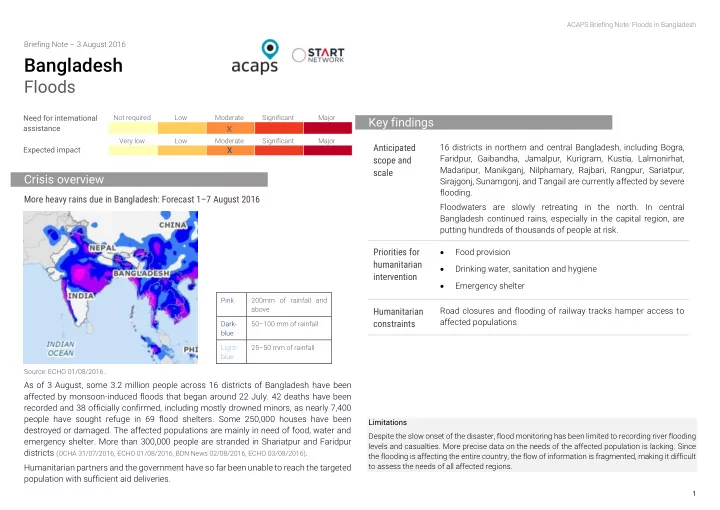
SLIDE 2 ACAPS Briefing Note: Floods in Bangladesh 2
Crisis impact
This monsoon’s flooding is being called the worst in Bangladesh since 1998 (Save the
Children 01/08/2016). More than 3.2 million people have been affected by monsoon-related
flooding and over 250,000 houses have been damaged or destroyed. 17 people have been killed (OCHA 31/07/2016, ECHO 01/08/2016, BDN News 02/08/2016, ECHO 03/08/2016). The northwest,
- ne of the hardest-hit regions, is particularly vulnerable due to widespread underlying
poverty. The flood-prone areas in Lalmonirhat have so far been most affected by flash floods (Daily
Star 01/08/2016). In the north of the country, waters are slowly receding yet the
humanitarian situation remains difficult. The Brahmaputra–Jamuna and Surma– Kushiyara River levels rose from 7cm above danger level on 12 July to 42cm above danger level on 1 August, but are now falling and may continue to fall in the next 72 hours
(Government 12/07/2016). Flooding levels still exceed the danger levels on all major rivers (Disaster Forum Dhaka 30/07/2016).
Previously unaffected areas in Bangladesh’s central and southern districts are experiencing severe flooding, particularly Madaripur, Manikganj, Sariatpur and the Dhaka capital region (see map below). Ou Outlook: The Flood Forecast and Warning Centre predicts worsening floods in central districts, with 19 major rivers still above danger level (ECHO 01/08/2016). The Ganges river basin was rising as of 3 August, having risen continuously between 17 July and 1 August
(Government 17/07/2016, Government 03/08/2016). The Padma River remains at steady high
levels, up to 82cm above danger level, which will cause the flooding situation in the lowlands adjacent to Rajbari, Manikganj, Munshiganj and Sariotpur districts to remain
- critical. The Buriganga, Balu, and Lakhya Rivers around Dhaka city are rising, and this will
likely to continue till at least 4 August and seriously endanger the capital (Government
01/08/2016, Government 03/08/2016).
Food securi rity and d livel elihoods ds: As of 1 August, at least 61,000 hectares of crops are flooded (ECHO 01/08/2016). In Lalmonirhat, Jamalpur, Gaibandha, Manikganj, Munshiganj, and Tangail, the affected population is facing acute food shortages, while there is a growing lack of fodder for cattle (Daily Star 01/08/2016). Reports suggest that sources of livelihoods have been destroyed, including fish farms and paddy fields, and farmers have no seeds. Food prices are expected to rise and shortages are likely in the flood-affected regions (GUK Documentation, Monitoring and Publication Cell 02/08/2016). Health and and WASH SH: There is a reported outbreak of waterborne diseases in the northern
- provinces. People have contracted diarrhoea, dysentery, and typhoid as drinking water
has been contaminated. People in Lalmonirhat, Jamalpur, Gaibandha, Manikganj, Munshiganj, and Tangail lack drinking water. Two health facilities in Kalirbazar have been flooded and are no longer operational (Daily Star 01/08/2016). 103 diarrhoeal cases, 60 RTI cases, 42 skin disease cases, 41 eye infection cases and 68 injuries have been reported so far from government health facilities. Flood shelters often have inadequate WASH facilities (Save the Children 2006). Open defecation is reportedly increasing and the absence of hygiene equipment and safe drinking water heightens the risk of possible outbreaks. Sh Shelter: r: More than 250,000 houses have been damaged or destroyed across the country
(ECHO 03/08/2016). As in previous floods, there are people taking shelter on the roof of their
houses putting themselves at risk of being inundated along with their houses. Nutri rition: Flooding after Cyclone Roanu disrupted treatment of SAM, and a lack of community-based screening means poor nutrition outcomes are potentially underreported (HCTT 01/06/2016). Flooding following monsoon rainfall that hit the northern provinces of Bangladesh in 2014 left some 370,000 people acutely malnourished (ECHO
17/11/2015).
Ed Education: In the affected provinces of Jamalpur, Sunamganj, Sirajganj, Bogra, Kurigram, Gaibandha, Tangail, Nilphamari, Lalmonirhat, and Faridpur, over 1,200 schools have been closed due to flooding (Disaster Forum Dhaka 30/07/2016).
Impact on critical infrastructure
Railway connections on the Jamalpur–Bangabandhu Bridge (east) and Jamalpur– Dewanganj routes are suspended as railway tracks have been submerged and need
- repair. Since 30 July, two 200m stretches of the Jamalpur–Sharishabari road in Phulbaria
area were damaged by floodwater, suspending traffic (Daily Star 01/08/2016). The Jamuna bridge is an important link between the east and west of the country.
Vulnerable groups affected
Children, women, the elderly, and people with disabilities are among the most vulnerable population groups. Households dependent on fishing, who live on riverbanks, were among the first victims (Dhaka Tribune 25/07/2016).