Briefing Note 26 January 2017 Health: Healthcare needs are linked - - PowerPoint PPT Presentation

briefing note 26 january 2017
SMART_READER_LITE
LIVE PREVIEW

Briefing Note 26 January 2017 Health: Healthcare needs are linked - - PowerPoint PPT Presentation

ACAPS Briefing Note: Floods Briefing Note 26 January 2017 Health: Healthcare needs are linked to the damage to MOZAMBIQUE healthcare facilities, which affects access to services. At least 30 healthcare centres have been affected. Floods


slide-1
SLIDE 1

ACAPS Briefing Note: Floods 1

Briefing Note – 26 January 2017

MOZAMBIQUE

Floods

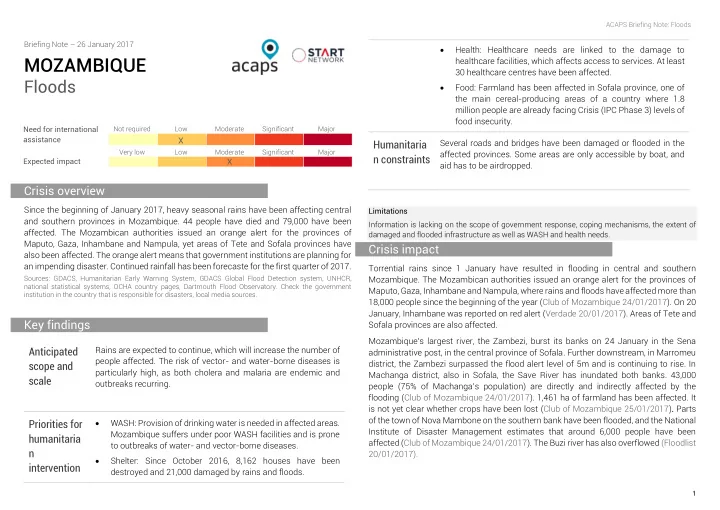
Need for international assistance

Not required Low Moderate Significant Major

X

Very low Low Moderate Significant Major

Expected impact X

Crisis overview

Since the beginning of January 2017, heavy seasonal rains have been affecting central and southern provinces in Mozambique. 44 people have died and 79,000 have been

  • affected. The Mozambican authorities issued an orange alert for the provinces of

Maputo, Gaza, Inhambane and Nampula, yet areas of Tete and Sofala provinces have also been affected. The orange alert means that government institutions are planning for an impending disaster. Continued rainfall has been forecaste for the first quarter of 2017.

Sources: GDACS, Humanitarian Early Warning System, GDACS Global Flood Detection system, UNHCR, national statistical systems, OCHA country pages, Dartmouth Flood Observatory. Check the government institution in the country that is responsible for disasters, local media sources.

Key findings

Anticipated scope and scale

Rains are expected to continue, which will increase the number of people affected. The risk of vector- and water-borne diseases is particularly high, as both cholera and malaria are endemic and

  • utbreaks recurring.

Priorities for humanitaria n intervention

 WASH: Provision of drinking water is needed in affected areas. Mozambique suffers under poor WASH facilities and is prone to outbreaks of water- and vector-borne diseases.  Shelter: Since October 2016, 8,162 houses have been destroyed and 21,000 damaged by rains and floods.  Health: Healthcare needs are linked to the damage to healthcare facilities, which affects access to services. At least 30 healthcare centres have been affected.  Food: Farmland has been affected in Sofala province, one of the main cereal-producing areas of a country where 1.8 million people are already facing Crisis (IPC Phase 3) levels of food insecurity.

Humanitaria n constraints

Several roads and bridges have been damaged or flooded in the affected provinces. Some areas are only accessible by boat, and aid has to be airdropped.

Limitations Information is lacking on the scope of government response, coping mechanisms, the extent of damaged and flooded infrastructure as well as WASH and health needs.

Crisis impact

Torrential rains since 1 January have resulted in flooding in central and southern

  • Mozambique. The Mozambican authorities issued an orange alert for the provinces of

Maputo, Gaza, Inhambane and Nampula, where rains and floods have affected more than 18,000 people since the beginning of the year (Club of Mozambique 24/01/2017). On 20 January, Inhambane was reported on red alert (Verdade 20/01/2017). Areas of Tete and Sofala provinces are also affected. Mozambique’s largest river, the Zambezi, burst its banks on 24 January in the Sena administrative post, in the central province of Sofala. Further downstream, in Marromeu district, the Zambezi surpassed the flood alert level of 5m and is continuing to rise. In Machanga district, also in Sofala, the Save River has inundated both banks. 43,000 people (75% of Machanga’s population) are directly and indirectly affected by the flooding (Club of Mozambique 24/01/2017). 1,461 ha of farmland has been affected. It is not yet clear whether crops have been lost (Club of Mozambique 25/01/2017). Parts

  • f the town of Nova Mambone on the southern bank have been flooded, and the National

Institute of Disaster Management estimates that around 6,000 people have been affected (Club of Mozambique 24/01/2017). The Buzi river has also overflowed (Floodlist 20/01/2017).

slide-2
SLIDE 2

ACAPS Briefing Note: Floods 2

Rains have been ongoing since October, with 44 dead and more than 79,000 affected in

  • total. 8,162 houses have been destroyed and 21,000 damaged (Club of Mozambique

24/01/2017). On 24 January, 18,000 people needed to be moved to safe areas (Club of Mozambique 24/01/2017). Some people are insisting on staying in areas at risk, prompting authorities to evacuate them by force (Club of Mozambique 24/01/2017). The National Institute of Meteorology (INAM) forecasts continued rainfall during the first quarter of 2017 (Saponoticias 23/01/2017). WAS ASH: Safe drinking water is needed in affected areas. . Mozambique’s president has stated that there is a high risk of vector-borne diseases as a result of stagnant water

  • ffering a breeding ground for mosquitos (Club of Mozambique 24/01/2017). In Maputo,

cholera cases were reported in December 2016, although no outbreak had been declared (UNICEF 31/12/2016). In December 2016, 190,428 people were estimated as potentially needing humanitarian assistance including the provision of safe drinking water, sanitation facilities and support to enable them to perform safe hygiene practices in case

  • f floods (UN 31/12/2016).

Shelt helter: In Machanga and the surrounding area, around 500 houses were destroyed. All government buildings in the town were submerged (Club of Mozambique 24/01/2017). Overall, 3,372 houses were damaged across the country in January (Saponoticias 23/01/2017) 8,162 houses have been destroyed and 21,000 damaged since October 2016 (Club of Mozambique 24/01/2017). Over 1,000 people in the town of Nova Mambone, Inhambane province, have been displaced because of flooding on the Save River. The river rose so rapidly that the residents had no chance to save their possessions before they fled (Club of Mozambique 23/01/2017). At least 200 families have been displaced in Chimoio, Manica province, and surrounding districts (All Africa 19/01/2017). In Tete province, rains since December have destroyed 140 houses. 129 were in Angonia district, and the rest were in Magoe, Zumbo, and Tete city. A further 60 houses were damaged (Club of Mozambique 18/01/2017). Healt lth: h: According to local media, 30 health centres had been affected as of 20 January (Verdade 20/01/2017). . In Machanga, the district hospital was flooded. Patients who were undergoing treatment in the hospital were evacuated by helicopter (Club of Mozambique 24/01/2017). The Pungue River has also inundated a health centre in Dondo district, Sofala province (Club of Mozambique 24/01/2017). Foo

  • od sec

secur urit ity and nd li liveli liho hood

  • ds: 1,000 hectares of crops in Machanga district have been

inundated and are regarded as lost. A further 400 ha are at risk (Club of Mozambique 24/01/2017). More than 400 ha of maize are at risk of being lost in Gaza province after being flooded. It is estimated that more than 1,000 ha have been lost in each district (Macua 23/01/2017). People in government shelters have been reporting insufficient food supplies (Club of Mozambique 23/01/2017). Edu ducatio ion: 21 of 45 schools in Muchanga district have been flooded. 7,014 pupils were not able to attend classes on the first day of the 2017 school year (Club of Mozambique 25/01/2017). Ten schools have been affected by the torrential rains and high winds in Tete province, with parts of their roofs blown off, in Tete city and in Magoe, Marara and Changara districts (Club of Mozambique 18/01/2017).

Impact on critical infrastructure

48 electricity poles had fallen across the country as of 20 January (Verdade 20/01/2017).

Humanitarian and operational constraints

Machanga town, Sofala province, is isolated and seven access roads in the district are

  • impassable. Two bridges on the road that links Machanga town to the country’s main

north-south highway (EN1) have been swept away. In the neighbouring district of Chibabava, traffic along the EN1 has been restricted since 19 January as the road has been damaged. Ferry services across the Buzi river, between Guara-Guara and Bandua, Sofala provice, remain suspended (Club of Mozambique 25/01/2017). The administrative post of Divinhe, Javane locality and several remote villages of Sofala province are completely cut off. Further north, in Dondo district, Sofala province, the Pungue river has isolated villages where about 5,000 people are living (Club of Mozambique 24/01/2017). In Gaza province, road transit is almost impossible in the districts of Massingir, Manjacaze and Chibuto. In the northern part of the province, traffic has been hampered in Mapai and Chicualacuala districts. Last week's rains also worsened the condition of some major roads in the province that had never been repaired after damage in 2013 floods, such as the Chissano-Chibuto section, the Madzucane road, and the Chibuto- Guijá section. The city of Xai-Xai also has about 70km of urban and peri-urban roads damaged by erosion (Macua 23/01/2017). In Sofala province, people are forced to move around in motorboats and canoes (All Africa 19/01/2017) . The rains caused mudslides at four points along the rail line to Maputo, one on the premises of Maputo port, one in the Infulene area, a few kilometres from the port, and two in Manhica district, about 80km from the capital. In the port, the rains swept away a wall, and large quantities of mud were driven onto the railway (Club of Mozambique 24/01/2017).

slide-3
SLIDE 3

ACAPS Briefing Note: Floods 3

Aggravating factors

Drought

The affected provinces are also among the worst affected by drought. 1.8 million people in Mozambique are at Crisis (IPC 3) food insecurity levels due to El Niño-induced dryness (FEWSNET 31/12/2016). An estimated 860,000 ha of cropland (about 18% of the total planted area) was affected in the main cereal-producing provinces of Sofala and Tete, as well as minor-producing provinces of Inhambane, Gaza, and Maputo, with many households forced to replant several times (FAO 15/11/2016). .

Poor WASH infrastructure

47% of the population in Mozambique has access to improved sources of water and 19% to improved sanitation (Global Alliance on Clean Cookstoves retrieved 25/01/2017).

Cholera

Heavy rainfall and floods cause annual outbreaks of cholera from December to June. Of 26 districts prone to floods, 17 are considered to be at high to moderate risk for cholera. In 2015, 8,885 cases with a mortality rate of 0.7% were reported. For 2016 (Jan - Oct), there were 1,715 cases with 0.1% mortality rate reported from seven districts (UN 31/12/2016).

Malaria

Most of the country has year-round malaria transmission with a seasonal peak during the rainy season from December to April. Floods have likely contributed to increases in malaria transmission in recent years, particularly in low-lying coastal areas and along major rivers. Malaria is considered the most important public health problem in Mozambique and accounts for 29% of all deaths, followed closely by AIDS at 27%. Among children under five years of age, malaria accounts for 42% of the deaths, followed by AIDS at 13% (USAID 26/10/2016).

Response capacity

Local and national response capacity

The government stated that there are no problems in delivering shelter and food assistance to affected people. (Club of Mozambique 24/01/2017). It has not requested assistance for now. In Govuru district, Inhambane province, authorities urged residents living in safe areas to show solidarity with flood victims and complement the government’s efforts to help (Club of Mozambique 23/01/2017). In the same area, two helicopters and four boats were deployed to distribute food and evacuate 2,000 people (Club of Mozambique 24/01/2017, RFI 22/01/2017). A motorboat and several canoes were employed to transport residents to safe areas in Machanga district, Sofala province (Club of Mozambique 24/01/2017). People have been evacuated in and around the southern city of Maxixe, Inhambane province, after their homes flooded, yet there is no precise number (All Africa 19/01/2017). The Sofala provincial government has reactivated all 15 local Disaster Risk Management Committees, seven of which are equipped with boats (Club of Mozambique 24/01/2017).

International response capacity

As of 31 December, there was a USD 90 million funding gap in the UN Strategic Response Plan for drought and floods in Mozambique (UN 31/12/2016). Most UN agencies have a presence in the country, as do major international NGOs such as Save the Children, CARE, Handicap International, World Vision, Concern, Action Aid (OCHA 23/11/2016). Buzi and Dondo districts were targeted for WASH assistance before the crisis, but nobody could be reached as of 30 November (OCHA 30/11/2016).

Information gaps and needs

There is little information on WASH and health impact and needs, as well as on international response and coping mechanisms. The exact number of roads and bridges affected is missing, as is information on the impact on other critical infrastructure such as the electricity supply or the telecommunication system. It is unclear how comprehensive government response is.

Lessons learned

From 2014–2015, floods displaced more than 61,000 people in Zambézia province alone.

slide-4
SLIDE 4

ACAPS Briefing Note: Floods 4

Heavy rainfall and floods cause annual outbreaks of cholera during the rainy season from December to June and of malaria from December to April. The Education sector is always affected by heavy rains, cyclones and floods in

  • Mozambique. This is related to the vulnerability of the school infrastructure to these

events given its diverse construction typology: conventional, mixed, local material (UN 31/12/2016).

slide-5
SLIDE 5

ACAPS Briefing Note: Floods 5

Key characteristics

Key indicators MOZAMBIQUE Inhambane province Sofala province Total population 27,977,863 (World Bank data 2015) 1,523,635 (IPC 08/2016) 2,099,152 % population in rural areas 68% (World Bank data 2015) Gender and age distribution

  • f population

Ag Age dist istribu ibution tion (Index Mundi 2016): 0-14 years: 44.92% 15-24 years: 21.51% 25-54 years: 27.24% 55-64 years: 3.42% 65 years and over: 2.9% Gender ratio io: 0.85 male(s)/female State capital Maputo, 1.187 million people (Index Mundi 2016) Inhambane Beira WASH figures Drink inking ing wa water ter sou source (Index Mundi 2015) Improved:

  • urban: 80.6% of population
  • rural: 37% of population
  • total: 51.1% of population

Unimproved:

  • urban: 19.4% of population
  • rural: 63% of population
  • total: 48.9% of population (2015

est.) Sanita itation tion fa facili ility a ty access ss (Index Mundi 2015) Improved:

  • urban: 42.4% of population
  • rural: 10.1% of population
  • total: 20.5% of population

Unimproved:

  • urban: 57.6% of population
  • rural: 89.9% of population
  • total: 79.5% of population (2015

est.)

slide-6
SLIDE 6

ACAPS Briefing Note: Floods 6

Health figures Infant mortality rate: 57 per 1,000 live births (World Bank data 2015) Under five mortality rate: 79 per 1,000 live births (World Bank data 2015) Maternal mortality rate: 489 per 100,000 live births (World Bank data 2015) Food security 1.8 million in Crisis (IPC 3) 126,417 in Crisis (IPC 3), 31,694 in Emergency (IPC 4) (IPC 07/2016) 268,889 in Crisis (IPC 3) 63,978 in Emergency (IPC 4) Nutrition levels 350,000 people in need of nutrition assistance (UN 31/12/2016) 1.4% GAM (3,498 cases) (IPC 08/2016) 5.7% GAM (19,623 cases) 7.3% SAM Literacy rates 58.8% (Index Mundi 2015)

slide-7
SLIDE 7

ACAPS Briefing Note: Floods 7

Map

Source: : UNOSAT 18/01/2017