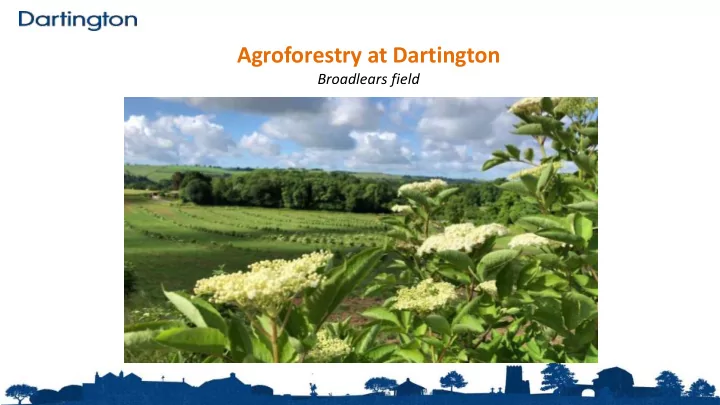
SLIDE 1 Agroforestry at Dartington
Broadlears field
Draft 1 - 22 August 2016
SLIDE 2
SLIDE 3 Draft 1 - 22 August 2016
SLIDE 4 Draft 1 - 22 August 2016
SLIDE 5 Draft 1 - 22 August 2016
SLIDE 6 Draft 1 - 22 August 2016
SLIDE 7 Draft 1 - 22 August 2016
SLIDE 8 ORFC 2020 - Woodland & agroforestry Offering new business opportunities for farmers
Jeremy Smith MRICS – Land Agent Perspective
24 January 2020
SLIDE 9 Land Agent – Who and what Landlord and Tenant Woodland & Agroforestry Diverse Estates Effects/Wider Impact Issues Productivity Case Study
SLIDE 10
SLIDE 11
‘Developing a Farm Woodland & Agroforestry Economy’
A strategy to make farmer led tree planting credible
SLIDE 12
Tories pledge 30 million trees a year until 2024
Lib Dems aim for 60 million trees a year through to 2045
Labour announces 2 billion more trees by 2040 = 100 million a year
SLIDE 13 But the reality is only 15 million publicly funded trees over the last 8 years – maybe its time for a new strategy? Farmers as foresters?
Woodland Ownership England (000 ha.) Scotland (000 ha.) Wales (000 ha.) Northern Ireland (000 ha.) %age
Woodland area TOTAL area (000 ha.) Farm Woodland 368 560 93 16 33% (45% of all private woodland) 1037 TOTAL Woodland area 1307 1445 308 113 3173
SLIDE 14 Benefits from trees
- 1. Public benefits = public money
- 2. Farm benefits = increased farm enterprise revenue
Farm benefits Indirect
- from the interaction between trees and the
agricultural system e.g. nutrient provision for crops
- r shelter benefits for livestock
- farm management benefits e.g. water management
Direct – substitution or market opportunities for the tree outputs e.g. timber, fuel, food Strategy = more focus on the direct farm enterprise benefits of trees
SLIDE 15
Timber from trees? ➢ For on farm fencing demand and farm buildings? ➢ For sale to timber markets
SLIDE 16
Fuel from trees? ➢ For on farm heat demand and/or local use
SLIDE 17
Food from trees? ➢ Hard & soft fruit ➢ Nuts ➢ Cider/Perry/Juice
SLIDE 18 Contract growing
➢ Cobnuts ➢ Cricket Bat Willow ➢ Poplar ➢ Cider/Perry
SLIDE 19
Income from capital grants ➢ Is tree planting & maintenance really that difficult? ➢ Transferable skills...
SLIDE 20
Farm fencing requirements – for trees and livestock ➢ Grown on the farm, erected by farmers?
SLIDE 21
Dealing with scale ➢ Mobile equipment ➢ Machinery rings ➢ Cooperatives/ Groups
SLIDE 22
Dealing with scale ➢ Low cost farm machinery adaptations
SLIDE 23
Making it happen? ➢ Learn from longstanding initiatives – e.g. Coed Cymru, European models ➢ Support for developing capacity/capability in tree management ➢ Rural development support for new business opportunities & supply chain development
SLIDE 24
The future? Trees for farmers, managed by farmers... ...with public benefits as well...
SLIDE 25
foodandforest.co.uk
SLIDE 26
Alley Cropping
SLIDE 27
Benefits
SLIDE 28 3-Point Alley Cropping Incentive Package
- 1. A specific, one-off, alley cropping grant
- 2. A forward contract for nut purchase
- 3. An equity release system to liquify the
timber value before harvest.
SLIDE 29
SLIDE 30
SLIDE 31
Forward Contract
SLIDE 32
Equity Release System
SLIDE 33 Alley Cropping Grant Proposal
Ecosystem Services Approach – “public money for public good” 35 35 tonnes of carbon sequestered per hectare per year (Palma et al, 2007) Social Cost of Carbon 2019 – central scenario = £13.15 per tonne 35 X 13.15 = £460.25 Social Cost of Carbon 2020 – central scenario = £13.84 per tonne 35 X 13.84 = £484.40 Social Cost of Carbon 2021 – central scenario = £20.54 35 X 20.54 = £718.90 Total = £1663.55 total
References: Palma et al, 2007 – Modelling environmental benefits of silvoarable agroforestry in Europe. Agriculture, Ecosystems and Environment 119: 320-334 Updated Short-Term Traded Carbon Values Used for UK public policy appraisal – accessed 09.07.19 https://assets.publishing.service.gov.uk/government/uploads/system/uploads/attachment_data/file/79 4186/2018-short-term-traded-carbon-values-for-appraisal-purposes.pdf
SLIDE 34 Results from Phase 1 – Jan 19
- All 30 proposals approach the topic at a landscape scale, intending to
link land owners in a approach.
- Use of a reverse auction method trialled by Wessex Water for
reductions in Nitrogen run off. http://green.brightblue.org.uk/blog/2017/12/8/paying-for-itself-using- reverse-auctions-for-environmental-improvement