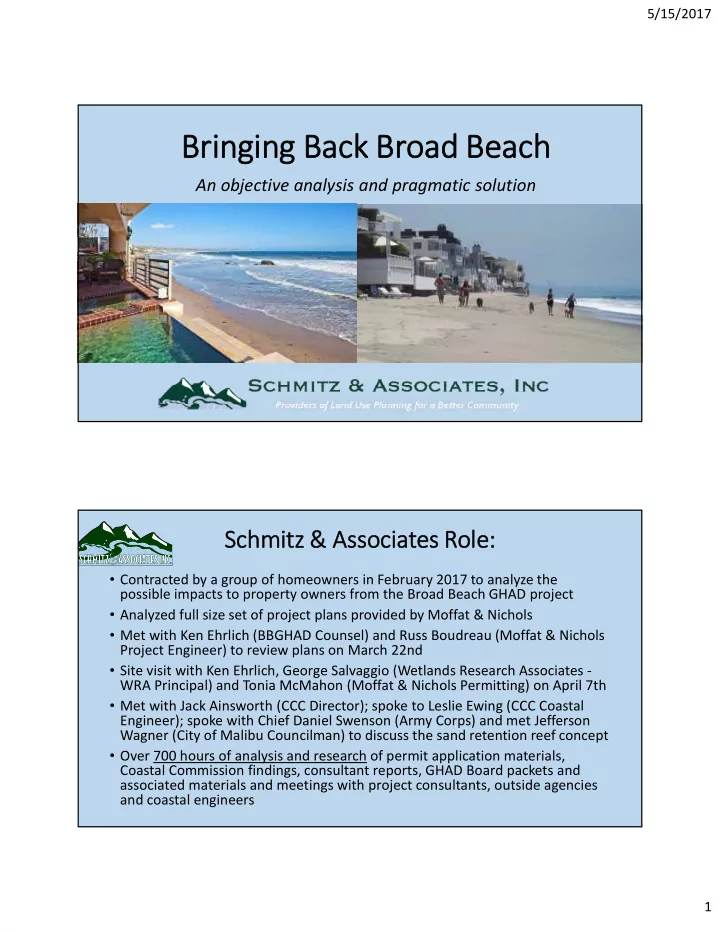
Bri ringing Back Broad Beach An objective analysis and pragmatic - - PDF document

bri ringing back broad beach
SMART_READER_LITE
LIVE PREVIEW

Bri ringing Back Broad Beach An objective analysis and pragmatic - - PDF document

5/15/2017 Bri ringing Back Broad Beach An objective analysis and pragmatic solution Schmitz & Ass ssociates Role: Contracted by a group of homeowners in February 2017 to analyze the possible impacts to property owners from the Broad


slide-1
SLIDE 1

5/15/2017 1

Bri ringing Back Broad Beach

An objective analysis and pragmatic solution

Schmitz & Ass ssociates Role:

  • Contracted by a group of homeowners in February 2017 to analyze the

possible impacts to property owners from the Broad Beach GHAD project

  • Analyzed full size set of project plans provided by Moffat & Nichols
  • Met with Ken Ehrlich (BBGHAD Counsel) and Russ Boudreau (Moffat & Nichols

Project Engineer) to review plans on March 22nd

  • Site visit with Ken Ehrlich, George Salvaggio (Wetlands Research Associates -

WRA Principal) and Tonia McMahon (Moffat & Nichols Permitting) on April 7th

  • Met with Jack Ainsworth (CCC Director); spoke to Leslie Ewing (CCC Coastal

Engineer); spoke with Chief Daniel Swenson (Army Corps) and met Jefferson Wagner (City of Malibu Councilman) to discuss the sand retention reef concept

  • Over 700 hours of analysis and research of permit application materials,

Coastal Commission findings, consultant reports, GHAD Board packets and associated materials and meetings with project consultants, outside agencies and coastal engineers

slide-2
SLIDE 2

5/15/2017 2

slide-3
SLIDE 3

5/15/2017 3

Findings Syno nopsis

  • Beach nourishment projects work best in low erosion environments (National

Research Council. 1995. Beach Nourishment and Protection. Washington, DC: The National Academies Press)

  • Broad Beach has been steadily eroding since the 1970s as almost all the

longshore sand supply to Broad Beach is diverted into the Mugu Submarine Canyon (BBGHAD Engineers Report-Final)

  • The project is viewed as an ‘experimental pilot project’ (CDP 4-15-0390 Staff

Report, pg 53)

  • Cost projections are incomplete as there is no information on backpassing

costs, financing costs and emergency mobilizations to nourish the beach in case of a storm

  • Significant loss of usable yard area for many property owners and increases in

annual assessments for all homeowners

  • Dr. Griggs is one of the foremost experts on California’s coastline, a Distinguished

Professor of Earth Sciences, a winner and has been the Director of UCSC’s Institute of Marine Sciences since 1991. The California Coastal Commission and Sunset Magazine named him one of California’s Coastal Heroes in 2009

With all of the effort and expense involved in nourishing Broad Beach with 600,000 cubic yards of sand, it makes no practical or environmental sense not to retain the sand that has been deposited on the beach. Without question, there are issues to be resolved, and more than one approach, but retention is strongly recommended as a consideration at the front end of the project.

Source: Summary of Broad Beach Erosion & Beach Nourishment Investigation and Responses to Proposed Nourishment Plan, Griggs, 2012

slide-4
SLIDE 4

5/15/2017 4

With all of the effort and expense involved in nourishing Broad Beach with 600,000 cubic yards of sand, it makes no practical or environmental sense not to retain the sand that has been deposited on the beach. Without question, there are issues to be resolved, and more than one approach, but retention is strongly recommended as a consideration at the front end of the project.

Source: Summary of Broad Beach Erosion & Beach Nourishment Investigation and Responses to Proposed Nourishment Plan, Griggs, 2012

Fut uture Risks

  • Dune restoration impacts to property owners may increase as dune

restoration is possible up “to the seaward edge of any legally existing residential structures, patios/decks”: [CDP 4-15-0390; Special Condition #5(A)(1), pg. 19]

  • Without any means of retaining sand, nourishment will become a ‘perpetual’

never-ending process, resulting in ever increasing assessments

  • With the current difficulty in sourcing sand, future costs for sand could

increase, further inflating project costs A long term solution is required to reduce erosion on Broad Beach for the nourishment project to succeed

slide-5
SLIDE 5

5/15/2017 5

Broad Beach Aerial: 1959 Broad Beach Aerial: 1971

slide-6
SLIDE 6

5/15/2017 6

Broad Beach Aerial: 2004

Source: Coastal Resource Consultants, 2015

slide-7
SLIDE 7

5/15/2017 7

Source: Broad Beach GHAD CDP Staff Report, pg. 63

The 2001 SANDAG (San Diego County) nourishment project involved placing 2,000,000 yds3 of sand dredged from 6 offshore sites onto 12 individual beaches in San Diego County. Total costs were $17.5 million and while fill life span depended upon each individual site, the volume of the fill and grain size,

  • verall the sand tended to move offshore and alongshore within the first year
  • r two. So while sand was present in the littoral system, it didn’t remain on the

dry beach face for public use for a significant time period. “Ambiguities in data trends severely constrain our ability to forecast beach fill nourishment requirements for Broad Beach”; and “Nature cannot be subdued by artificially adding beach fill. But it can be held at bay for a time and how long will depend on the future availability and cost of sand the will of Broad Beach residents to nourish their beach.”

Source: Summary of Broad Beach Erosion & Beach Nourishment Investigation and Responses to Proposed Nourishment Plan, Griggs, 2012

slide-8
SLIDE 8

5/15/2017 8 “This is some work that was highlighted quite extensively in the press, and you may have heard it in various forms. The bottom line is that the projections by 2100 is that many beaches in California will erode on the order of about 50 meters, which is about 165 feet or

  • so. In and of itself, this is not that big of a deal if these beaches have places to go, but in many

cases, they obviously do not. 31 to 67% of beaches will be completely eroded and effectively ‘drowned’ by 2100 given different sea level rise and management scenarios. So we looked at beach nourishment, we looked at infrastructure, and at the end of the day, historical rates of nourishment didn’t make that much of a deal”- Patrick Barnard (Research Director - Climate Impacts and Coastal Processes Team, USGS)

slide-9
SLIDE 9

5/15/2017 9

Estimated sand nourishment costs for original 10 year timeframe

Year 1

  • 300,000 cubic yard nourishment
  • $16-20 million
  • Interim 75,000 cubic yard nourishment
  • $4-5 million

Year 5

  • 300,000 cubic yard nourishment
  • $16-20 million
  • Interim 75,000 cubic yard nourishment
  • $4-5 million

Year 10

  • 300,000 cubic yard nourishment
  • $16-20 million

Sand costs: Russ Boudreau/Ken Ehrlich (03/22/2017 meeting)

Estimated sand nourishment costs for original 10 year timeframe

Total Sand Nourishment Costs $56 to $70 million depending on sand source

Sand costs: Russ Boudreau/Ken Ehrlich (03/22/2017 meeting)

slide-10
SLIDE 10

5/15/2017 10

Estimated Fut uture Proje ject Costs

Sand nourishment

$6 million- $7 million Average /year Dune Construction $300,000- $325,000 One time cost

Dune Monitoring & Maintenance

$240,000- 530,000 /year Habitat Monitoring $450,000- 850,000 /year

Scientific Advisory Panel $180,000 /year

Backpassing Sand Unknown

Habitat Monitoring cost Source: Russ Boudreau/Ken Ehrlich (03/22/2017 meeting); Scientific Advisory Panel cost: CDP 4-15-0390 Staff Report; Dune Construction/Maintenance Cost Source: Ken Ehrlich email (05/11/2017)

Estimated Fut uture Proje ject Costs

Estimated Future Project Costs $69 to $86 million over 10 years

Habitat Monitoring cost Source: Russ Boudreau/Ken Ehrlich (03/22/2017 meeting); Scientific Advisory Panel cost: CDP 4-15-0390 Staff Report; Dune Construction/Maintenance Cost Source: Ken Ehrlich email (05/11/2017)

slide-11
SLIDE 11

5/15/2017 11

Proje ject costs to da date: 2011-2017

Administration Costs

  • $525,355

Monitoring Costs

  • $177,902

Elkins Kalt Weintraub Reuben Gartside 3,597,218 Moffat & Nichols Fees $6,590,297

Agency Fees/Lobbyists/ Additional Legal /Engineering Fees

  • $3,548,072

Source: BBGHAD Regular Session Packet 4/23/17

Proje ject costs to da date: 2011-2017

Total Costs to Date $14,798,844 over 7 years

Source: BBGHAD Regular Session Packet 4/23/17

slide-12
SLIDE 12

5/15/2017 12

Cha hanges to Ass ssessments

Current annual budget: $3.1 million

Current assessment: $602/ft/yr for east end Current assessment: $155/ft/yr for west end

Future annual budget: $ 6.9 million to $8.6 million

Future assessment: $1350-1650/ft/yr for east end Future assessment: $350-425/ft/yr for west end

Future budget is based on 10 year permit

$16,000 $24,080 $53,600 $66,800 $16,000 $6,200 $13,800 $17,200

$0 $10,000 $20,000 $30,000 $40,000 $50,000 $60,000 $70,000 $80,000

2011 Assessment Current Assessment Projected Minimum Projected High-end

Annual Assessment 40' Lot on west end Annual Assessment 40' lot on east end

slide-13
SLIDE 13

5/15/2017 13

$16,000 $24,080 $53,600 $66,800 $16,000 $6,200 $13,800 $17,200

$0 $10,000 $20,000 $30,000 $40,000 $50,000 $60,000 $70,000 $80,000

2011 Assessment Current Assessment Projected Minimum Projected High-end

Annual Assessment 40' Lot on west end Annual Assessment 40' lot on east end

These estimates do not include the following costs that are yet to be determined:

  • Backpassing sand
  • Possible mitigation costs for damage to marine habitats
  • Finance costs for loan(s) required for nourishments

Source: Broad Beach GHAD CDP Staff Report

slide-14
SLIDE 14

5/15/2017 14

320,000 cubic yards of nourished beach washed away in 24 hours at Torrey Pines state beach

Source: Seymour, R.J., R.T. Guza, W. O'Reilly and Steve Elgar, J. Coastal Engineering, 52, (2), pp151-158, 2005.

320,000 cubic yards of nourished beach washed away in 24 hours at Torrey Pines state beach in November 2001

Source: Seymour, R.J., R.T. Guza, W. O'Reilly and Steve Elgar, J. Coastal Engineering, 52, (2), pp151-158, 2005

slide-15
SLIDE 15

5/15/2017 15

It is important to keep in mind that if sand hasn’t remained on a beach under natural conditions, then there are going to be environmental reasons why sand placed as a nourishment project may not remain either.

Summary of Broad Beach Erosion & Beach Nourishment Investigation and Responses to Proposed Nourishment Plan, Griggs, 2012

If the sand is removed rapidly during a period of large waves, as happened to the SANDAG fill at Torrey Pines, it is possible that it may move past Trancas Creek, the boundary of the project, before mobilization and backpassing can be initiated. In this case, the sand would essentially be permanently lost from the Broad Beach project

  • area. So while backpassing may be able to extend the life of the

nourished sand, there are no guarantees that this approach can keep up under severe wave attack.

Source: Summary of Broad Beach Erosion & Beach Nourishment Investigation and Responses to Proposed Nourishment Plan, Griggs, 2012

300,000 cubic yards of sand 21,400 truck loads 420 truck trips/day

$16-$20 million could be lost in 24 hours

slide-16
SLIDE 16

5/15/2017 16 Aggregate Sustainability in California – California Geological Survey (2012)

Only 34% of the 50 year demand is available

Main CDP Conditions

Dune Restoration and Monitoring Marine Resources Monitoring and Mitigation Springing Licenses Septic Conversion Study Dune Restoration and Monitoring

slide-17
SLIDE 17

5/15/2017 17 Source: BBGHAD website Source: BBGHAD website

slide-18
SLIDE 18

5/15/2017 18 2010 Mean High Tide Line (Property Line) Backyard Encroachment Septic Systems Source: Moffat & Nichols Plans Restored dunes will be designated ESHA

slide-19
SLIDE 19

5/15/2017 19 Special Condition 5(A)(6) Signs shall be installed and maintained in conspicuous locations along the approved accessways adjacent to the restoration/enhancement area to notify the public and residents that the area is a sensitive habitat restoration area and to keep out of the dune restoration areas. The signs shall indicate “Habitat Restoration In Progress: Please Keep Out of Dune Restoration Area”, or alternative language that is substantially similar. The signs will serve to minimize unauthorized encroachments into the restored dune system.

CDP 4-15-0390 Staff Report, pages 21, 126

Special Condition 5(A)(2)

Discontinuous sand fencing that is placed perpendicular to the prevailing wind direction shall be temporarily employed to facilitate establishment of dune hummocks. CDP 4-15-0390 Staff Report, pg. 20-21

slide-20
SLIDE 20

5/15/2017 20 Source: BBGHAD website 2010 Mean High Tide Line (Property Line) Backyard Encroachment Septic System Source: Moffat & Nichols Plans

slide-21
SLIDE 21

5/15/2017 21 Restored dunes will be designated ESHA Special Condition 5(A)(5) The dune habitat restoration/enhancement plan shall incorporate a maximum of one shared private beach access path through the dunes (natural sand path only that is delineated by a two-foot high symbolic post and cable/rope type fence) for every two residences adjacent to the restoration area both of which have less than a sixty foot frontage, and one non-shared private beach access path through the dunes (natural sand path only that is delineated by a two-foot high symbolic post and cable/rope type fence) for every residence with a frontage of sixty feet or more.

CDP 4-15-0390 Staff Report, pg. 21

slide-22
SLIDE 22

5/15/2017 22 Source: BBGHAD website 2010 Mean High Tide Line (Property Line) Backyard Encroachment Septic Systems Source: Moffat & Nichols Plans

slide-23
SLIDE 23

5/15/2017 23 Restored dunes will be designated ESHA Proposed paths to beach

Sur urveyor Staking

slide-24
SLIDE 24

5/15/2017 24 Special Condition 5(A)(1) The dune habitat restoration/enhancement area footprint shall extend from the property at 31350 Broad Beach Road to the property at 30708 Broad Beach Road, and that begins as far landward as feasible (at a stringline of approved development across the subject properties as generally depicted in Exhibit 8b) and extends seaward to the expected maximum wave uprush limit. The stringline of approved development that is to be the landward limit of the dune restoration/enhancement area shall be generally located at the seaward edge of any legally existing residential structures, patios/decks. CDP 4-15-0390 Staff Report, pg. 19 BBGHAD original dune footprint (Exhibit 8b, 4-15- 0390 Staff Report) Final dune footprint (Moffat & Nichols plan)

slide-25
SLIDE 25

5/15/2017 25 CCC proposed dune footprint (Exhibit 8b, 4-15- 0390 Staff Report) Final dune footprint (Moffat & Nichols plan) Source: CDP 4-15- 0390 Staff Report In addition, there is uncertainty regarding the success of the beach nourishment component of the project. As such, the Commission finds that adequate mitigation shall be provided. Where there are unavoidable adverse impacts to ESHA, in past permit actions the Commission has required habitat mitigation at a ratio of 3:1. In this case, at a minimum, the direct removal of approximately 3.62 acres of foredune habitat from the placement of the sand bag and rock revetments shall be mitigated at a ratio of 3:1. This mitigation shall be provided on-site through the proposed beach nourishment and dune restoration and enhancement. However, modifications are required to the proposed beach nourishment and dune restoration components of the project in order to ensure that an adequate and appropriate area is restored/enhanced and that it is designed to mimic a natural dune system in habitat function and value to the maximum extent feasible. Source: CDP 4-15-0390 Staff Report, pg. 121-122

slide-26
SLIDE 26

5/15/2017 26 Source: Moffat & Nichols/Russ Boudreau/Ken Ehrlich (03/22/2017 meeting)

Proposed Dun une Restoration Footprint

‘Sacrificial dunes’

Source: CDP 4-15- 0390 Staff Report

We expect all dunes in front of the revetment will be “sacrificial” ultimately, and that “permanent” dunes that function naturally are only feasible where there is no revetment present or the revetment is placed far enough landward that it will not be exposed to waves even during extreme erosion events.

Source: Analysis of Dune Restoration at Broad Beach, Coastal Resource Consultants (2015) (in CDP Staff Report)

slide-27
SLIDE 27

5/15/2017 27 Revetment Residential structure Restored beach Original dune restoration area Revetment Residential structure Original dune restoration area Wave attack erodes beach

slide-28
SLIDE 28

5/15/2017 28 Revetment Residential structure Original dune restoration area Wave attack erodes beach and dunes Revetment Residential structure Possible new dune location

slide-29
SLIDE 29

5/15/2017 29

If the annual monitoring indicates that the restoration project has in part, or in whole, been unsuccessful, based on the approved performance standards, the applicant shall be required to submit a revised or supplemental program to compensate for those portions of the original program which were not successful. CDP 4-15-0390 Staff Report, pages 126-127

2010 Mean High Tide Line (Property Line) Possible future dune footprint that may be required when the sacrificial dunes get washed

  • ut

Current footprint

  • f dunes

Revetment

slide-30
SLIDE 30

5/15/2017 30

There is no contingency plan, however, if backpassing isn’t able to return enough sand to maintain the western end of Broad Beach, and the beach is narrowed sooner than 10 years. The probability of this happening is unknown, and future wave climate and storm frequency will most likely be the deciding

  • factors. Nonetheless, the Broad Beach homeowners should be aware that

this is a likely outcome. In this situation, the revetment would serve as the last line of defense for the septic systems and homes, as it has over the past two years.

Source: Summary of Broad Beach Erosion & Beach Nourishment Investigation and Responses to Proposed Nourishment Plan, Griggs, 2012

The modeling predictions for the proposed nourishment project anticipate that the upcoast portions of the nourished beach will be significantly lost due to erosion within 2 years from completion of the proposed initial 300,000 cu. yd. nourishment.

CDP 4-15-0390 Staff Report, pg. 77

slide-31
SLIDE 31

5/15/2017 31 Special Condition 2(D) The coastal development permit amendment application submitted by the permittee for an additional ten (10) year term, pursuant to Part B of this special condition, shall include a complete evaluation of all feasible alternatives to the retention of the rock revetment in its current location should beach re-nourishment measures outlined in Special Condition 4(B) fail to consistently maintain at least a 30 foot wide sandy beach

  • ver the 10 year period. Project alternatives evaluated shall include, but not be limited

to, landward relocation of part or all of the revetment and removal of part or all of the revetment; construction of an alternative shoreline protective structure in a more landward location; status of removal of the existing septic systems and connection to a new or upgraded package sewage treatment plant based on the septic conversion implementation study required pursuant to Special Condition 16; and options for

removal and/or landward relocation of existing private residential development.

CDP 4-15-0390 Staff Report, pg. 14

Main CDP Conditions

Dune Restoration and Monitoring Marine Resources Monitoring and Mitigation Temporary Springing Licenses Septic Conversion Study Springing Licenses

slide-32
SLIDE 32

5/15/2017 32 10 foot path landward

  • f revetment (not to

scale) Revetment Source: Moffat & Nichols Plans 10 foot public path landward of revetment (not to scale)

slide-33
SLIDE 33

5/15/2017 33

Special Condition 14(1)

Each license shall provide for public access only if and when one or more of the following conditions is occurring, and only for the duration of time that one or more of the following conditions continues to occur:

  • a. If at any time there is less than ten feet of dry sandy beach providing for lateral public access

extending seaward of the seaward face of the approved revetment on, or within 100 feet upcoast

  • r downcoast of, any part of the licensor’s parcel; or
  • b. Any circumstance occurs (such as, but not limited to, an oil spill) that prohibits the public’s use,

access, and enjoyment of any of the area of licensor’s property seaward of the revetment or of any property within 100 feet upcoast or downcoast thereof.

CDP 4-15-0390 Staff Report, pg. 37

Conclusions:

  • Without sand retention as part of the project, the beach nourishment

will fail

  • Costs of multiple nourishments of the beach will increase and cause

significant environmental impacts and result in increasing assessments

  • The current dune restoration footprint encroaches on a large number of

properties

  • With the likelihood of the beach nourishment and dune mitigation

failing; there is the potential for the dune restoration footprint being expanded and septic systems requiring removal (per the Septic Conversion Study) when the permit is to be renewed in October 2025.

  • Keeping the revetment in place as the last line of defense for the homes
  • n Broad Beach will require the permit to be renewed
slide-34
SLIDE 34

5/15/2017 34

Beach Erosion in California

“The prospect of losing so many our beaches in Southern California to sea level rise is frankly unacceptable. The beaches are our public parks and economic heart and soul of our coastal communities. We must do everything we can to ensure that as much of the iconic California coast is preserved for future generations.” Jack Ainsworth, California Coastal Commission Executive Director (March 27, 2017)

  • Many of California’s beaches have formed as a result of natural littoral transport

barriers, primarily points, headlands, stream deltas, and similar obstructions.

  • Sand retention systems have been used effectively at a number of sites in

California, however, as a way to significantly extend the lifespan of a beach nourishment project (Griggs & Patch, 2006)

  • Properly designed artificial reef systems will provide wave attenuation that assist

with beach stabilization without causing adverse impacts on adjacent beaches (Harris, 2003)

Art rtificial Reefs and Erosion Control

slide-35
SLIDE 35

5/15/2017 35

  • Funded by the Gold Coast City Council to protect Surfers Paradise beaches from

erosion (Jackson & Hornsey, 2002)

  • Primary purpose was to widen the beach and dunes along Surfer’s Paradise, Main

and Narrowneck Beaches to accommodate storm erosion and sea level rise

  • Secondary purpose to create artificial surfing reef

Narrowneck Reef on the he Gold Coast

Storm erosion on Narrowneck beach in 1996 (taken at high tide)

slide-36
SLIDE 36

5/15/2017 36 Narrowneck beach after storms in 2001 (taken at high tide) Geotextile and sand reef constructed in 1999/2000

slide-37
SLIDE 37

5/15/2017 37

Since its construction, comprehensive monitoring has been undertaken. To date, the reef has been a success in terms of retaining the wider nourished beach.

  • Reef Balls are designed for habitat enhancement and can be

customized for selected benthic/pelagic species

  • No visual impacts as the reef is below the waterline
  • Easy and cost effective fabrication and installation utilizing

barges (Harris, 2009)

Bene nefits of Reef Balls

slide-38
SLIDE 38

5/15/2017 38

Cast concrete off site Articulated mat for anchoring allows for mobility Transport and installation via barge

slide-39
SLIDE 39

5/15/2017 39

100 Reef Balls will be deployed by Southern California Edison to study effectiveness in increasing fish biomass required for the mitigation target required by CDP no. 6-81-330

slide-40
SLIDE 40

5/15/2017 40

Each Reef Ball module produces about 400lb of biomass/year – Dr. Lee Harris (2006) Some of the reefs built in Japanese waters support a biomass of fish that is 20 times greater than similarly sized natural reefs, says Shinya Otake, a marine biologist at Fukui Prefectural University. Reef Balls Gran Dominicus Beach (Harris, 2003)

slide-41
SLIDE 41

5/15/2017 41

Gran Dominicus Beach in 1999 (Harris, 2003) Gran Dominicus Beach in 2001 (Harris, 2003)

slide-42
SLIDE 42

5/15/2017 42

1999 Beach Profile 3-Row Reef Ball Reef 2001 Beach Profile US Army Corps of Engineers Miami-Dade County Artificial Reef utilizes Reef Balls to reduce erosion

slide-43
SLIDE 43

5/15/2017 43

Cost for the Miami Dade project is estimated to be from $2,000 to $2,400/linear foot (Coastal Systems International, 2015)

To protect 4,000 feet of beach $8 – 9.6 million

Estimate of 1-2 years for reef permitting per 05/09/17 phone conversation Chief Daniel Swenson LA & San Bernardino Counties Section North Coast Branch, Regulatory Division Los Angeles District, U.S. Army Corps of Engineers

To protect 4,000 feet of beach $8 – 9.6 million One 300,000 cubic yard fill $16-20 million

slide-44
SLIDE 44

5/15/2017 44

30 Reef Balls were installed in Toyon Bay, west of Avalon in 1999

Eels, lobsters, octopus, fish and algae growth were reported within the first month (Cindy Dawson, Catalina Island Marine Institute, 1999)

MPAs are a type of marine managed area (MMA) where marine or estuarine waters are set aside primarily to protect or conserve marine life and associated habitats. Take pursuant to beach nourishment and other sediment management activities is allowed inside the conservation area pursuant to any required federal, state and local permits, or as otherwise authorized by the department.

slide-45
SLIDE 45

5/15/2017 45

Proposed solution

Install off-shore sand retention reef

  • Cast concrete and barged in
  • Articulated mats allow reef to be moved if required

Revetment maintained

  • To safeguard homes
  • Dune restoration on and in front of revetment

Limited nourishment

  • Sand nourishment without ongoing significant renourishments
  • Study of erosion rates

Feasibility Ana nalysis of Reef

  • Feasibility Study for the reef concept should take 6-8

weeks

  • Site visit
  • Literature view
  • Modelling and Design
  • Report Writing
  • Total cost of analysis should be $75-100,000 but will

save millions in the long term if the reef is feasible

slide-46
SLIDE 46

5/15/2017 46

END

Thank you

Section 30235 Construction altering natural shoreline Revetments, breakwaters, groins, harbor channels, seawalls, cliff retaining walls, and other such construction that alters natural shoreline processes shall be permitted when required to serve coastal dependent uses or to protect existing structures or public beaches in danger from erosion, and when designed to eliminate or mitigate adverse impacts on local shoreline sand supply.