. BP = T where VP of a L is = atm P Triple pt. = s, l and g states - - PowerPoint PPT Presentation

bp t where vp of a l is atm p triple pt s l and g states
SMART_READER_LITE
LIVE PREVIEW

. BP = T where VP of a L is = atm P Triple pt. = s, l and g states - - PowerPoint PPT Presentation

Vapor pressure of liquid determined by: Phase Diagram Pure substance in closed system Strength of IMFs T Topic 7.5 S Pressure atm L Define BP in terms of VP: phase diagrams . BP = T where VP of a L is = atm P Triple pt. = s, l and


slide-1
SLIDE 1

1

phase diagrams

Topic 7.5

  • Strength of IMFs
  • T

1

Vapor pressure of liquid determined by:

Normal MP = melting T at 1 atm external P MP = T where VP of S = VP of L Normal BP = boiling T at 1 atm external P

Define MP in terms of VP: Define BP in terms of VP:

BP = T where VP of a L is = atm P

S G L

Temperature °C Pressure atm

Normal Sublimation pt. Triple pt. = s, l and g states have = VP, all are in EQ

.

Pure substance in closed system

5

Phase Diagram

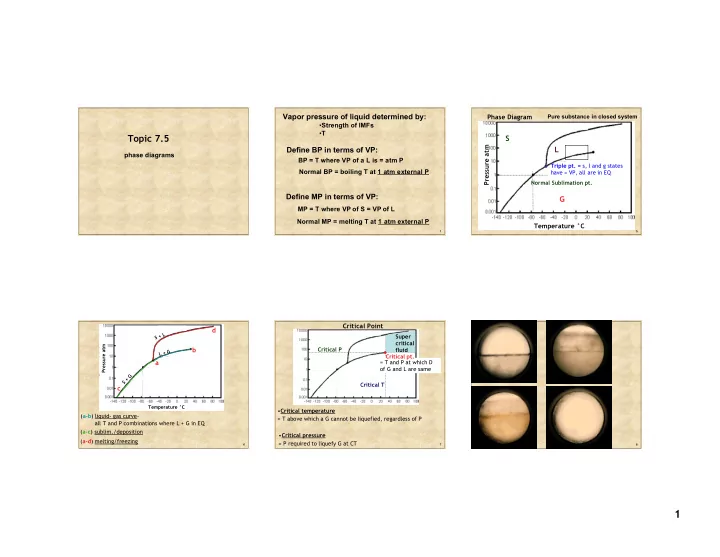
(a-b) liquid- gas curve- (a-c) sublim./deposition all T and P combinations where L + G in EQ (a-d) melting/freezing

Temperature °C Pressure atm

c

S + G

d

S + L

a b

L + G

6

Critical Point

  • Critical temperature

= T above which a G cannot be liquefied, regardless of P Critical T Critical P = T and P at which D

  • f G and L are same

Super critical fluid Critical pt.

.

  • Critical pressure

= P required to liquefy G at CT

7 8

slide-2
SLIDE 2

2

What happens to MP of CO2 as P↑? MP↑

9

Phase diagram for water What happens to MP of H2O as P↑? MP↓

10

  • ↑ External P, particles compressed
  • D ↑
  • ↑ P favors more D phase
  • S over L: so S has ↑ D

Slope of liquid/solid boundary line

  • ↑ P, particles compressed
  • D ↑
  • H2O unusual in that L molecules fit more

tightly than S

  • L over S: so L has ↑ D

CO2

If slope positive, solid more dense than the liquid

water

If slope negative, solid less dense than the liquid:

11 12

Problem A. Sketch a phase diagram for a substance based on the following information: Normal BP = 110°C Normal FP = -22°C Triple point = -20 °C and 0.100 atm Critical point = 200°C and 150 atm

T °C P (atm)

G S L

  • 20

0.100 200 150 1

  • 22

.

NFP NBP

.

110

.

TP

.

CP

13

Pressure atm

gas solid liquid

  • 20

0.100 200 150 1

  • 22

.

NFP NBP

.

110

.

Triple pt

.

Critical pt.

If a sample is placed in a container at 20°C and 0.98 atm, what phase(s) would exist? liquid The P of a sample is decreased from 140 atm to 0.095 atm at a constant T of 130°C and then the T is decreased from 130°C to -60°C at a constant P of 0.095 atm, what phase change(s) would take place?

.

vaporization and deposition

.

If a sample of solid is dropped into liquid, what would happen? L more D than S, ∴S floats

. .

14

slide-3
SLIDE 3

3

Which phase transitions could occur if a solid is heated at a pressure above its triple point?

Melting and vaporization

.

P

Problem E.

16

Water has several solid forms

17

Do problem # 4 on PS 7.5 as independent practice in class

Problem set 7.5

Problem # 3