
SLIDE 1
Resisting Israeli Apartheid Conference
December 5, 2004 University of London - SOAS “Where is the world? Is it dead?” exclaimed the bereaved mother in Rafah on Al-Jazeera. Before her lied the lifeless body of her little child.
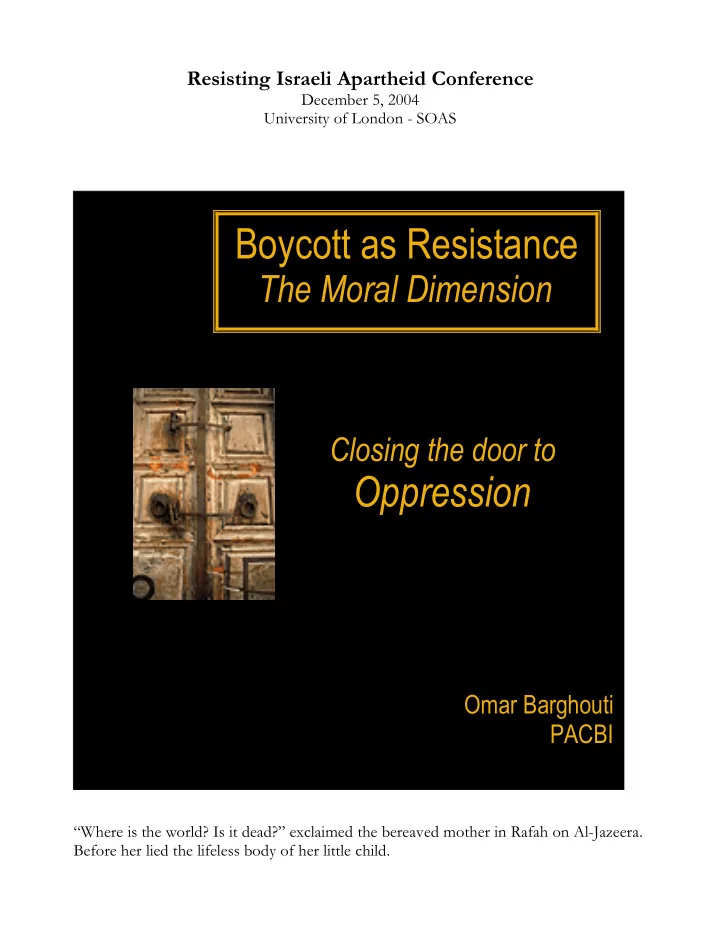
Boycott as Resistance The Moral Dimension Closing the door to - - PDF document
Resisting Israeli Apartheid Conference December 5, 2004 University of London - SOAS Boycott as Resistance The Moral Dimension Closing the door to Oppression Omar Barghouti PACBI Where is the world? Is it dead? exclaimed the bereaved
December 5, 2004 University of London - SOAS “Where is the world? Is it dead?” exclaimed the bereaved mother in Rafah on Al-Jazeera. Before her lied the lifeless body of her little child.
Faced with overwhelming Israeli oppression, Palestinians under occupation, in refugee camps and in the heart of Israel’s distinct form of apartheid have increasingly reached
nation of hapless victims. We are resisting oppression, aspiring to attain justice and genuine peace. Above all, we are struggling for the universal principle of equal humanity. But we cannot do it alone. We need international support. The question of Palestine was created by the world and it is the world that must rise to its moral responsibility to resolve it. The renowned French philosopher Etienne Balibar says the Palestinian cause is a universal one because “it is a test for the recognition of right, and the implementation of international law.” Only with consistent, systematic and comprehensive international pressure on Israel will it be possible to end its oppression and injustice. This short presentation will focus on the ethical dimension of boycott, which I consider a justified form of international intervention. Actually, it is far more than justified; it is necessary. ***
The Palestinian call for boycott is based specifically on Israel’s systematic oppression of the Palestinian people which takes three fundamental forms: First: Rejecting the Palestinian refugees’ right of return to their properties, as stipulated in international law, and denying any responsibility for the Nakba -- the massive dispossession and ethnic cleansing campaign carried out by Zionists around 1948, transforming close to 800,000 Palestinians into refugees. A virtual consensus exists among Israelis, including academics and other intellectuals, on rejecting the legally and morally binding rights of Palestinian refugees.1 The most peculiar dimension in the popular and academic Israeli discourses about the “birth” of the state is substituting “independence” for colonization and birth for
superiority” after occupying the West Bank and Gaza in 1967, as if prior to that Israel were as civil, legitimate and law-abiding as Finland! Ironically, while stubbornly rejecting Palestinian refugee rights, Israeli academics play a central role in the massive
campaigns demanding, and often receiving, restitution, repatriation and compensation rights for Jewish refugees of the World War II era. *** Second: the Military colonization of the West Bank and Gaza Strip since 1967, with all what it entails in land expropriations, house demolitions, indiscriminate killings, and, most ominously, the colonial wall, which was found illegal by the International Court of Justice (ICJ), and which serves to facilitate Israel’s ongoing land grab and gradual ethnic cleansing of Palestinians. Israeli universities have not only been complicit in planning, maintaining and furnishing the justification for various aspects of the occupation, but have also directly participated in acts of colonization. The Hebrew University has been slowly but consistently expropriating Palestinian lands and expelling their owners. Tel Aviv University refuses to date to acknowledge the fact that it sits on top of an ethnically cleansed Palestinian village.2 Bar Ilan University operates a campus on the illegal colony
cleansing of the Palestinian Bedouins in the Negev. And Haifa University boasts one of the most racist academics alive: Prof. Arnon Sofer, the infamous “prophet of the Arab
demographic threat,” who relentlessly provides academic justification for ethnic cleansing in various shapes and forms.3 *** It is widely accepted that the Palestinians have suffered grave human losses due to Israel’s 37-year-old occupation. Most recently, during this intifada, the Israeli army has crossed some of its former red lines, committing crimes that are reminiscent in form -- but certainly not in scale -- of Nazi crimes against European Jews, as British MP Oona King had once stated.4 From forcing a Palestinian violinist to play at a roadblock5, to executing a 13-year-old refugee girl in Rafah in cold blood,6 to engraving the Star of David on the arms of teenage Palestinian boys, to inscribing ID numbers on the foreheads and forearms of
Palestinians, young and old,7 Israel has acted with nauseating criminality and shocking
for an end to the occupation have remained in a depressingly tiny minority. *** Third: The third form of Israeli oppression is hardly ever mentioned in the western media or in academia: the system of racial discrimination against Palestinian-Arabs8 who are officially “citizens” of Israel, a state which categorically precludes them from its self-
them disempowered, largely dispossessed and lacking equal status in the laws and practices of the state. Polls have steadily shown that a solid majority of two thirds of all Israeli Jews supports “encouraging the Arabs to leave” by various means.9 ***
Avraham Burg, The Guardian, 15/9/2003
In every vital aspect of life, from land ownership to access to higher education and jobs, Israel has for been practicing its own form of apartheid for 56 years. Of all the areas of racial discrimination, education stands out. A ground-breaking Human Rights Watch study published in 2001 concludes: “The hurdles Palestinian Arab students face from kindergarten to university function like a series of sieves with sequentially finer holes. At each stage, the education system filters
Israel's courts have yet to use … laws or more general principles of equality to protect Palestinian Arab children from discrimination in education.” 10
*** SLIDE 7: I agree with those who argue that Israel is not identical to South Africa, that it is more complex, more multi-dimensional and even more sinister, in some respect. But, no matter how we define Israel, the fundamental and undisputed existence in it of a system
South Africa-like sanctions against Israel. Apartheid, Zionist settler-colonialism, Jewish supremacy, ...etc. are all variations on the name of the ailment. What matters is how best to cure it. Taking into consideration all 3 dimensions of Israel’s oppression mentioned above, it can be concluded that a sufficient family resemblance between Israel and South Africa exists to grant advocating South Africa style remedies. ***
Some distinguished supporters of the Palestinian cause11 have argued against applying South-Africa style sanctions and boycotts to Israel for various reasons, most significant
(A) The Holocaust’s memory makes calls for boycotting Israel widely detested and prohibitively unpopular. (B) Israel is a democratic country with a vibrant civil society, and therefore it can be convinced to end its oppression without sanctions. (C) Unlike in South Africa during apartheid, the majority in Israel is opposed to sanctions. (D) Israeli academics are largely progressive and at the vanguard of the peace movement, and therefore they must be supported not boycotted.
*** (A) As Etienne Balibar says, “Israel should not be allowed to instrumentalize the genocide of European Jews to put [itself] above the law of nations.” Beyond that, by turning a blind eye to Israel’s oppression, as the U.S. and most official Europe often do, the west has in fact perpetuated the misery, the human suffering and the injustice that have ensued since the Holocaust. Only the oppressed are different now; they are “the victims of the victims,” as Edward Said said. As for the unpopularity argument, recent breakthroughs in the positions of the US Presbyterian church, the Anglican church and some mainstream, progressive Jewish- American organizations -- not to mention the fast spreading boycott movement in Europe -- indicate that there is an encouragingly growing acceptance of the need to boycott Israel in western countries. (B) How can an ethno-religious supremacy that is also a colonial power ever qualify as a democracy? Israel may be a democracy for its Jewish citizens, but it is an apartheid for its Palestinian citizens, as argued earlier. New York University professor Tony Judt, for instance, calls Israel a “dysfunctional anachronism,” categorizing it among the “belligerently intolerant, faith-driven ethno states.”12
(C) Of all the anti-boycott arguments, this one reflects either surprising naiveté or deliberate intellectual dishonesty. Are we to judge whether to apply sanctions on a colonial power based on the opinion of the majority in the oppressors’ community? Does the oppressed community count at all? (D) This is simply a myth propagated and maintained by Israeli academics who count themselves in the “left.” The vast majority of Israeli academics serves in the army’s reserve forces, and therefore directly knows of and participates in the daily crimes. Moreover, with the exception of a tiny yet crucial minority, Israeli academics are largely supportive of their state’s oppression or are acquiescently silent about it. Some infamous cases must be mentioned: Israel’s most celebrated philosopher, Asa Kasher, provided “ethical” justification for extra-judicial killings, even when a large number of innocent civilians are deliberately killed or injured in the process.13 Israel’s foremost military historian, Martin Van Creveld, of Hebrew University, advised the Israeli army14 in 2002 -- in the Jerusalem regional weekly, March 1, 2004 -- to commit swift genocide against the Palestinians, explaining that, “Perhaps 5.000 or 10.000 killed won’t be enough, and then we will have to kill more.” He concludes by saying, “it is better that there be one massive crime, after which we will exit and lock the gate behind us.” Like any proper peacenik, his ultimate objective remains to “exit” the occupied territories. Far from being isolated examples, such explicitly racist and criminal positions are quite popular in Israel today. They are not only condoned in universities, but highly praised, judging from the prominent stature enjoyed by Kasher, Van Creveld, Benny Moris and their ilk. ***
Some have argued that boycotting Israel is counterproductive and may lead to: (1) Losing the ability to influence Israel’s possible path to peace (2) Radicalizing the Israeli right and pulling the rug from under the feet of the left (3) Indirectly increasing the suffering of Palestinians who stand to lose financially and may even be subjected to deteriorating conditions of oppression by a wilder, more isolated Israel. ***
(1) What influence? Europe hardly has any right now. Even in the U.S., the Israeliziation
tying the hands of any potential American pressure aimed at curtailing, not to mention changing, Israel’s oppressive policies. On the rare occasions when Israel did at all contemplate changing its policies, it was mainly attributed to facing concerted pressures by the international community. (2) What left? Those in Israel who officially call themselves “the left” -- the Zionist left, more accurately -- easily make the far-right parties in Europe look as humane as Mother Teresa, especially when it comes to recognizing Palestinian refugees’ rights. On the other hand, the morally consistent, non-Zionist left, is a very tiny group, whose members may inadvertently end up losing benefits, privileges and funding as a result of boycott. This should compel us to nuance our boycott tactics to decrease the possibility of that unnecessarily happening. But, we all know, this is not an exact science (if any science is). Rather than focusing on the “error margin,” we must emphasize the impact boycott might have on the overall academic establishment in Israel. The price that some conscientious academics may pay as an unavoidable byproduct of the boycott is quite cheap when compared to the price Palestinian academics, and indeed the Palestinian people at large, have to pay for the lack of boycotts or any similarly effective pressures
The most urgent type of support the international community can provide to the Palestinian academy is to adopt various forms of boycott against Israel’s academic institutions, forcing them to disengage themselves from their direct and/or indirect collusion in their state’s oppression. This will serve not only the Palestinians, but also, in the longer term, the true Israeli left in Israel, academics included. Challenging the fanatic, militaristic establishment now may strengthen its grip on power in the short run -- extreme populism and the rise of fascist tendencies in Israel attest to that; but in the longer run it will weaken that establishment, just as in South Africa. Repression under
apartheid did not die down in a smooth downwards spiral, after all. (3) More suffocation? Even South Africa’s leading human rights advocate, archbishop Desmund Tutu, was horrified by the elaborate, multi-layered siege Israel has set up in the
cautioned against boycotting Israel, mainly because doing so ignores the pressing need to alleviate the immediate suffering of Palestinians under occupation. But, as I have argued elsewhere,15 this type of arguments is not only patronizing, claiming to better know what’s best for Palestinians, but also based on an unconscious premise that Palestinians have less than normal human needs, whereby food, shelter and basic services -- which, the argument claims, would be better served without boycott -- are regarded as more profound or consequential than their need for freedom, justice, self-determination, dignified living and the opportunity to develop culturally, economically and socially in peace. *** Regardless of all the above, some argue, isn’t it necessary for Palestinian academics and intellectuals to communicate with their Israeli counterparts, to debate, to share, to convince, to learn, to overcome the “psychological barriers” and ultimately to reach a common vision and a common struggle for peace? ***
I beg to differ with those who imagine they can wish away the conflict by suggesting some channels of rapprochement, détente, or “dialogue,” which they hope can lead to authentic processes of reconciliation and eventually peace. First, given the financial luring and political arm-twisting that come as part of the package of western “suggestions” for collaboration, the latter are more often than not perceived as right out dictates. Second, any sincere joint projects aimed at reaching a just peace must be fundamentally based on rejection of all oppression and recognition of equal humanity. Third, if a member of the oppressors’ community theoretically accepts -- on principle -- the requirements for justice without acting to attain them, while simultaneously enjoying the benefits brought about due to occupation, apartheid and the illegal use of Palestinian refugees’ properties, then he/she would still be indirectly responsible, and ethically accountable for the injustice his/her state is committing. Reflection without action cannot suffice to exonerate a member of an oppressive group. Action is needed to translate the formal commitment into a process for change and ethical transformation. Israelis who always ask the Palestinians to for a political price to be paid in advance in return for their “noble” recognition of a meager subset of Palestinian rights are not really seeking justice or a moral end to the conflict. Some shamelessly seek European funds;
behaviour as a form of taming the Palestinian shrew, or inhibiting resistance to
Striving for peace divorced from justice is as good as institutionalizing injustice, or making the oppressed submit to the overwhelming force of the oppressor and accept the inequality as fate. *** Those who attempt to change the perception of the oppressed rather than help resist
Edward Said used to say: “Equality or nothing!” ***
In conclusion, I wish to emphasize the necessity of applying an evolving, comprehensive, in stitu tio nal bo yc o tt against Israel’s academic, cultural, economic and political
form of resistance to oppression, intellectuals and academics will be abandoning their moral obligation to stand up for right, for justice, for equality and for a chance to establish the primacy of universal ethical principles.
Endnotes:
1 “The Palestinian leadership would be well advised to take very seriously the united front in Israel
that opposes a right of return,” read the lead editorial in Ha’aretz, August 18, 2003.
2 The Palestinian village’s name is Sheikh Muwannis. 3 One example is the “Mitzpim Project,” supervised by Sofer, which calls for the “conquest” of areas
populated by Palestinian-Arabs inside via Jews-only settlements and roads. http://www.haaretz.com/hasen/spages/481680.html
4 Following a visit to the completely fenced Gaza Strip, Oona King, a Jewish member of the British
parliament commented on the irony that Israeli Jews face today, saying: “…in escaping the ashes of the Holocaust, they have incarcerated another people in a hell similar in its nature - though not its extent - to the Warsaw ghetto.” Israel Can Halt This Now, The Guardian, June 12, 2003. http://www.guardian.co.uk/comment/story/0,3604,975423,00.html
5
Chris McGreal, Israel Shocked by image of soldiers forcing violinist to play at roadblock, The Guardian, November 29, 2004. http://www.guardian.co.uk/israel/Story/0,2763,1361755,00.html
6
Amos Harel, Absolutely Illegal, Ha’aretz, 23/11/2004. http://www.haaretz.com/hasen/spages/504878.html
7 Serge Schmemann, At Least 17 Are Killed in Israeli Raid at Palestinian Camp in Gaza, New York Times,
12/3/2002.
8 According to Physicians for Human Rights-Israel, “Although the Palestinian citizens of the State of
Israel represent approximately 20% of its population, this community suffers from institutionalized discrimination that produces severe socio-economic gaps between the Jewish majority and the Arab
population continues to suffer from under-budgeting and discrimination in many areas including employment, education, property and planning policies, and health care services.” http://www.phr.org.il/Phr/Pages/PhrArticle_Unit.asp?Cat=37&Pcat=4
9 Yulie Khromchenco , Poll: 64% of Israeli Jews support encouraging Arabs to leave, Ha’aretz, June 22, 2004.
10 Human Rights Watch, Second Class: Discrimination Against Palestinian Arab Children in Israel's Schools,
September 2001. http://www.hrw.org/reports/2001/israel2
11 Noam Chomsky, for instance, describes sanctions as “probably harmful and at best pointless,”
arguing that, “In the current real-world circumstances, a call for sanctions, even if it were justified, would be greatly welcomed by the right wing extremists and hard-liners, because they could easily convert it into another ‘proof’ that everyone wants to kill the Jews and so we must rise to the support of embattled Israel to prevent another Holocaust.” ZNet, May 31, 2004. http://blog.zmag.org/ttt/archives/000492.html
12 Tony Judt, Israel: The Alternative, New York Review of Books, Vol. 50, #16, October 23, 2003.
http://www.nybooks.com/articles/16671
13 Reuven Pedatzur, The Israeli army's house philosopher, Ha’aretz, February 24, 2004.
14 Ran Hacohen, Against Negotiations, Antiwar.com, March 28, 2002.
http://www.antiwar.com/hacohen/h032802.html
15 See “On Refugees, Creativity and Ethics,” ZNet, September 28, 2002.
http://www.zmag.org/content/Mideast/bhargoutirefeth.cfm