Body Fluid Identification by Integrated Analysis of DNA Methylation - - PDF document

body fluid identification by integrated analysis of dna
SMART_READER_LITE
LIVE PREVIEW

Body Fluid Identification by Integrated Analysis of DNA Methylation - - PDF document

Body Fluid Identification by Integrated Analysis of DNA Methylation and Body Fluid-Specific Microbial DNA Ajin Choi, Kyoung-Jin Shin, Woo Ick Yang, and Hwan Young Lee Department of Forensic Medicine Yonsei University College of Medicine Body


slide-1
SLIDE 1

1

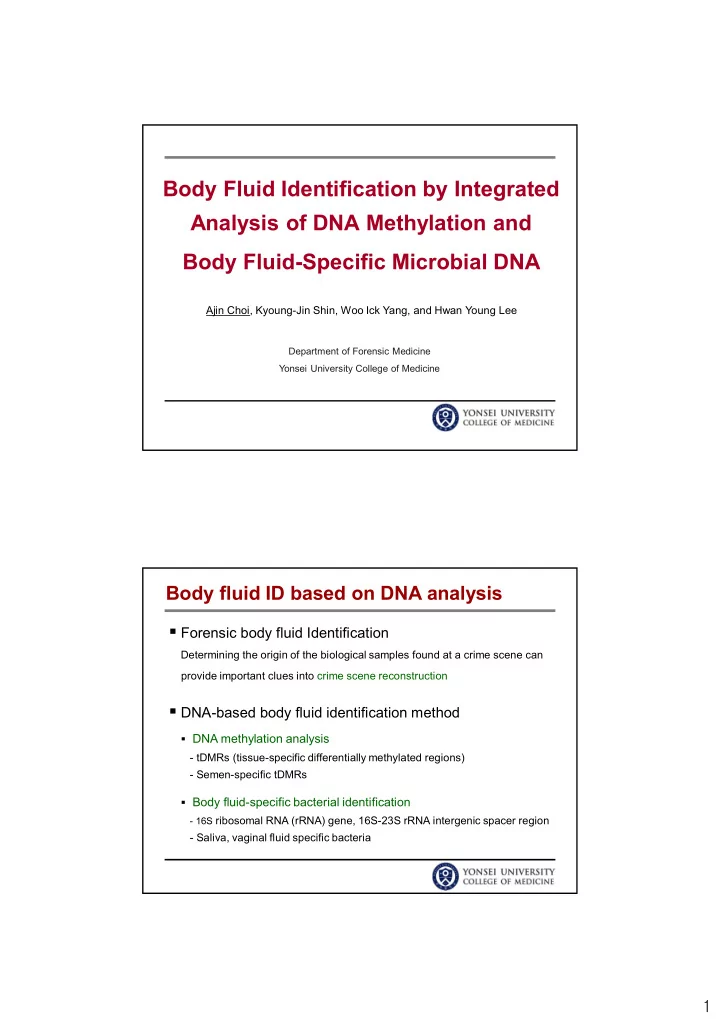
Body Fluid Identification by Integrated Analysis of DNA Methylation and Body Fluid-Specific Microbial DNA

Ajin Choi, Kyoung-Jin Shin, Woo Ick Yang, and Hwan Young Lee

Department of Forensic Medicine Yonsei University College of Medicine

Body fluid ID based on DNA analysis

§ Forensic body fluid Identification

Determining the origin of the biological samples found at a crime scene can provide important clues into crime scene reconstruction

§ DNA-based body fluid identification method

§ DNA methylation analysis

  • tDMRs (tissue-specific differentially methylated regions)
  • Semen-specific tDMRs

§ Body fluid-specific bacterial identification

  • 16S ribosomal RNA (rRNA) gene, 16S-23S rRNA intergenic spacer region
  • Saliva, vaginal fluid specific bacteria
slide-2
SLIDE 2

2

Limitations

§ DNA methylation analysis

  • Can clearly identify semen with sperm cells

à Imperfect discrimination of detailed body fluids

§ Body fluid-specific bacterial identification

  • Can discriminate only saliva and vaginal fluid
  • Bacteria can reside from body sites that are proximate or can be

in contact with the body site à Low specificity

èNeed to additional markers or integration of other body fluid identification methods for identification of various body fluids in one reaction

Objects

§ Development of multiplex PCR system for efficient body

fluid identification by integrated analysis of DNA methy- lation and body fluid-specific microbial DNA

§ Forensic evaluation of developed multiplex PCR system

slide-3
SLIDE 3

3

Experimental Procedures

DNA extraction & quantification Methylation-sensitive restriction enzyme (MSRE) Treatment

PCR product No PCR product

CpG CpG

Met

CpG CpG

Met

PCR amplification

Template DNA 1 ng, 10 U HhaⅠ, 37℃ 30 min Enzyme treated DNA 10 ul, Gold Taq 2.0 U, DMSO 5% Fluorescence-labeled primers Thermal cycling

95 ℃ for 11 min, 28 cycles of 94 ℃ for 20 sec, 59 ℃ for 1 min, 72 ℃ for 30 sec 60 ℃ for 60 min

Schema of multiplex PCR

Saliva-specific bacteria Vaginal fluid-specific bacteria

After MSRE treatment

slide-4
SLIDE 4

4

Results of multiplex PCR system

Blood Saliva Semen Vaginal fluid Menstrual blood

Bacteria profiles for each body fluid

Body fluid N Number of positive samples Number of negative samples L.crispatus L.gasseri S.salivarius V.atypica Blood 20

  • Saliva

21 1 19 13 2 Semen 21

  • Vaginal fluid

14 8 9 1 Menstrual blood 14 8 8 3

slide-5
SLIDE 5

5

Stability test

Blood Saliva Semen Vaginal fluid Menstrual blood

§ Aged samples (environment exposure for 75 days) showed almost

identical results compared with freshly obtained samples

§ The multiplex PCR system, which allows combined use of 4

tDMRs for USP49, DACT1, L81528,PFN3, and 4 body fluid- specific bacteria markers for L.crispatus, L.gasseri, S.salivarius, V.atypica, could be used to discriminate blood, saliva, semen, and vaginal fluid-menstrual blood.

§ Because developed multiplex system uses the same biological

source

  • f

DNA for individual identification profiling and simultaneously analyzes various body fluids in one reaction, the method will facilitate more efficient body fluid identification in forensic casework.

Concluding remarks

slide-6
SLIDE 6

6

Thank you for your attention!

Yonsei DNA Profiling Group http://forensic.yonsei.ac.kr/