Body fluid identification by simultaneous analysis of DNA - - PDF document

body fluid identification by simultaneous analysis of dna
SMART_READER_LITE
LIVE PREVIEW

Body fluid identification by simultaneous analysis of DNA - - PDF document

Body fluid identification by simultaneous analysis of DNA methylation and body fluid- specific bacteria Ajin Choi, Kyoung-Jin Shin, Woo Ick Yang, and Hwan Young Lee Department of Forensic Medicine, Yonsei University College of Medicine, Seoul,


slide-1
SLIDE 1

1

Body fluid identification by simultaneous analysis of DNA methylation and body fluid- specific bacteria

Ajin Choi, Kyoung-Jin Shin, Woo Ick Yang, and Hwan Young Lee

Department of Forensic Medicine, Yonsei University College of Medicine, Seoul, Korea

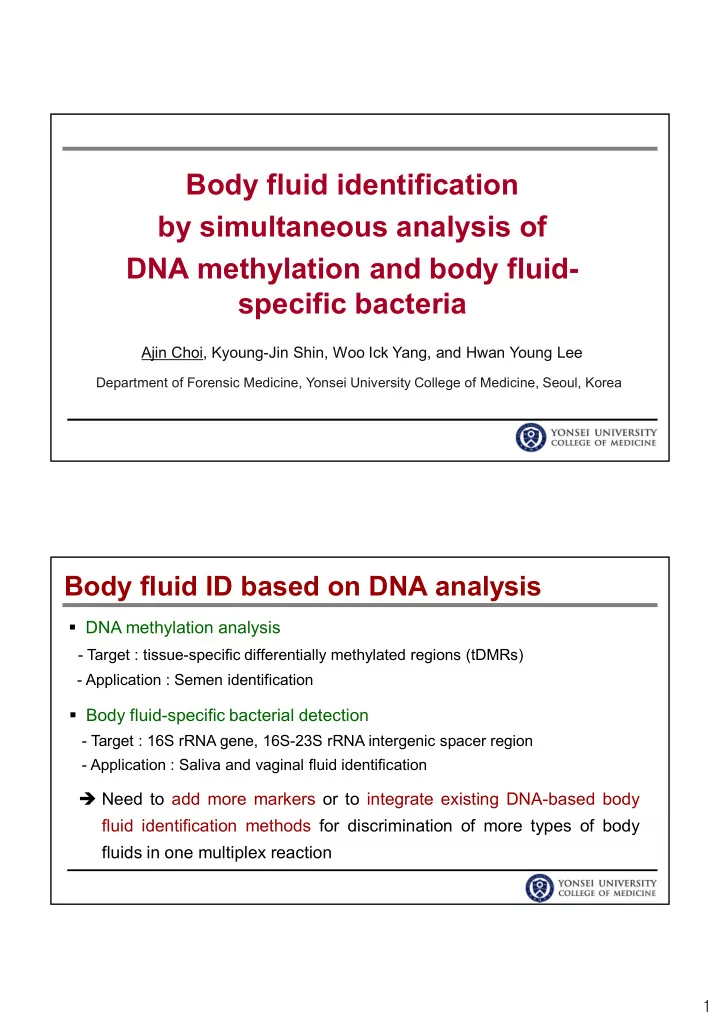
Body fluid ID based on DNA analysis

§ DNA methylation analysis

  • Target : tissue-specific differentially methylated regions (tDMRs)
  • Application : Semen identification

§ Body fluid-specific bacterial detection

  • Target : 16S rRNA gene, 16S-23S rRNA intergenic spacer region
  • Application : Saliva and vaginal fluid identification

è Need to add more markers or to integrate existing DNA-based body fluid identification methods for discrimination of more types of body fluids in one multiplex reaction

slide-2
SLIDE 2

2

Experimental procedures

DNA extraction & quantification

PCR product No PCR product

CpG CpG

Met

CpG CpG

Met

PCR amplification Methylation-Sensitive Restriction Enzyme treatment

1 ng of DNA, 10 U of HhaⅠ, 37℃ for 30 min Enzyme treated DNA, 2.0 U Gold Taq pol, 5% DMSO, fluorescence-labeled primers Thermal cycling 95 ℃ for 11 min 94 ℃ for 20 sec 59℃ for 1 min 72 ℃ for 30 sec X 28 cycles 60℃ for 60 min

Schema of multiplex PCR

Saliva-specific bacteria Vaginal fluid-specific bacteria After MSRE treatment

slide-3
SLIDE 3

3

Body fluid ID using multiplex PCR

Blood Saliva Semen Vaginal fluid Menstrual blood

Semen identification using multiplex PCR

Semen (2 vasectomy) Semen (10 of 18)

Int J Legal Med (2013) 127:35–43

Semen (8 of 18)

Multiplex PCR in the present study

slide-4
SLIDE 4

4

Bacteria profiles for each body fluid

Body fluid N Number of positive samples Number of negative samples L.crispatus L.gasseri S.salivarius V.atypica Blood 20

  • Saliva

20 1 18 12 2 Semen 20

  • Vaginal fluid

14 8 9 1 Menstrual blood 14 8 8 3

500 pg saliva

Forensic evaluation - Sensitivity test

125 pg saliva 250 pg vaginal fluid 125 pg vaginal fluid 500 pg semen

slide-5
SLIDE 5

5

Forensic evaluation - Stability test

Blood Saliva Semen Vaginal fluid Menstrual blood

§ Aged samples showed almost identical results compared with freshly obtained samples

Skin swab

  • f kissing site

Forensic evaluation – Casework sample test

Post-coital vaginal swab Post-coital penile wipe

slide-6
SLIDE 6

6

§ The multiplex PCR system, which allows combined use of 4 tDMRs for

USP49, DACT1, L81528 and PFN3, and 4 body fluid-specific bacteria markers for L.crispatus, L.gasseri, S.salivarius and V.atypica, could be used to discriminate blood, saliva, semen and vaginal fluid-menstrual blood.

§ The newly developed multiplex method ensures forensic applicability as

well as high specificity, reliability and sensitivity, thereby facilitating more efficient body fluid identification in forensic casework.

Conclusion

Thank you for your attention