Bob Diezi, Project Manager, District One Road Rangers Project - - PowerPoint PPT Presentation

bob diezi project manager district one road rangers
SMART_READER_LITE
LIVE PREVIEW

Bob Diezi, Project Manager, District One Road Rangers Project - - PowerPoint PPT Presentation

Bob Diezi, Project Manager, District One Road Rangers Project Manager Responsibilities Point of contact for the Department Thoroughly knowledgeable and experienced in relation to all aspects of the scope of services and the contract


slide-1
SLIDE 1

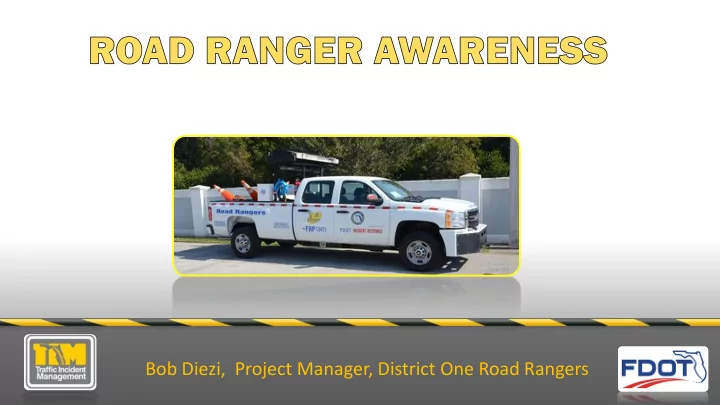
Bob Diezi, Project Manager, District One Road Rangers
slide-2
SLIDE 2

Project Manager Responsibilities

  • Point of contact for the Department
  • Thoroughly knowledgeable and experienced in relation to all aspects of the scope
  • f services and the contract
  • Administrative authority
  • Available 24/7
  • Respond within 30 minutes
  • On scene in 60 minutes
  • Participate in Traffic Incident Management (TIM) meetings
  • Meet with the Department regularly
slide-3
SLIDE 3
slide-4
SLIDE 4

Two Hundred Center Line Miles of Roadway

  • Collier = 63
  • Lee = 34
  • Charlotte = 22
  • Sarasota = 43
  • Manatee = 21
  • Manatee/Hillsborough/Pinellas = 17
  • Accounting for multi-lanes, both directions North and South, limited access

entrance, and exit ramps

  • The total roadway being patrolled closer to 1800 miles
slide-5
SLIDE 5

SCHEDULES

  • Two Road Rangers on patrol in each county
  • Collier County

Mile marker 49-105

24 hours , 7 days a week

8 hour shifts on weekdays

12 hour shifts on weekends

  • Lee County

Mile marker 105-138

6:00 a.m. – 7:00 p.m. on weekdays

9:00 a.m. – 9:00 p.m. on weekends

  • Charlotte County

Mile marker 136-170

6:00 a.m. – 7:00 p.m. on weekdays

9:00 a.m. – 9:00 p.m. on weekends

slide-6
SLIDE 6

SCHEDULES

  • Sarasota County

Mile marker 167-213

6:00 a.m. – 7:00 p.m. on weekdays

9:00 a.m. – 9:00 p.m. on weekends

  • Manatee County

Mile marker 210-234

6:00 a.m. – 7:00 p.m. on weekdays

9:00 a.m. – 9:00 p.m. on weekends

  • Sky Way Bridge I-275

Mile marker 1-13

7:00 a.m. – 7:00 p.m. on weekdays

9:00 a.m. – 9:00 p.m. on weekends

slide-7
SLIDE 7

Road Ranger Qualifications and Responsibilities

  • Be competent in the task of operating the vehicles and in providing safe and proper

execution of the services within the contract

  • Speak and understand English fluently
  • Provide documented automotive mechanical background
  • Current Florida Class “E” or higher classification along with 8 years of driving

experience

  • A safe driving record
  • Minimum of 18 years of age
  • Pass SLERS criminal record
  • High school diploma or GED equivalent
  • Drug free
slide-8
SLIDE 8

Road Ranger Qualifications and Responsibilities – Con’t.

  • Be well groomed, clean, and have neatly trimmed hair, including facial hair, if

applicable

  • No visible tattoos
  • Wear required uniforms
  • Be professional and courteous at all times
  • Cannot consumed alcoholic beverage with-in 8 hours of shift and/or consume

alcohol while on shift

  • Cannot take tips, gifts or gratuity for services
slide-9
SLIDE 9

Meet your Road Rangers for District One!

slide-10
SLIDE 10

Training and Certifications

  • Basic First Aid Certificate
  • Cardiopulmonary Resuscitation (CPR)
  • Training and Vendor Certification
  • Use of equipment operations and road side maintenance safety procedures
  • 40 hours of a “ride along” with an experienced Ranger
  • Training on of part VI of the manual on Uniform Traffic Control Devices –Temp

Traffic Control

  • FEMA-Emergency Management Institute online certification
  • IS-100 Introduction to Incident Command System
  • IS-700 Introduction to National Incident Management System
  • CJIS-Criminal Justice Information
slide-11
SLIDE 11

Authorized Stops

  • Assist law enforcement-DBI-ICA-FDOT with incident management
  • Stranded motorist with minor repairs (15 Minutes)
  • Remove disabled vehicle
  • Remove debris non-hazardous spills from travel lane
  • Abandon vehicle - initial check- Red Tag
  • Complete Patrol Logs
  • Refuel Road Ranger vehicle and containers
  • Meal and restroom breaks
slide-12
SLIDE 12

Standard Operating Guidelines

  • Methods and activities
  • Traffic incident detection, notification, and rapid response
  • Assist motorists
  • Improving safety
  • Reducing congestion and economic delay
  • Assist incident first responders and the scene of an event
slide-13
SLIDE 13

Response Priority

  • Injury crash blocking the travel portion of highway
  • Non-injury crash blocking the travel portion of the highway
  • Disabled vehicle blocking the travel portion of the highway
  • Abandoned vehicle blocking the travel portion of the highway
  • Emergency traffic control operations
  • Debris blocking one or more travel lanes
  • Crash not blocking any travel lane
  • Disabled vehicle not blocking a travel lane
  • Abandon vehicle not blocking but in questionable location
slide-14
SLIDE 14

Do’s and Don’ts

  • Do not take gratuity of any value or charge a fee
  • Do not add engine oil to any vehicle
  • Do attempt minor repairs
  • Do not exceed 15 minutes in repair time
  • Do provide water and shelter in road ranger vehicle
  • Do transport motorist to safe location
  • Do jump start vehicle
  • Do change flat tries
  • Do give no less than (1) gallon of fuel
slide-15
SLIDE 15

Road Rangers Provide

  • Drinking water
  • Radiator water
  • Make special efforts for persons with special needs
  • NEVER Leave a motorist or responders in any

abnormally unsafe or dangerous location

slide-16
SLIDE 16

Authorized Equipment

  • Truck mounted dynamic message sign
  • Light bar-roof mounted
  • On board computer-data collection/AVL system
  • Ranger operator logs
  • Move it law – informational cards provided both

English and Spanish

  • Abandon red (orange) tags
slide-17
SLIDE 17

Road Rangers Train Together

slide-18
SLIDE 18

Hurricanes and Other Services

  • Make resources available for certain traffic maintenance request or as directed by

the Department.

  • Keep evacuation routes clear of debris and or disabled vehicles
  • Fuel and water
  • Keep all lanes open to include emergency lanes
  • Own, operate and monitor NOAA radio and alarm equipment
  • Continue patrol until FHP/Department determines unsafe for motorist to remain on

the highway

  • Expand contract relocate and or deploy coverage at the request of the department
slide-19
SLIDE 19

Other Information

  • It is important to note that a fully funded Road Ranger Program is

dramatically less expensive than building additional lanes to increase capacity

  • The cost to construct two new lanes for two miles is

approximately $45 million and provides additional capacity only in that localized area. That same funding for the Road Rangers would benefit the entire intrastate highway system in Florida.

  • The Road Ranger Incident Response Program fully supports the

strategic mission of the Florida Department of Transportation and sound traffic incident management principles.

  • Road Rangers Are Much More than “Schmucks with Trucks”!!
slide-20
SLIDE 20

Qu Questions? tions?