= = = f f BOB BOB not does like not like = Alice Bob - - PowerPoint PPT Presentation

f f bob bob not does like not like alice bob alice bob
SMART_READER_LITE
LIVE PREVIEW

= = = f f BOB BOB not does like not like = Alice Bob - - PowerPoint PPT Presentation

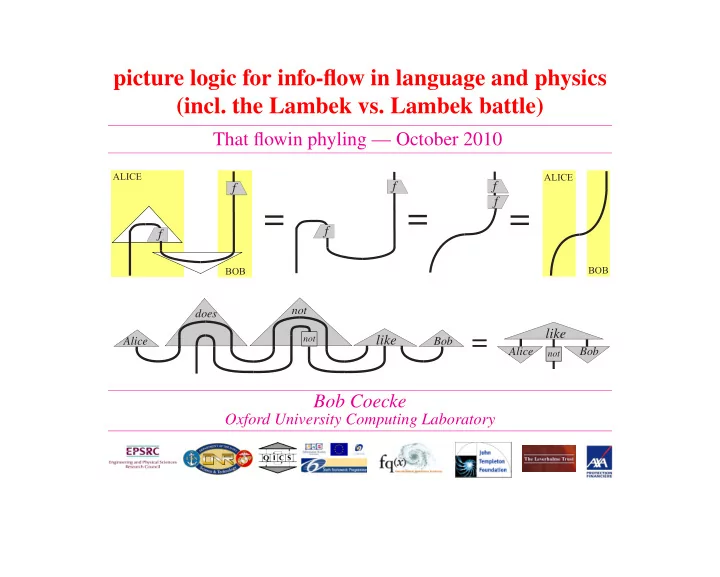
picture logic for info-flow in language and physics (incl. the Lambek vs. Lambek battle) That flowin phyling October 2010 ALICE ALICE f f f f = = = f f BOB BOB not does like not like = Alice Bob Alice Bob not Bob


slide-1
SLIDE 1

picture logic for info-flow in language and physics (incl. the Lambek vs. Lambek battle)

That flowin phyling — October 2010

=

f f

=

f f f

ALICE BOB

=

ALICE BOB

f

=

not

like

Bob Alice does Alice

not

like

not Bob

Bob Coecke

Oxford University Computing Laboratory

slide-2
SLIDE 2

Context:

  • S. Abramsky and B. Coecke (2004) A categorical semantics of

quantum protocols. In: Proc. 19th IEEE LiCS. IEEE Press.

slide-3
SLIDE 3

Context:

  • S. Abramsky and B. Coecke (2004) A categorical semantics of

quantum protocols. In: Proc. 19th IEEE LiCS. IEEE Press.

  • J. Lambek (2010; talk in 2006 at Cats, Kets, Cloisters) Compact

monoidal categories from Linguistics to Physics. In: New Struc- tures for Physics, B. Coecke, Ed., Springer-Verlag.

slide-4
SLIDE 4

Context:

  • S. Abramsky and B. Coecke (2004) A categorical semantics of

quantum protocols. In: Proc. 19th IEEE LiCS. IEEE Press.

  • J. Lambek (2010; talk in 2006 at Cats, Kets, Cloisters) Compact

monoidal categories from Linguistics to Physics. In: New Struc- tures for Physics, B. Coecke, Ed., Springer-Verlag.

  • S. Clark and S. Pulman (2007) Combining symbolic and distribu-

tional models of meaning. Proceedings of AAAI Spring Sympo- sium on Quantum Interaction.

slide-5
SLIDE 5

Context:

  • S. Abramsky and B. Coecke (2004) A categorical semantics of

quantum protocols. In: Proc. 19th IEEE LiCS. IEEE Press.

  • J. Lambek (2010; talk in 2006 at Cats, Kets, Cloisters) Compact

monoidal categories from Linguistics to Physics. In: New Struc- tures for Physics, B. Coecke, Ed., Springer-Verlag.

  • S. Clark and S. Pulman (2007) Combining symbolic and distribu-

tional models of meaning. Proceedings of AAAI Spring Sympo- sium on Quantum Interaction.

  • B. Coecke, M. Sadrzadeh and S. Clark (2008; 2010) Mathemat-

ical Foundations for a Compositional Distributional Model of

  • Meaning. Linguistic Analysis - Lambek Festschrift.
slide-6
SLIDE 6

This talk: Survey of aspects of categories and graphical language:

  • What is a monoidal category
  • Connection to categories
  • Known completeness results
slide-7
SLIDE 7

This talk: Survey of aspects of categories and graphical language:

  • What is a monoidal category
  • Connection to categories
  • Known completeness results

Pictures of quantum state information flow Pictures of linguistic meaning information flow

slide-8
SLIDE 8

This talk: Survey of aspects of categories and graphical language:

  • What is a monoidal category
  • Connection to categories
  • Known completeness results

Pictures of quantum state information flow Pictures of linguistic meaning information flow Differences between these two Flexibility of these two

slide-9
SLIDE 9

WHY ‘MONOIDAL’ CATEGORIES?

slide-10
SLIDE 10

BECAUSE THEY ARE EVERYWHERE!

slide-11
SLIDE 11
  • 1. Let A be a raw potato.
slide-12
SLIDE 12
  • 1. Let A be a raw potato.

A admits many states e.g. dirty, clean, skinned, ...

slide-13
SLIDE 13
  • 1. Let A be a raw potato.

A admits many states e.g. dirty, clean, skinned, ...

  • 2. We want to process A into cooked potato B.

B admits many states e.g. boiled, fried, deep fried, baked with skin, baked without skin, ...

slide-14
SLIDE 14
  • 1. Let A be a raw potato.

A admits many states e.g. dirty, clean, skinned, ...

  • 2. We want to process A into cooked potato B.

B admits many states e.g. boiled, fried, deep fried, baked with skin, baked without skin, ... Let A

f

✲ B

A

f′

✲ B

A

f′′

✲ B

be boiling, frying, baking.

slide-15
SLIDE 15
  • 1. Let A be a raw potato.

A admits many states e.g. dirty, clean, skinned, ...

  • 2. We want to process A into cooked potato B.

B admits many states e.g. boiled, fried, deep fried, baked with skin, baked without skin, ... Let A

f

✲ B

A

f′

✲ B

A

f′′

✲ B

be boiling, frying, baking. States are processes I := unspecified

ψ

✲ A.

slide-16
SLIDE 16
  • 3. Let

A

g ◦ f

✲ C

be the composite process of first boiling A

f

✲ B and

then salting B

g

✲ C.

slide-17
SLIDE 17
  • 3. Let

A

g ◦ f

✲ C

be the composite process of first boiling A

f

✲ B and

then salting B

g

✲ C. Let

X

1X ✲ X

be doing nothing. We have 1Y ◦ ξ = ξ ◦ 1X = ξ.

slide-18
SLIDE 18
  • 4. Let A ⊗ D be potato A and carrot D and let
slide-19
SLIDE 19
  • 4. Let A ⊗ D be potato A and carrot D and let

A ⊗ D

f⊗h

✲ B ⊗ E

be boiling potato while frying carrot.

slide-20
SLIDE 20
  • 4. Let A ⊗ D be potato A and carrot D and let

A ⊗ D

f⊗h

✲ B ⊗ E

be boiling potato while frying carrot. Let C ⊗ F

x

✲ M

be mashing spice-cook-potato and spice-cook-carrot.

slide-21
SLIDE 21
  • 5. Total process:

A⊗D

f⊗h

✲ B⊗E

g⊗k

✲ C ⊗F

x ✲ M= A⊗D x◦(g⊗k)◦(f⊗h)

✲ M.

slide-22
SLIDE 22
  • 5. Total process:

A⊗D

f⊗h

✲ B⊗E

g⊗k

✲ C ⊗F

x ✲ M= A⊗D x◦(g⊗k)◦(f⊗h)

✲ M.

  • 6. Recipe = composition structure on processes.
slide-23
SLIDE 23
  • 5. Total process:

A⊗D

f⊗h

✲ B⊗E

g⊗k

✲ C ⊗F

x ✲ M= A⊗D x◦(g⊗k)◦(f⊗h)

✲ M.

  • 6. Recipe = composition structure on processes.
  • 7. Law governing recipes:
slide-24
SLIDE 24
  • 5. Total process:

A⊗D

f⊗h

✲ B⊗E

g⊗k

✲ C ⊗F

x ✲ M= A⊗D x◦(g⊗k)◦(f⊗h)

✲ M.

  • 6. Recipe = composition structure on processes.
  • 7. Law governing recipes:

(1B ⊗ g) ◦ (f ⊗ 1C) = (f ⊗ 1D) ◦ (1A ⊗ g)

slide-25
SLIDE 25
  • 5. Total process:

A⊗D

f⊗h

✲ B⊗E

g⊗k

✲ C ⊗F

x ✲ M= A⊗D x◦(g⊗k)◦(f⊗h)

✲ M.

  • 6. Recipe = composition structure on processes.
  • 7. Law governing recipes:

(1B ⊗ g) ◦ (f ⊗ 1C) = (f ⊗ 1D) ◦ (1A ⊗ g) i.e. boil potato then fry carrot = fry carrot then boil potato

slide-26
SLIDE 26

Very successful in proof theory and programming: proof theory programming Propositions Data Types Proofs Programs BLUE = systems Red = processes

slide-27
SLIDE 27

Very successful in proof theory and programming: proof theory programming Propositions Data Types Proofs Programs BLUE = systems Red = processes but also applies to: biology physics language Biological syst. Physical syst. language syst. Biological proc Physical proc. language proc.

slide-28
SLIDE 28

Very successful in proof theory and programming: proof theory programming Propositions Data Types Proofs Programs BLUE = systems Red = processes but also applies to: biology physics language Biological syst. Physical syst. language syst. Biological proc Physical proc. language proc.

slide-29
SLIDE 29

A MINIMAL LANGUAGE FOR QUANTUM REASONING

Abramsky & Coecke (2004) A categorical semantics for quantum protocols. arXiv:quant-ph/0402130 Coecke (2005) Kindergarten quantum mechanics. arXiv:quant-ph/0510032

slide-30
SLIDE 30

— (physical) data in the language — Systems: A B C Processes: A

f

✲ A

A

g

✲ B

B

h

✲ C

Compound systems: A ⊗ B I A ⊗ C

f⊗g

✲ B ⊗ D

Temporal composition: A

h◦g

✲ C := A

g

✲ B

h

✲ C

A

1A ✲ A

slide-31
SLIDE 31

— graphical notation —

g ◦ f ≡

g f

f ⊗ g ≡

f f g

Roger Penrose (1971) Applications of negative dimensional tensors. In: Combinatorial Mathematics and its Applications. Academic Press. Andr´ e Joyal & Ross Street (1991) The geometry of tensor calculus I. Advances in Mathematics 88, 55–112.

slide-32
SLIDE 32

— merely a new notation? —

(g ◦ f) ⊗ (k ◦ h) = (g ⊗ k) ◦ (f ⊗ h)

slide-33
SLIDE 33

— merely a new notation? —

(g ◦ f) ⊗ (k ◦ h) = (g ⊗ k) ◦ (f ⊗ h)

=

f h g k f h g k

slide-34
SLIDE 34

— merely a new notation? —

(g ◦ f) ⊗ (k ◦ h) = (g ⊗ k) ◦ (f ⊗ h)

=

f h g k f h g k

peel potato and then fry it, while, clean carrot and then boil it

=

peel potato while clean carrot, and then, fry potato while boil carrot

slide-35
SLIDE 35

— graphical notation — ψ : I → A π : A → I π ◦ ψ : I → I

ψ

A A

π ψ π

slide-36
SLIDE 36

— graphical notation — ψ : I → A π : A → I π ◦ ψ : I → I

ψ

A A

π ψ π

slide-37
SLIDE 37

— graphical notation — ψ : I → A π : A → I π ◦ ψ : I → I

ψ

A A

π ψ π

slide-38
SLIDE 38

— graphical notation — ψ : I → A π : A → I π ◦ ψ : I → I

ψ

A A

π ψ π

slide-39
SLIDE 39

— graphical notation — ψ : I → A π : A → I π ◦ ψ : I → I

ψ

A A

π ψ π

slide-40
SLIDE 40

— graphical notation — ψ : I → A π : A → I π ◦ ψ : I → I

ψ

A A

π ψ π

slide-41
SLIDE 41

— graphical notation — ψ : I → A π : A → I π ◦ ψ : I → I

ψ

A A

π ψ π

slide-42
SLIDE 42

— graphical notation — ψ : I → A π : A → I π ◦ ψ : I → I

ψ

A A

π ψ π

slide-43
SLIDE 43

— graphical notation — ψ : I → A π : A → I π ◦ ψ : I → I

ψ

A A

π ψ π

slide-44
SLIDE 44

— graphical notation — ψ : I → A π : A → I π ◦ ψ : I → I

ψ

A A

π ψ π

slide-45
SLIDE 45

— adjoint —

f : A → B

f A B

slide-46
SLIDE 46

— adjoint —

f†: B → A

f B A

slide-47
SLIDE 47

— asserting (pure) entanglement — quantum classical =

= =

slide-48
SLIDE 48

— quantum-like —

A A

slide-49
SLIDE 49

— quantum-like —

A A

=

A A A A

slide-50
SLIDE 50

— quantum-like —

A A

=

A A A A

slide-51
SLIDE 51

— quantum-like —

A A

=

A A A A

slide-52
SLIDE 52

— quantum-like —

A A

=

A A A A

slide-53
SLIDE 53

— quantum-like —

A A

=

A A A A

slide-54
SLIDE 54

— quantum-like —

f f

=

slide-55
SLIDE 55

— sliding —

=

f f

=

f f

slide-56
SLIDE 56

— sliding —

=

f f

=

f f

In QM: cups = Bell-states, caps =Bell-effects, π-rotations = transpose

slide-57
SLIDE 57

classical data flow? f

=

f f f

slide-58
SLIDE 58

classical data flow? f

=

f

slide-59
SLIDE 59

classical data flow? f

=

f

slide-60
SLIDE 60

classical data flow? f

ALICE BOB

=

ALICE BOB

f

⇒ quantum teleportation

slide-61
SLIDE 61

Applying “decorated” normalization 3

=

f f f f

⇒ Entanglement swapping

slide-62
SLIDE 62

classical data flow? f

=

f g g ‘

⇒ gate teleportation computation

slide-63
SLIDE 63

— dagger compact symmetric monoidal categories —

slide-64
SLIDE 64

— dagger compact symmetric monoidal categories —

  • Thm. [Selinger ’05] An equational statement between

expressions in dagger compact symmetric monoidal categorical language holds if and only if it is deriv- able in the graphical notation via homotopy.

slide-65
SLIDE 65

— dagger compact symmetric monoidal categories —

  • Thm. [Selinger ’05] An equational statement between

expressions in dagger compact symmetric monoidal categorical language holds if and only if it is deriv- able in the graphical notation via homotopy.

  • Thm. [Selinger ’08] An equational statement between

expressions in dagger compact symmetric monoidal categorical language holds if and only if it is derivable in the category of finite dimensional Hilbert spaces, linear maps, tensor product, and adjoints.

slide-66
SLIDE 66

— dagger compact symmetric monoidal categories — In words: Any equation involving:

  • states, operations, effects
  • unitarity, adjoints (e.g. self-adjoint), projections
  • Bell-states/effects, transpose, conjugation
  • inner-product, trace, Hilbert-Schmidt norm
  • positivity, completely positive maps, ...

holds in quantum theory if and only if it can be derived in the graphical language via homotopy.

slide-67
SLIDE 67

— bases and phases —

H H H H

slide-68
SLIDE 68

— bases and phases —

H H H H

slide-69
SLIDE 69

— bases and phases —

H H H H

slide-70
SLIDE 70

— bases and phases —

⇒ One-way quantum computing

slide-71
SLIDE 71

A SLIGHTLY DIFFERENT LANGUAGE FOR NATURAL LANGUAGE MEANING

Coecke, Sadrzadeh & Clark (2010) Mathematical Foundations for a Compo- sitional Distributional Model of Meaning. arXiv:1003.4394

slide-72
SLIDE 72

— the from-words-to-a-sentence process — Consider meaning triangle (e.g. vectors cf. Google) of words:

word 1 word 2 word n

...

?

How do we/machines compute meaning of sentences?

slide-73
SLIDE 73

— the from-words-to-a-sentence process — Consider meaning triangle (e.g. vectors cf. Google) of words:

word 1 word 2 word n

...

grammar

How do we/machines compute meaning of sentences?

slide-74
SLIDE 74

— the from-words-to-a-sentence process — Information flow within a verb:

verb

  • bject
  • bject

subject subject

slide-75
SLIDE 75

— the from-words-to-a-sentence process — Information flow within a verb:

verb

  • bject
  • bject

subject subject

Again we have:

=

slide-76
SLIDE 76

— going non-symmetric —

I

ηl

→ A ⊗ Al Al⊗ A

ǫl

→ I I

ηr

→ Ar⊗ A A ⊗ Ar ǫr → I

A Al A A A A

l r

A Ar

=

A A A A

=

A A A A

r r

=

A A A A

=

A A A A

l l l l r r

slide-77
SLIDE 77

— Vector spaces and linear maps (⊇ vectors) form CC — Meaning:

  • vector spaces V, W
  • linear maps f: V → W
  • tensor product V ⊗ W with unit R
  • V l = V r = V
  • caps:

ǫl = ǫr : V ⊗ V → R ::

  • ij

cij si ⊗ sj →

  • ij

cijsi|sj

  • cups:

ηl = ηr : R → V ⊗ V :: 1 →

  • i

ei ⊗ ei

slide-78
SLIDE 78

— Grammatical type calculus forms CC — Grammar = Pregroup:

  • types p, q and type reductions p ≤ q
  • concatenation pq with unit is 1:

p ≤ q ⇒ rp ≤ rq , pr ≤ qr

  • left/right:

p ≤ q ⇒ ql ≤ pl, qr ≤ pr (pq)l = qlpl (pq)r = qrpr

  • caps and cups:

ǫr = [ppr ≤ 1] ǫl = [plp ≤ 1] ηr = [1 ≤ prp] ηl = [1 ≤ ppl]

  • yanking:

plp ≤ 1 ≤ ppl ppr ≤ 1 ≤ prp

slide-79
SLIDE 79

— The categorical product of CC’s is a CC — language Gram ✛

πg

p

g

Gram × Mean

πm

✲ Mean

p

m

  • objects (p, V ) and morphisms (p ≤ q , f : V → W)
  • all operations are component-wise
slide-80
SLIDE 80

— The categorical product of CC’s is a CC — language Gram ✛

πg

p

g

Gram × Mean

πm

✲ Mean

p

m

  • objects (p, V ) and morphisms (p ≤ q , f : V → W)
  • all operations are component-wise

⇒ a CC that combines grammar and meaning The grammar will control in which the meaning of words interact to make up the meaning of the sentence. ⇒ ‘grammatical’ quantum field theory

slide-81
SLIDE 81

— − − − → Alice ⊗ − − → does ⊗ − → not ⊗ − − → like ⊗ − − → Bob —

Alice

not

like

Bob

meaning vectors of words

not

grammar

does

slide-82
SLIDE 82

— − − − → Alice ⊗ − − → does ⊗ − → not ⊗ − − → like ⊗ − − → Bob —

Alice

like

Bob

meaning vectors of words grammar not

slide-83
SLIDE 83

— − − − → Alice ⊗ − − → does ⊗ − → not ⊗ − − → like ⊗ − − → Bob —

Alice

like

Bob

meaning vectors of words grammar not

slide-84
SLIDE 84

— − − − → Alice ⊗ − − → does ⊗ − → not ⊗ − − → like ⊗ − − → Bob —

Alice

like

Bob

meaning vectors of words grammar not

=

not

like

Bob Alice

slide-85
SLIDE 85

ANALOGIES & CONTRASTS

slide-86
SLIDE 86

Alice

hates

Bob

meaning vectors of words grammar

f f

states measurements

slide-87
SLIDE 87

— analogy: “non-local” info-flows —

English (& French): Hindi: Persian: Arabic (and Hebrew): Mehrnoosh Sadrzadeh (2008) Pregroup analysis of Persian sentences.

slide-88
SLIDE 88

— methodological analogy —

Physical experiments: Physical experiments: Probing systems with Probing systems with measurement devices measurement devices Language experiments: Language experiments: Querying texts, www Querying texts, www and large data bases and large data bases

Physical theories Physical theories Linguistic theories Linguistic theories Interaction Interaction

  • f quantum
  • f quantum

systems systems Interaction Interaction

  • f words in
  • f words in

sentences sentences High-level High-level interaction interaction structures structures

Oxbridge team: Ed Grefenstette, Mehrs Sadrzadeh, Steve Clark/Pulman, I
slide-89
SLIDE 89

Quantum-flow Meaning-flow States Meanings Measurement patterns Grammatical structure Symmetric Non-symmetric Phases Seemingly non counterpart Bases “that” (other logical stuff?) Mixedness Steve C. told me something

slide-90
SLIDE 90

a bit on STRUCTURE REQUIREMENTS

(the Lambek vs. Lambek battle)

slide-91
SLIDE 91

Alice

f f

Does Hate

associativity associativity

slide-92
SLIDE 92

Alice

f f

Hate

weak distributivity weak distributivity

Does

slide-93
SLIDE 93

Grammatical graphical components: unary - compact binary - clossed type reduction a ◦ a† ≤ e a · (a → c) ≤ c type introduction e ≤ a† ◦ a c ≤ a → (a · c) All seem to do the job:

❍❍❍❍❍❍❍❍❍❍

intro red none closed compact none AB-pom protogroup closed

  • resid. pom

compact Grishin pom, pregroup Inclusive non-associative variants it seems, ...

slide-94
SLIDE 94

(limited) State of art: Selinger’s Chapter in New Struc. Phys.:

  • Rigorous stuff in categories ≃ graphical languages

Baez-Stay Chapter in New Struc. Phys.:

  • ‘Info-flow ideas’ on non-CC closed ⊗ cats
  • J. C. Baez & M. Stay (2010) Physics, topology, logic and computation: a

Rosetta Stone. In: New Structures for Physics. arXiv:0903.0340

  • P. Selinger (2009) A survey of graphical languages for monoidal categories.

In: New Structures for Physics. arXiv:0908.3347