Physics, Language, Maths & Music
(partly in arXiv:1204.3458) Bob Coecke, Oxford, CS-Quantum SyFest, Vienna, July 2013
=
f f
=
f f f
ALICE BOB=
ALICE BOBf
=
notlike
Bob Alice does Alice notlike
not Bob meaning vectors of words pregroup grammar
= = = f f BOB BOB meaning vectors of words not does like - - PowerPoint PPT Presentation
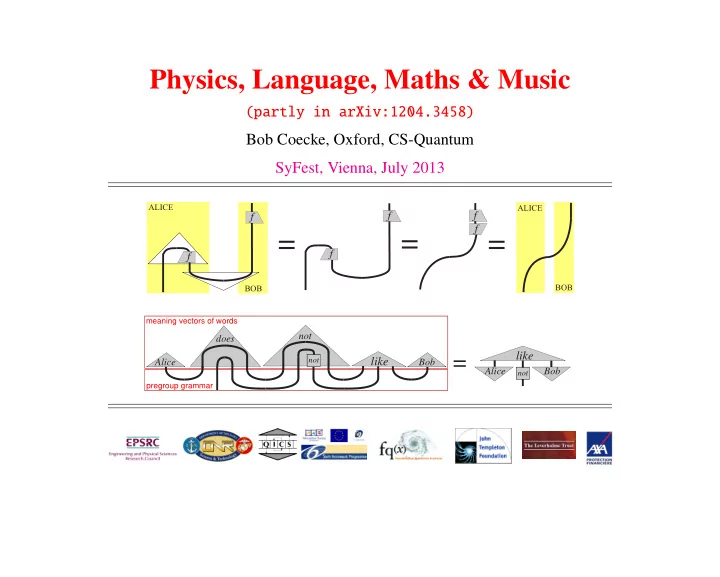
Physics, Language, Maths & Music (partly in arXiv:1204.3458) Bob Coecke, Oxford, CS-Quantum SyFest, Vienna, July 2013 ALICE ALICE f f f f = = = f f BOB BOB meaning vectors of words not does like not like = Alice Bob
Physics, Language, Maths & Music
(partly in arXiv:1204.3458) Bob Coecke, Oxford, CS-Quantum SyFest, Vienna, July 2013
=
f f
=
f f f
ALICE BOB=
ALICE BOBf
=
notlike
Bob Alice does Alice notlike
not Bob meaning vectors of words pregroup grammar. . . via (some sort of) Logic
(partly in arXiv:1204.3458) Bob Coecke, Oxford, CS-Quantum SyFest, Vienna, July 2013
=
f f
=
f f f
ALICE BOB=
ALICE BOBf
=
notlike
Bob Alice does Alice notlike
not Bob meaning vectors of words pregroup grammar— PHYSICS —
Samson Abramsky & BC (2004) A categorical semantics for quantum proto-
BC (2005) Kindergarten quantum mechanics. quant-ph/0510032
— genesis — [von Neumann 1932] Formalized quantum mechanics in “Mathematische Grundlagen der Quantenmechanik”
— genesis — [von Neumann 1932] Formalized quantum mechanics in “Mathematische Grundlagen der Quantenmechanik” [von Neumann to Birkhoff 1935] “I would like to make a confession which may seem immoral: I do not believe absolutely in Hilbert space no more.” (sic)
— genesis — [von Neumann 1932] Formalized quantum mechanics in “Mathematische Grundlagen der Quantenmechanik” [von Neumann to Birkhoff 1935] “I would like to make a confession which may seem immoral: I do not believe absolutely in Hilbert space no more.” (sic) [Birkhoff and von Neumann 1936] The Logic of Quan- tum Mechanics in Annals of Mathematics.
— genesis — [von Neumann 1932] Formalized quantum mechanics in “Mathematische Grundlagen der Quantenmechanik” [von Neumann to Birkhoff 1935] “I would like to make a confession which may seem immoral: I do not believe absolutely in Hilbert space no more.” (sic) [Birkhoff and von Neumann 1936] The Logic of Quan- tum Mechanics in Annals of Mathematics. [1936 – 2000] many followed them, ... and FAILED.
— the mathematics of it —
— the mathematics of it — Hilbert space stuff: continuum, field structure of com- plex numbers, vector space over it, inner-product, etc.
— the mathematics of it — Hilbert space stuff: continuum, field structure of com- plex numbers, vector space over it, inner-product, etc. WHY?
— the mathematics of it — Hilbert space stuff: continuum, field structure of com- plex numbers, vector space over it, inner-product, etc. WHY? von Neumann: only used it since it was ‘available’.
— the physics of it —
— the physics of it — von Neumann crafted Birkhoff-von Neumann Quan- tum ‘Logic’ to capture the concept of superposition.
— the physics of it — von Neumann crafted Birkhoff-von Neumann Quan- tum ‘Logic’ to capture the concept of superposition. Schr¨
quantum theory is how quantum systems compose.
— the physics of it — von Neumann crafted Birkhoff-von Neumann Quan- tum ‘Logic’ to capture the concept of superposition. Schr¨
quantum theory is how quantum systems compose. Quantum Computer Scientists: Schr¨
— the game plan —
— the game plan — Task 0. Solve: tensor product structure the other stuff = ???
— the game plan — Task 0. Solve: tensor product structure the other stuff = ??? i.e. axiomatize “⊗” without reference to spaces.
— the game plan — Task 0. Solve: tensor product structure the other stuff = ??? i.e. axiomatize “⊗” without reference to spaces. Task 1. Investigate which assumptions (i.e. which struc- ture) on ⊗ is needed to deduce physical phenomena.
— the game plan — Task 0. Solve: tensor product structure the other stuff = ??? i.e. axiomatize “⊗” without reference to spaces. Task 1. Investigate which assumptions (i.e. which struc- ture) on ⊗ is needed to deduce physical phenomena. Task 2. Investigate wether such an “interaction struc- ture” appear elsewhere in “our classical reality”.
— wire and box language —
f
input wire(s) input wire(s)
Box Box = :
Interpretation: wire := system ; box := process
— wire and box language —
f
input wire(s) input wire(s)
Box Box = :
Interpretation: wire := system ; box := process
n subsystems: no system:
— wire and box games — sequential or causal or connected composition:
g ◦ f ≡
g f
parallel or acausal or disconnected composition:
f ⊗ g ≡
f f g
— merely a new notation? —
(g ◦ f) ⊗ (k ◦ h) = (g ⊗ k) ◦ ( f ⊗ h)
f h g k f h g k
— quantitative metric —
f : A → B
f A B
— quantitative metric —
f †: B → A
f B A
— asserting (pure) entanglement — quantum classical =
⇒ introduce ‘parallel wire’ between systems: subject to: only topology matters!
— quantum-like — E.g.
Transpose:
f f
Conjugate:
f f
classical data flow? f
f f f
classical data flow? f
f
classical data flow? f
f
classical data flow? f
ALICE BOB
ALICE BOB
f
⇒ quantum teleportation
— symbolically: dagger compact categories —
tional statement between expressions in dagger com- pact categorical language holds if and only if it is derivable in the graphical notation via homotopy.
An equational statement between expressions in dag- ger compact categorical language holds if and only if it is derivable in the dagger compact category of fi- nite dimensional Hilbert spaces, linear maps, tensor product and adjoints.
— LANGUAGE—
BC, Mehrnoosh Sadrzadeh & Stephen Clark (2010) Mathematical foundations for a compositional distributional model of meaning. arXiv:1003.4394
— the logic of it — WHAT IS “LOGIC”?
— the logic of it — WHAT IS “LOGIC”? Pragmatic option 1: Logic is structure in language.
“Alice and Bob ate everything or nothing, then got sick.” connectives (∧, ∨) : and, or negation (¬) : not (cf. nothing = not something) entailment (⇒) : then quantifiers (∀, ∃) : every(thing), some(thing) constants (a, b) : thing variable (x) : Alice, Bob predicates (P(x), R(x, y)) : eating, getting sick truth valuation (0, 1) : true, false
(∀z : Eat(a, z) ∧ Eat(b, z)) ∧ ¬(∃z : Eat(a, z) ∧ Eat(b, z)) ⇒ S ick(a), S ick(b)
— the logic of it — WHAT IS “LOGIC”? Pragmatic option 1: Logic is structure in language. Pragmatic option 2: Logic lets machines reason.
— the logic of it — WHAT IS “LOGIC”? Pragmatic option 1: Logic is structure in language. Pragmatic option 2: Logic lets machines reason. E.g. automated theory exploration, ...
— the logic of it — WHAT IS “LOGIC”? Pragmatic option 1: Logic is structure in language. Pragmatic option 2: Logic lets machines reason. Our framework appeals to both senses of logic, and moreover induces important new applications: From truth to meaning in natural language processing:
— (December 2010)
Automated theorem generation for graphical theories:
—
http://sites.google.com/site/quantomatic/
— the from-words-to-a-sentence process — Consider meanings of words, e.g. as vectors (cf. Google):
word 1 word 2 word n
— the from-words-to-a-sentence process — What is the meaning the sentence made up of these?
word 1 word 2 word n
— the from-words-to-a-sentence process — I.e. how do we/machines produce meanings of sentences?
word 1 word 2 word n
— the from-words-to-a-sentence process — I.e. how do we/machines produce meanings of sentences?
word 1 word 2 word n
— the from-words-to-a-sentence process — Information flow within a verb:
verb
subject subject
— the from-words-to-a-sentence process — Information flow within a verb:
verb
subject subject
Again we have:
— pregoup grammar — Lambek’s residuated monoids (1950’s): b ≤ a ⊸ c ⇔ a · b ≤ c ⇔ a ≤ c b
a · (a ⊸ c) ≤ c ≤ a ⊸ (a · c) (c b) · b ≤ c ≤ (c · b) b
— pregoup grammar — Lambek’s residuated monoids (1950’s): b ≤ a ⊸ c ⇔ a · b ≤ c ⇔ a ≤ c b
a · (a ⊸ c) ≤ c ≤ a ⊸ (a · c) (c b) · b ≤ c ≤ (c · b) b Lambek’s pregroups (2000’s): a · ∗a ≤ 1 ≤ ∗a · a b∗ · b ≤ 1 ≤ b · b∗
— pregoup grammar — Lambek’s residuated monoids (1950’s): b ≤ a ⊸ c ⇔ a · b ≤ c ⇔ a ≤ c b
a · (a ⊸ c) ≤ c ≤ a ⊸ (a · c) (c b) · b ≤ c ≤ (c · b) b Lambek’s pregroups (2000’s): a · −1a ≤ 1 ≤ −1a · a b−1 · b ≤ 1 ≤ b · b−1
— pregoup grammar — A A A A A A A A
=
A A A A
=
A A A A
=
A A A A
=
A A A A
— pregoup grammar — For noun type n, verb type is −1n · s · n−1, so:
n · −1n · s · n−1 · n ≤ 1 · s · 1 ≤ s
— pregoup grammar — For noun type n, verb type is −1n · s · n−1, so:
n · −1n · s · n−1 · n ≤ 1 · s · 1 ≤ s
— pregoup grammar — For noun type n, verb type is −1n · s · n−1, so:
n · −1n · s · n−1 · n ≤ 1 · s · 1 ≤ s
— pregoup grammar — For noun type n, verb type is −1n · s · n−1, so:
n · −1n · s · n−1 · n ≤ 1 · s · 1 ≤ s
Diagrammatic type reduction:
n n s n n
— pregoup grammar — For noun type n, verb type is −1n · s · n−1, so:
n · −1n · s · n−1 · n ≤ 1 · s · 1 ≤ s
Diagrammatic meaning:
verb n n
flow flow flow flow
— algorithm for meaning of sentences —
(word type 1) . . . (word type n) sentence type
— algorithm for meaning of sentences —
(word type 1) . . . (word type n) sentence type
f :: →
ii| ⊗ id ⊗
ii|
— algorithm for meaning of sentences —
(word type 1) . . . (word type n) sentence type
f :: →
ii| ⊗ id ⊗
ii|
f − → v 1 ⊗ . . . ⊗ − → v n
— − − − − → Alice ⊗ − − − → does ⊗ − − → not ⊗ − − → like ⊗ − − → Bob —
Alice
not
like
Bob
meaning vectors of words
not
grammar
does
— − − − − → Alice ⊗ − − − → does ⊗ − − → not ⊗ − − → like ⊗ − − → Bob —
Alice
like
Bob
meaning vectors of words grammar not
— − − − − → Alice ⊗ − − − → does ⊗ − − → not ⊗ − − → like ⊗ − − → Bob —
Alice
like
Bob
meaning vectors of words grammar not
— − − − − → Alice ⊗ − − − → does ⊗ − − → not ⊗ − − → like ⊗ − − → Bob —
Alice
like
Bob
meaning vectors of words grammar not
=
not
like
Bob Alice
— − − − − → Alice ⊗ − − − → does ⊗ − − → not ⊗ − − → like ⊗ − − → Bob —
Alice
like
Bob
meaning vectors of words grammar not
=
not
like
Bob Alice
=
not
like
Bob Alice
Using:
=
like like
=
like like
— experiment: word disambiguation — E.g. what is “saw”’ in: “Alice saw Bob with a saw”.
Edward Grefenstette & Mehrnoosh Sadrzadeh (2011) Experimental support for a categorical compositional distributional model of meaning. Accepted for: Empirical Methods in Natural Language Processing (EMNLP’11).
— Frobenius algebras —
— Frobenius algebras — ‘spiders’ =
m
....
such that, for k > 0:
m+m′−k
.... .... .... ....
= .... ....
BC & Dusko Pavlovic (2007) Quantum measurement without sums. In: Math- ematics of Quantum Computing and Technology. quant-ph/0608035 BC, Dusko Pavlovic & Jamie Vicary (2008) A new description of orthogonal
— Frobenius algebras — ‘spiders’ =
m
....
such that, for k > 0:
m+m′−k
.... .... .... ....
= .... ....
BC & Dusko Pavlovic (2007) Quantum measurement without sums. In: Math- ematics of Quantum Computing and Technology. quant-ph/0608035 BC, Dusko Pavlovic & Jamie Vicary (2008) A new description of orthogonal
— Frobenius algebras — Language-meaning: Bob = (the) man who Alice hates = Bob
Stephen Clark, BC and Mehrnoosh Sadrzadeh (2013) The Frobenius Anatomy
— Frobenius algebras — Language-meaning: Bob = (the) man who Alice hates = Bob
Stephen Clark, BC and Mehrnoosh Sadrzadeh (2013) The Frobenius Anatomy
— Frobenius algebras — Language-meaning: Bob = (the) man who Alice hates = Bob
Stephen Clark, BC and Mehrnoosh Sadrzadeh (2013) The Frobenius Anatomy
— MATHS —
— MATHS —
“Topological” QFT (Atiyah ’88): F :: → f : V ⊗ V → V
— MATHS —
“Topological” QFT (Atiyah ’88): F :: → f : V ⊗ V → V “Grammatical” QFT: F :: →
ii| ⊗id⊗
ii|
— MUSIC —
— MUSIC —