BIG BANG: beginning of Time Early times in the Universe were really - - PowerPoint PPT Presentation

big bang beginning of time
SMART_READER_LITE
LIVE PREVIEW

BIG BANG: beginning of Time Early times in the Universe were really - - PowerPoint PPT Presentation

ASTR 1120 OUR Universe: General Astronomy: Accelerating Universe REVIEW Stars & Galaxies Dark Energy is causing the FINAL: Saturday, Dec 12th, 7:30pm, HERE expansion of ALTERNATE FINAL : Monday, Dec 7th, 5:30pm the universe


slide-1
SLIDE 1

ASTR 1120 General Astronomy: Stars & Galaxies

  • FINAL: Saturday, Dec 12th, 7:30pm, HERE
  • ALTERNATE FINAL: Monday, Dec 7th, 5:30pm

in Muenzinger E131

  • Last OBSERVING session, Tue, Dec.8th, 7pm
  • Please check your grade on clickers, midterms,

HWs on CU learn - e-mail Thomas if you see discrepancies/missing grades

  • Homework #9 due TODAY, by 5pm

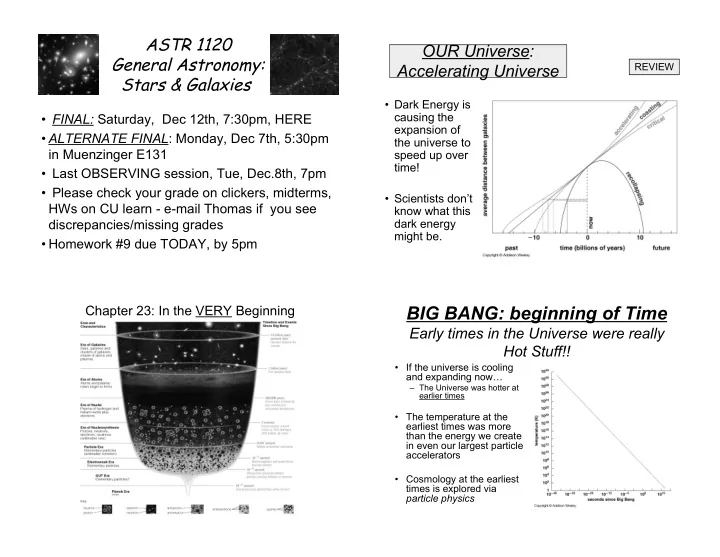
OUR Universe: Accelerating Universe

  • Dark Energy is

causing the expansion of the universe to speed up over time!

  • Scientists don’t

know what this dark energy might be.

REVIEW

Chapter 23: In the VERY Beginning

BIG BANG: beginning of Time

Early times in the Universe were really Hot Stuff!!

  • If the universe is cooling

and expanding now…

– The Universe was hotter at earlier times

  • The temperature at the

earliest times was more than the energy we create in even our largest particle accelerators

  • Cosmology at the earliest

times is explored via particle physics

slide-2
SLIDE 2

Photons converted into particle-antiparticle pairs and vice-versa (Matter and Energy are the same!!)

E = mc2

Early universe was full

  • f particles and

radiation because of its high temperature

Matter, Antimatter, and Energy

Planck Era 0 - 10-43 sec Before Planck time =???

  • Things were

so small and so dense… modern physics fails

–No theory

  • f quantum

gravity

  • Gravity
  • Electromagnetism
  • Strong Force
  • Weak Force

The Four Known Forces in the Universe

Four known forces in the universe:

  • Gravity
  • Electromagnetism
  • Strong Force
  • Weak Force

Do forces unify at high temperatures?

slide-3
SLIDE 3

Four known forces in the universe:

  • Gravity
  • Electromagnetism
  • Strong Force
  • Weak Force

Yes! (Electroweak)

Do forces unify at high temperatures?

Four known forces in the universe:

  • Gravity
  • Electromagnetism
  • Strong Force
  • Weak Force

Yes! (Electroweak) Maybe (Grand Unified Theories)

Do forces unify at high temperatures?

Four known forces in the universe:

  • Gravity
  • Electromagnetism
  • Strong Force
  • Weak Force

Yes! (Electroweak) Maybe (GUT) Who knows? (String Theory)

Do forces unify at high temperatures?

GUT Era ~10-43-10-38 sec Lasts from Planck time to end of GUT force

slide-4
SLIDE 4

Inflation of the Universe

  • As strong force

becomes distinct (end

  • f GUT era), a huge

amount of energy is released

  • Universe INFLATES:

– Universe of atomic nucleus size becomes solar system size in 10-36 sec

Electroweak Era ~10-38-10-10 sec

Lasts from end of GUT force to end

  • f electroweak

force

  • Universe still

made up of elementary particles (quarks)

Particle Era (10-10-.001 sec)

Finally temperatures low enough that quarks can combine to form subatomic particles (protons, antiprotons, neutrons, antineutrons, etc…)

The Particle Era

  • Universe still hot: 1015 to

1012 K

  • Particles now exist:

electrons, protons, anti- protons, anti-electrons, neutrinos etc.

  • Particle soup! Particles

and photons/energy created and annihilated

slide-5
SLIDE 5

At the end of the particle era, temperatures are low enough that photons cannot collide to create matter/anti-matter anymore. Nearly all the matter and antimatter that is in the universe at that time collides and forms photons. But a little bit of some type of matter remains… which type is it?

  • A. Regular matter
  • B. Anti-matter
  • C. There’s no way we

can tell!

Clicker Question

At the end of the particle era, temperatures are low enough that photons cannot collide to create matter/anti-matter anymore. Nearly all the matter and antimatter that is in the universe at that time collides and forms photons. But a little bit of some type of matter remains… which type is it?

  • A. Regular matter
  • B. Anti-matter
  • C. There’s no way we

can tell!

Clicker Question

Matter and Anti-matter

  • At end of particle era,

universe contains matter!

  • Protons must have

slightly outnumbered anti- protons

  • Universe ratio today:

– 1 billion photons (light) for every 1 proton (matter)

  • Universe ratio then:

– 1 billion and 1 protons for every 1 billion anti-protons

Era of Nucleo- synthesis 0.001 sec-3 min

Begins when matter annihilates remaining antimatter

slide-6
SLIDE 6

Era of Nucleosynthesis (Fusion)

  • Matter particles are

“frozen out”

– no longer spontaneously generated to/from photons

  • Temperatures hot

enough to fuse protons (hydrogen nuclei) into helium nuclei

Nucleosynthesis stops after about 3 minutes

  • Fusion ends because density drops

– remember the universe has been expanding this whole time – Matter left as ~75% hydrogen, ~25% helium, with trace amounts of lithium, deuterium

  • Amounts seen throughout the universe today

(with slight enhancements of heavy elements from fusion in stars) Era of Nuclei 3 min - 380,000 yrs

  • Most matter was

in the shape of hydrogen/helium nuclei, electrons

  • Universe has

become too cool to blast helium apart but too hot to allow electrons to combine with nuclei to make atoms

The era of nuclei created a lot of light but it couldn’t get anywhere!!

  • Density was so

high, photons would hit an electron or nuclei before getting anywhere

– Just like the random walk inside the Sun!

slide-7
SLIDE 7

380,000 years to 1 billion years

  • Finally, the

temperature drops to about 3000 K and electrons all combine with nuclei to form the first atoms Era of Atoms

Era of Atoms

  • Finally cool enough

(3000 K) for electrons combine with nuclei to form atoms (380,000 yrs)

  • Photons now

“decoupled” = free to fly away

  • Universe becomes

transparent to light

Era of Galaxies 1 billion years - now

Era of Galaxies

  • About 1 billion years after Big Bang, first stars

and galaxies start to form

  • We live in the Era of Galaxies now.
slide-8
SLIDE 8

Big Bang evidence

Penzias & Wilson in 1965 discovered Cosmic Microwave Background (CMB) radiation

  • -> 2.73 K “black body”

Photons created when hot universe was only 380,000 yrs

  • ld – as first atoms formed

Very uniform radiation from everywhere – 1 part in 100,000 severely redshifted by expansion of universe WMAP

1978 Nobel Prize

Spectrum of Cosmic Microwave Background (CMB)

2.73 K `black body’

Light from beginning of time

  • This faint light looks light a solid glowing wall
  • Thermal spectrum at 3000 K, if redshifted by factor

~1000 microwaves!

  • Helps measure degree of isotropy in early

Universe

slide-9
SLIDE 9

Chemical abundances also confirm the Big Bang model

  • Big Bang Theory

prediction: 7-1 proton-to-neutron ratio

– Should lead to 75% H, 25% He (by mass)

  • Matches
  • bservations of

nearly primordial gas

Which of these abundance patterns (by mass) is an unrealistic chemical composition for a star?

  • A. 70% H, 28% He, 2% other
  • B. 95% H, 5% He, less than 0.02% other
  • C. 75% H, 25% He, less than 0.02% other
  • D. 72% H, 27% He, 1% other

Clicker Question

Which of these abundance patterns (by mass) is an unrealistic chemical composition for a star?

  • A. 70% H, 28% He, 2% other
  • B. 95% H, 5% He, less than 0.02% other
  • C. 75% H, 25% He, less than 0.02% other
  • D. 72% H, 27% He, 1% other

Clicker Question

Which of the following is not an evidence supporting the Big Bang theory?

  • A. Cosmic microwave radiation
  • B. The Hubble expansion of the universe
  • C. Helium is 25% of all matter
  • D. Gamma ray bursts

Clicker Question

slide-10
SLIDE 10

Which of the following is not an evidence supporting the Big Bang theory?

  • A. Cosmic microwave radiation
  • B. The Hubble expansion of the universe
  • C. Helium is 25% of all matter
  • D. Gamma ray bursts

Clicker Question