SLIDE 1
Chapter 23 The Beginning of Time
SLIDE 2 23.1 The Big Bang
- Our goals for learning
- What were conditions like in the early
universe?
- What is the history of the universe
according to the Big Bang theory?
SLIDE 3
What were conditions like in the early universe?
SLIDE 4
Universe must have been much hotter and denser early in time
SLIDE 5
The early universe must have been extremely hot and dense
SLIDE 6
Photons converted into particle-antiparticle pairs and vice-versa
E = mc2
Early universe was full of particles and radiation because of its high temperature
SLIDE 7
What is the history of the universe according to the Big Bang theory?
SLIDE 8
SLIDE 9
Planck Era Before Planck time (~10-43 sec) No theory of quantum gravity
SLIDE 10
Four known forces in universe: Strong Force Electromagnetism Weak Force Gravity
SLIDE 11
Four known forces in universe: Strong Force Electromagnetism Weak Force Gravity Do forces unify at high temperatures?
SLIDE 12
Four known forces in universe: Strong Force Electromagnetism Weak Force Gravity Do forces unify at high temperatures? Yes! (Electroweak)
SLIDE 13
Four known forces in universe: Strong Force Electromagnetism Weak Force Gravity Do forces unify at high temperatures? Yes! (Electroweak) Maybe (GUT)
SLIDE 14
Four known forces in universe: Strong Force Electromagnetism Weak Force Gravity Do forces unify at high temperatures? Yes! (Electroweak) Maybe (GUT) Who knows? (String Theory)
SLIDE 15
GUT Era Lasts from Planck time (~10-43 sec) to end of GUT force (~10-38 sec)
SLIDE 16 Electroweak Era Lasts from end
(~10-38 sec) to end of electroweak force (~10-10 sec)
SLIDE 17
Particle Era Amounts of matter and antimatter nearly equal (Roughly 1 extra proton for every 109 proton- antiproton pairs!)
SLIDE 18
Era of Nucleo- synthesis Begins when matter annihilates remaining antimatter at ~ 0.001 sec Nuclei begin to fuse
SLIDE 19
Era of Nuclei Helium nuclei form at age ~ 3 minutes Universe has become too cool to blast helium apart
SLIDE 20
Era of Atoms Atoms form at age ~ 380,000 years Background radiation released
SLIDE 21
Era of Galaxies Galaxies form at age ~ 1 billion years
SLIDE 22
Primary Evidence
1) We have detected the leftover radiation from the Big Bang. 2) The Big Bang theory correctly predicts the abundance of helium and other light elements.
SLIDE 23 What have we learned?
- What were conditions like in the early
universe?
– The early universe was so hot and so dense that radiation was constantly producing particle-antiparticle pairs and vice versa
- What is the history of the universe
according to the Big Bang theory?
– As the universe cooled, particle production stopped, leaving matter instead of antimatter – Fusion turned remaining neutrons into helium – Radiation traveled freely after formation of atoms
SLIDE 24 23.2 Evidence for the Big Bang
- Our goals for learning
- How do we observe the radiation left over
from the Big Bang?
- How do the abundances of elements support
the Big Bang theory?
SLIDE 25
How do we observe the radiation left over from the Big Bang?
SLIDE 26 The cosmic microwave background – the radiation left
Big Bang – was detected by Penzias & Wilson in 1965
SLIDE 27
Background radiation from Big Bang has been freely streaming across universe since atoms formed at temperature ~ 3,000 K: visible/IR
SLIDE 28
Expansion of universe has redshifted thermal radiation from that time to ~1000 times longer wavelength: microwaves Background has perfect thermal radiation spectrum at temperature 2.73 K
SLIDE 29
CLICK TO PLAY MOVIE
SLIDE 30
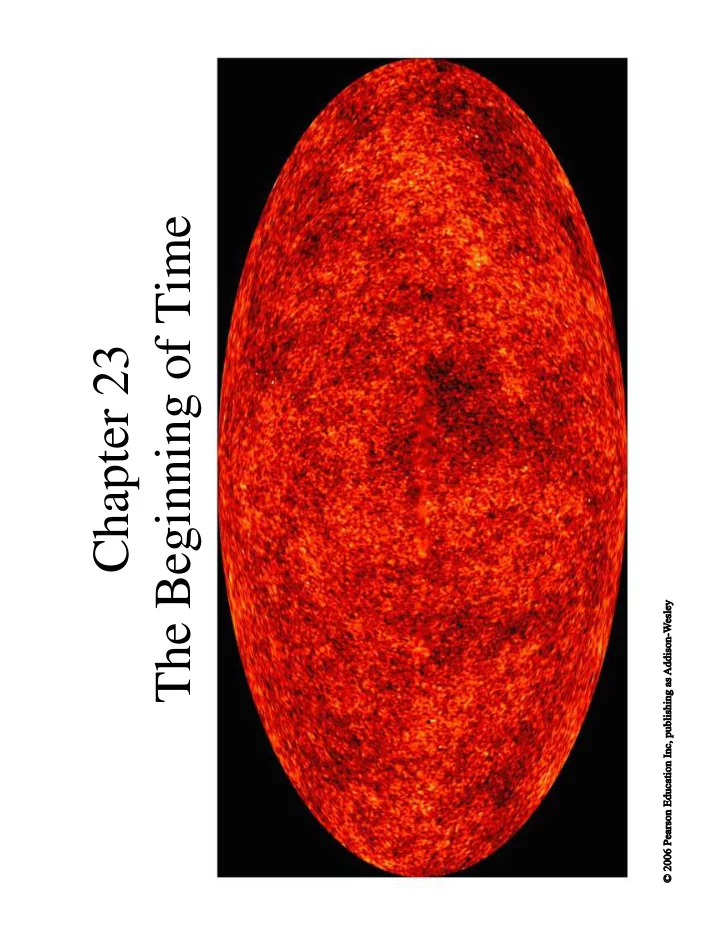
WMAP gives us detailed baby pictures of structure in the universe
SLIDE 31
How do the abundances of elements support the Big Bang theory?
SLIDE 32
Protons and neutrons combined to make long-lasting helium nuclei when universe was ~ 3 minutes old
SLIDE 33
Big Bang theory prediction: 75% H, 25% He (by mass) Matches observations of nearly primordial gases
SLIDE 34 Abundances of
elements agree with Big Bang model having 4.4% normal matter – more evidence for WIMPS!
SLIDE 35 What have we learned?
- How do we observe the radiation left over
from the Big Bang?
– Radiation left over from the Big Bang is now in the form of microwaves—the cosmic microwave background—which we can
- bserve with a radio telescope.
- How do the abundances of elements
support the Big Bang theory?
– Observations of helium and other light elements agree with the predictions for fusion in the Big Bang theory
SLIDE 36 23.3 Inflation
- Our goals for learning
- What aspects of the universe were
- riginally unexplained with the Big Bang
theory?
- How does inflation explain these features?
- How can we test the idea of inflation?
SLIDE 37
What aspects of the universe were originally unexplained with the Big Bang theory?
SLIDE 38
Mysteries Needing Explanation
1) Where does structure come from? 2) Why is the overall distribution of matter so uniform? 3) Why is the density of the universe so close to the critical density?
SLIDE 39
Mysteries Needing Explanation
1) Where does structure come from? 2) Why is the overall distribution of matter so uniform? 3) Why is the density of the universe so close to the critical density? An early episode of rapid inflation can solve all three mysteries!
SLIDE 40
How does inflation explain these features?
SLIDE 41
Inflation can make all the structure by stretching tiny quantum ripples to enormous size These ripples in density then become the seeds for all structures
SLIDE 42 How can microwave temperature be nearly identical on
- pposite sides of the sky?
SLIDE 43
Regions now on opposite sides of the sky were close together before inflation pushed them far apart
SLIDE 44 Overall geometry of the universe is closely related to total density
energy
Density = Critical Density > Critical Density < Critical
SLIDE 45 Inflation of universe flattens
geometry like the inflation of a balloon, causing
- verall density
- f matter plus
energy to be very close to critical density
SLIDE 46
How can we test the idea of inflation?
SLIDE 47
Patterns of structure observed by WMAP show us the “seeds” of universe
SLIDE 48
Observed patterns of structure in universe agree (so far) with the “seeds” that inflation would produce
SLIDE 49 “Seeds” Inferred from CMB
– Total mass+energy has critical density
- Ordinary matter ~ 4.4% of total
- Total matter is ~ 27% of total
– Dark matter is ~ 23% of total – Dark energy is ~ 73% of total
- Age of 13.7 billion years
SLIDE 50 “Seeds” Inferred from CMB
– Total mass+energy has critical density
- Ordinary matter ~ 4.4% of total
- Total matter is ~ 27% of total
– Dark matter is ~ 23% of total – Dark energy is ~ 73% of total
- Age of 13.7 billion years
In excellent agreement with observations of present-day universe and models involving inflation and WIMPs!
SLIDE 51 What have we learned?
- What aspects of the universe were originally
unexplained with the Big Bang theory?
– The origin of structure, the smoothness of the universe on large scales, the nearly critical density of the universe
- How does inflation explain these features?
– Structure comes from inflated quantum ripples – Observable universe became smooth before inflation, when it was very tiny – Inflation flattened the curvature of space, bringing expansion rate into balance with the
- verall density of mass-energy
SLIDE 52 What have we learned?
- How can we test the idea of inflation?
– We can compare the structures we see in detailed observations of the microwave background with predictions for the “seeds” that should have been planted by inflation – So far, our observations of the universe agree well with models in which inflation planted the “seeds”
SLIDE 53 23.4 Observing the Big Bang for Yourself
- Our goals for learning
- Why is the darkness of the night sky
evidence for the Big Bang?
SLIDE 54
Why is the darkness of the night sky evidence for the Big Bang?
SLIDE 55
Olbers’ Paradox If universe were 1) infinite 2) unchanging 3) everywhere the same Then, stars would cover the night sky
SLIDE 56
Olbers’ Paradox If universe were 1) infinite 2) unchanging 3) everywhere the same Then, stars would cover the night sky
SLIDE 57 Night sky is dark because the universe changes with time As we look
we can look back to a time when there were no stars
SLIDE 58 Night sky is dark because the universe changes with time As we look
we can look back to a time when there were no stars
SLIDE 59 What have we learned?
- Why is the darkness of the night sky
evidence for the Big Bang?
– If the universe were eternal, unchanging, and everywhere the same, the entire night sky would be covered with stars – The night sky is dark because we can see back to a time when there were no stars