Beyond Audio & Video Beyond Audio & Video Beyond Audio - - PowerPoint PPT Presentation

beyond audio video beyond audio video beyond audio video
SMART_READER_LITE
LIVE PREVIEW

Beyond Audio & Video Beyond Audio & Video Beyond Audio - - PowerPoint PPT Presentation

University of North Carolina at University of North Carolina at University of North Carolina at Multimedia Networking Multimedia Networking Chapel Hill Beyond Audio and Video Beyond Audio and Video Chapel Hill Chapel Hill Support for


slide-1
SLIDE 1

1 1

Kevin Jeffay Thomas Hudson Mark Parris Kevin Kevin Jeffay Jeffay Thomas Hudson Thomas Hudson Mark Parris Mark Parris

Beyond Audio & Video

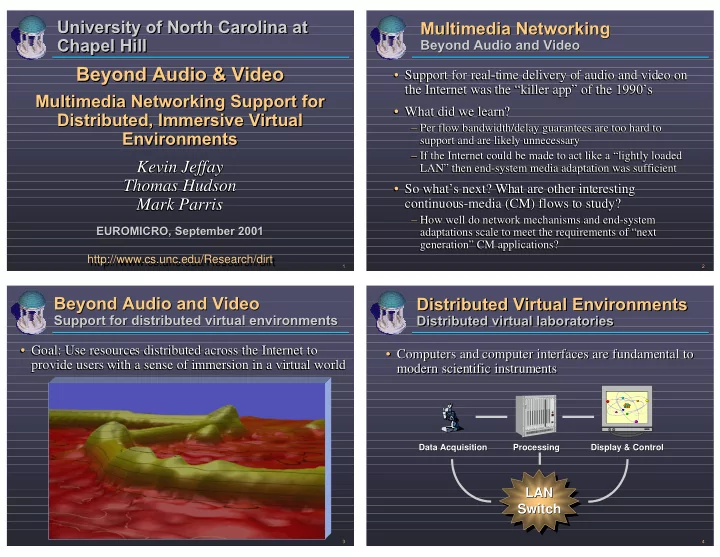
Multimedia Networking Support for Distributed, Immersive Virtual Environments

Beyond Audio & Video Beyond Audio & Video

Multimedia Networking Support for Multimedia Networking Support for Distributed, Distributed, Immersive Immersive Virtual Virtual Environments Environments University of North Carolina at Chapel Hill University of North Carolina at University of North Carolina at Chapel Hill Chapel Hill

http://www.cs.unc.edu/Research/dirt http://www.cs.unc.edu/Research/dirt EUROMICRO, September 2001 EUROMICRO, September 2001

2 2

Multimedia Networking Multimedia Networking

Beyond Audio and Video Beyond Audio and Video

  • Support for real-time delivery of audio and video on

the Internet was the “killer app” of the 1990’s

  • What did we learn?

– Per flow bandwidth/delay guarantees are too hard to support and are likely unnecessary – If the Internet could be made to act like a “lightly loaded LAN” then end-system media adaptation was sufficient

  • Support for real-time delivery of audio and video on

Support for real-time delivery of audio and video on the Internet was the “killer app” of the 1990’s the Internet was the “killer app” of the 1990’s

  • What did we learn?

What did we learn?

– – Per flow bandwidth/delay guarantees are too hard to Per flow bandwidth/delay guarantees are too hard to support and are likely unnecessary support and are likely unnecessary – – If the Internet could be made to act like a “lightly loaded If the Internet could be made to act like a “lightly loaded LAN” then end-system media adaptation was sufficient LAN” then end-system media adaptation was sufficient

  • So what’s next? What are other interesting

continuous-media (CM) flows to study?

– How well do network mechanisms and end-system adaptations scale to meet the requirements of “next generation” CM applications?

  • So what’s next? What are other interesting

So what’s next? What are other interesting continuous-media (CM) flows to study? continuous-media (CM) flows to study?

– – How well do network mechanisms and end-system How well do network mechanisms and end-system adaptations scale to meet the requirements of “next adaptations scale to meet the requirements of “next generation” CM applications? generation” CM applications?

3 3

Beyond Audio and Video Beyond Audio and Video

Support for distributed virtual environments Support for distributed virtual environments

  • Goal: Use resources distributed across the Internet to

provide users with a sense of immersion in a virtual world

  • Goal: Use resources distributed across the Internet to

Goal: Use resources distributed across the Internet to provide users with a sense of immersion in a virtual world provide users with a sense of immersion in a virtual world

4 4

Distributed Virtual Environments

Distributed virtual laboratories

Distributed Virtual Environments Distributed Virtual Environments

Distributed virtual laboratories Distributed virtual laboratories

  • Computers and computer interfaces are fundamental to

modern scientific instruments

  • Computers and computer interfaces are fundamental to

Computers and computer interfaces are fundamental to modern scientific instruments modern scientific instruments

Data Acquisition Data Acquisition Processing Processing Display & Control Display & Control

LAN Switch LAN LAN Switch Switch

slide-2
SLIDE 2

5 5

Distributed Virtual Environments Distributed Virtual Environments

The UNC The UNC nanoManipulator nanoManipulator system system

  • A virtual environment interface to a scan-probe microscope
  • Provides telepresence on sample surfaces scaled 1,000,000:1
  • A virtual environment interface to a scan-probe microscope

A virtual environment interface to a scan-probe microscope

  • Provides

Provides telepresence telepresence on sample surfaces scaled 1,000,000:1

  • n sample surfaces scaled 1,000,000:1

6 6

The UNC nanoManipulator

Atomic force microscopy simplified

The UNC The UNC nanoManipulator nanoManipulator

Atomic force microscopy simplified Atomic force microscopy simplified

Microscope Tip Microscope Microscope Tip Tip

Sample Surface Scanned Back & Forth Sample Surface Scanned Back & Forth Sample Surface Scanned Back & Forth

Mirror Mirror Mirror LASER LASER LASER LASER Detector LASER LASER Detector Detector Computer Computer Computer Display Display Display

7 7

Graphics Engine Graphics Engine & Host Processor & Host Processor

Distributed Virtual Environments

The nanoManipulator as a distributed system

Distributed Virtual Environments Distributed Virtual Environments

The The nanoManipulator nanoManipulator as a distributed system as a distributed system 800 kb/s 800 kb/s 800 kb/s 100 kb/s 100 kb/s 100 kb/s 1 - 1,000 Mb/s 1 - 1,000 Mb/s 1 - 1,000 Mb/s

PC-based PC-based Microscope Microscope Controller Controller PC-based PC-based PHANToM PHANToM Controller Controller Force Feedback Force Force Feedback Feedback Visual Feedback Visual Feedback Visual Feedback Atomic Force Microscope Atomic Atomic Force Force Microscope Microscope Internetwork I Internetwork

nternetwork

8 8

Distributed Virtual Environments Distributed Virtual Environments

Haptic Haptic displays: Feeling a surface displays: Feeling a surface

Microscope tip Microscope tip sample sample Force feedback stylus Force feedback stylus

User feels a series of approximating planes User feels a series of approximating planes

(At a 20 Hz update rate, surface appears smooth) (At a 20 Hz update rate, surface appears smooth)

slide-3
SLIDE 3

9 9

Supporting Supporting DVEs DVEs

The impact of Internet pathologies on The impact of Internet pathologies on nM nM flows flows

  • Packet delay, delay-jitter, and loss lead to “pops” and

“gaps” in audio playout

  • For haptics display, Internet pathologies lead to

incorrect surface shape

  • Packet delay, delay-jitter, and loss lead to “pops” and

Packet delay, delay-jitter, and loss lead to “pops” and “gaps” in audio “gaps” in audio playout playout

  • For

For haptics haptics display, Internet pathologies lead to display, Internet pathologies lead to incorrect surface shape incorrect surface shape

Actual Actual Surface Surface Desired Desired Representation Representation Representation Representation with delay with delay

10 10

Supporting Supporting DVEs DVEs

The impact of Internet pathologies on The impact of Internet pathologies on nM nM flows flows

  • Essential problems: Manage delay, delay-jitter, and loss

– The abstract requirements are the same as for interactive audio/video applications, just the constants change

  • Approach:

– Investigate the use end-system audio/video media adaptations for ameliorating the effects of delay-jitter and loss – Investigate the use of novel router active queue management mechanisms for realizing better-than-best-effort services (differentiated services) for DVE flows

  • Essential problems: Manage delay, delay-jitter, and loss

Essential problems: Manage delay, delay-jitter, and loss

– – The abstract requirements are the same as for interactive The abstract requirements are the same as for interactive audio/video applications, just the constants change audio/video applications, just the constants change

  • Approach:

Approach:

– – Investigate the use end-system audio/video media adaptations Investigate the use end-system audio/video media adaptations for ameliorating the effects of delay-jitter and loss for ameliorating the effects of delay-jitter and loss – – Investigate the use of novel router active queue management Investigate the use of novel router active queue management mechanisms for realizing better-than-best-effort services mechanisms for realizing better-than-best-effort services (differentiated services) for DVE flows (differentiated services) for DVE flows

11 11

Supporting Supporting DVEs DVEs

End-system media adaptation End-system media adaptation

  • To ameliorate the effects of loss we use a simple

FEC scheme [MMCN 01]

  • To ameliorate the effects of delay-jitter we use an

elastic display queue management scheme called queue monitoring (QM) [MMSJ ‘95]

  • To ameliorate the effects of loss we use a simple

To ameliorate the effects of loss we use a simple FEC scheme [MMCN 01] FEC scheme [MMCN 01]

  • To ameliorate the effects of delay-jitter we use an

To ameliorate the effects of delay-jitter we use an elastic display queue management scheme called elastic display queue management scheme called queue monitoring queue monitoring (QM) [MMSJ ‘95] (QM) [MMSJ ‘95]

Media receiver’s processing pipeline Media receiver’s processing pipeline

“Display Queue” Display Synchronization Display Application Processing OS Processing

Network Output Device

12 12

Delay-Jitter Adaptation Delay-Jitter Adaptation

Principles of display queue management Principles of display queue management

  • Discard late samples — Constant playout delay but high gap-rate
  • Discard late samples — Constant

Discard late samples — Constant playout playout delay but high gap-rate delay but high gap-rate

h b c d d e e f g Send Receive Playout 2p p 2p 3p Display Queue a b c d e f g h a

  • Enqueue all arriving samples — Variable playout delay but minimal

gap-rate

  • Enqueue

Enqueue all arriving samples — Variable all arriving samples — Variable playout playout delay but minimal delay but minimal gap-rate gap-rate

slide-4
SLIDE 4

13 13

Delay-Jitter Adaptation Delay-Jitter Adaptation

Principles of display queue management Principles of display queue management

Display Queue i j j k k l m l m n m n

  • n
  • p
  • p

q p q q r r s Send Receive Playout 3p k l m n

  • p

q r s h

  • If display queue length grows, network delay is decreasing
  • If queue length shrinks, network delay is increasing
  • If queue remains constant, network delay is stable
  • If display queue length grows, network delay is decreasing

If display queue length grows, network delay is decreasing

  • If queue length shrinks, network delay is increasing

If queue length shrinks, network delay is increasing

  • If queue remains constant, network delay is stable

If queue remains constant, network delay is stable

14 14

Delay-Jitter Adaptation Delay-Jitter Adaptation

Queue monitoring Queue monitoring

  • Define a threshold value and a decay rate dropping

queue elements in an effort to reduce latency

– If queue element k always contains a media sample for threshold x (decay x (n–k)) enqueues, then it is “safe” to drop the element in location k

  • Define a

Define a threshold value threshold value and a and a decay rate decay rate dropping dropping queue elements in an effort to reduce latency queue elements in an effort to reduce latency

– – If queue element If queue element k k always contains a media sample for always contains a media sample for threshold threshold x

x (

(decay decay x

x (

(n n– –k k)) )) enqueues enqueues, then it is “safe” to drop the element in location , then it is “safe” to drop the element in location k k Thresholds: 1 Thresholds: 1 3 3 7 7 15 30 15 30

Arrivals Arrivals Playout Playout

  • Drop quickly from long queues, drop slowly from short

queues

  • Drop quickly from long queues, drop slowly from short

Drop quickly from long queues, drop slowly from short queues queues

15 15

Delay-Jitter Adaptation Delay-Jitter Adaptation

Queue monitoring performance Queue monitoring performance

  • In a laboratory testbed simulating a small-scale

internetwork, queue monitoring is effective

  • For haptics data flow, queue monitoring results in

a gap-rate equal to the packet-loss rate

– At the cost of slightly increased latency

  • Remote operation of the nanoManipulator on the

East coast of the USA confirms these results

  • (See paper for details)
  • In a laboratory

In a laboratory testbed testbed simulating a small-scale simulating a small-scale internetwork internetwork, queue monitoring is effective , queue monitoring is effective

  • For

For haptics haptics data flow, queue monitoring results in data flow, queue monitoring results in a gap-rate equal to the packet-loss rate a gap-rate equal to the packet-loss rate

– – At the cost of slightly increased latency At the cost of slightly increased latency

  • Remote operation of the

Remote operation of the nanoManipulator nanoManipulator on the

  • n the

East coast of the USA confirms these results East coast of the USA confirms these results

  • (See paper for details)

(See paper for details)

16 16

Delay-Jitter Adaptation Delay-Jitter Adaptation

Queue monitoring performance Queue monitoring performance

  • For haptics data flow, queue monitoring results in a gap-

rate equal to the packet-loss rate

– At the cost of slightly increased latency

  • For

For haptics haptics data flow, queue monitoring results in a gap- data flow, queue monitoring results in a gap- rate equal to the packet-loss rate rate equal to the packet-loss rate

– – At the cost of slightly increased latency At the cost of slightly increased latency Protocol Protocol Loss Drop rate Gap rate Latency Loss Drop rate Gap rate Latency UDP UDP 9.7% 9.7% 11.7% 21.5% 11.7% 21.5% 89 89 ms ms QM (30, 2) QM (30, 2) 10% 10% 0.6% 0.6% 10.6% 10.6% 94 94 ms ms QM (150, 2) 9.7% QM (150, 2) 9.7% 0.02% 0.02% 9.7% 9.7% 96 96 ms ms QM (3600, 2) QM (3600, 2) 9.5% 9.5% 0.001% 9.5% 0.001% 9.5% 91 91 ms ms

slide-5
SLIDE 5

17 17

End System Media Adaptation End System Media Adaptation

What more is needed? What more is needed?

  • Queue monitoring (and other adaptations) can work

well but…

– They don’t scale well – They don’t address issues of fair bandwidth allocation between TCP and non-TCP flows

  • We are also investigating the use of router-based

mechanisms for realizing better-than-best-effort services

– (Within the context of the differentiated services architecture for the Internet)

  • Queue monitoring (and other adaptations) can work

Queue monitoring (and other adaptations) can work well but… well but…

– – They don’t scale well They don’t scale well – – They don’t address issues of fair bandwidth allocation They don’t address issues of fair bandwidth allocation between TCP and non-TCP flows between TCP and non-TCP flows

  • We are also investigating the use of router-based

We are also investigating the use of router-based mechanisms for realizing better-than-best-effort mechanisms for realizing better-than-best-effort services services

– – (Within the context of the (Within the context of the differentiated services differentiated services architecture for the Internet) architecture for the Internet)

18 18

Towards QoS Networking

The differentiated services architecture

Towards Towards QoS QoS Networking Networking

The The differentiated services differentiated services architecture architecture

  • ISPs allocate and sell capacity for a “premium” service
  • ISPs allocate and sell capacity for a “premium” service

ISPs allocate and sell capacity for a “premium” service Network Access Point Network Network Access Access Point Point

FCFS FCFS Scheduler Scheduler

ISP ISP

Router Router

ISP ISP

Router Router

19 19

ISP ISP

Router Router FCFS FCFS Scheduler Scheduler

Towards QoS Networking

The differentiated services architecture

Towards Towards QoS QoS Networking Networking

The The differentiated services differentiated services architecture architecture

  • ISPs allocate and sell capacity for a “premium” service
  • ISPs allocate and sell capacity for a “premium” service

ISPs allocate and sell capacity for a “premium” service Network Access Point Network Network Access Access Point Point

Profile Meter

Classifier Classifier

  • Packets are marked

according to “service profiles”

  • Packets are marked

Packets are marked according to “service according to “service profiles” profiles”

Priority Priority Scheduler Scheduler

ISP ISP

Router Router

20 20

ISP ISP

Router Router

Realizing Differentiated Services Realizing Differentiated Services

Active queue management Active queue management

  • This is significant utility in realizing differential services

with a single router queue

  • This is significant utility in realizing differential services

This is significant utility in realizing differential services with a single router queue with a single router queue

Profile Meter

– In this model, a key technology for realizing differential services is a packet dropping policy – – In this model, a key technology In this model, a key technology for realizing differential services for realizing differential services is a packet dropping policy is a packet dropping policy

FCFS FCFS Scheduler Scheduler Packet Packet Dropper Dropper

Network Access Point Network Network Access Access Point Point

ISP ISP

Router Router

slide-6
SLIDE 6

21 21

Realizing Differentiated Services

RED active queue management

Realizing Differentiated Services Realizing Differentiated Services

RED active queue management RED active queue management

  • Basic mechanism for realizing differentiated services is

the random early detection (RED ) congestion avoidance mechanism

  • Basic mechanism for realizing differentiated services is

Basic mechanism for realizing differentiated services is the the random early detection random early detection (RED ) congestion avoidance (RED ) congestion avoidance mechanism mechanism

Time Time

Max Max queue length queue length Forced drop Forced drop Min Min threshold threshold

Drop probability Drop probability

No drop No drop Max Max threshold threshold Probabilistic Probabilistic early drop early drop

Average router queue length Average router queue length

22 22

Realizing Differentiated Services

RED active queue management

Realizing Differentiated Services Realizing Differentiated Services

RED active queue management RED active queue management

  • Random drops avoid lock-out/synchronization effects

– All flows see the same loss rate

  • Early drops avoid full queues

– Increases effective network utilization (“goodput”) – Decreases end-to-end latency by decreasing queuing delay

  • Random drops avoid lock-out/synchronization effects

Random drops avoid lock-out/synchronization effects

– – All flows see the same loss rate All flows see the same loss rate

  • Early drops avoid full queues

Early drops avoid full queues

– – Increases effective network utilization (“ Increases effective network utilization (“goodput goodput”) ”) – – Decreases end-to-end latency by decreasing queuing delay Decreases end-to-end latency by decreasing queuing delay

Time Time

Max Max queue length queue length Forced drop Forced drop Min Min threshold threshold

Drop probability Drop probability

No drop No drop Max Max threshold threshold Probabilistic Probabilistic early drop early drop

Average router queue length Average router queue length

23 23

Realizing Realizing QoS QoS Through AQM Through AQM

“Class-based thresholds” “Class-based thresholds”

  • Designate a set of traffic classes and allocate a fraction of a

router’s buffer capacity to each class

  • Designate a set of traffic classes and allocate a fraction of a

Designate a set of traffic classes and allocate a fraction of a router’s buffer capacity to each class router’s buffer capacity to each class

Classifier Classifier

f fn

n

≤ ≤ f f1

1

≤ ≤ f f2

2

≤ ≤

... ...

FCFS FCFS Scheduler Scheduler

  • Once a class is occupying its (weighted average) limit of queue

elements, discard all arriving packets

  • Within a traffic class, further active queue management may be

performed

  • Once a class is occupying its (weighted average) limit of queue

Once a class is occupying its (weighted average) limit of queue elements, discard elements, discard all all arriving packets arriving packets

  • Within a traffic class, further active queue management may be

Within a traffic class, further active queue management may be performed performed

24 24

Active Queue Management Active Queue Management

CBT performance comparison CBT performance comparison

  • Reserving buffer capacity for multimedia (nano) flows

improves both TCP and multimedia performance

– At the cost of small router state complexity

  • Reserving buffer capacity for multimedia (

Reserving buffer capacity for multimedia (nano nano) flows ) flows improves both TCP and multimedia performance improves both TCP and multimedia performance

– – At the cost of small router state complexity At the cost of small router state complexity FIFO FIFO 32.4% 32.4% 63.2 63.2 ms ms 200 200 kbps kbps RED RED 30.0% 30.0% 26.2 26.2 ms ms 300 300 kbps kbps CBT CBT 1.3% 1.3% 28.4 28.4 ms ms 790 790 kbps kbps Queue Queue Management Management Scheme Scheme Drop Rate Drop Rate for Marked for Marked Flows Flows Latency for Latency for Marked Marked Flows Flows TCP TCP Throughput Throughput

slide-7
SLIDE 7

25 25

Beyond Audio and Video

Network support for immersive DVEs

Beyond Audio and Video Beyond Audio and Video

Network support for Network support for immersive DVEs immersive DVEs

  • Distributed virtual environments represent a significant

generalization of the traditional multimedia networking problem

  • We’re attempting to…

– Allow co-existence of selected non-congestion responsive UDP traffic and responsive TCP traffic through differentiated services – Apply audio/video end-system media adaptations to ameliorate remaining congestion effects

  • Conclusion: Mechanisms for supporting real-time audio

and video flows work well for immersive DVEs

  • Distributed virtual environments represent a significant

Distributed virtual environments represent a significant generalization of the traditional multimedia networking generalization of the traditional multimedia networking problem problem

  • We’re attempting to…

We’re attempting to…

– – Allow co-existence of selected non-congestion responsive Allow co-existence of selected non-congestion responsive UDP traffic and responsive TCP traffic through differentiated UDP traffic and responsive TCP traffic through differentiated services services – – Apply audio/video end-system media adaptations to Apply audio/video end-system media adaptations to ameliorate remaining congestion effects ameliorate remaining congestion effects

  • Conclusion: Mechanisms for supporting real-time audio

Conclusion: Mechanisms for supporting real-time audio and video flows work well for and video flows work well for immersive DVEs immersive DVEs

Summary Summary

26 26

Beyond Audio and Video Beyond Audio and Video

The The nanoManipulator nanoManipulator in detail in detail