
SLIDE 1
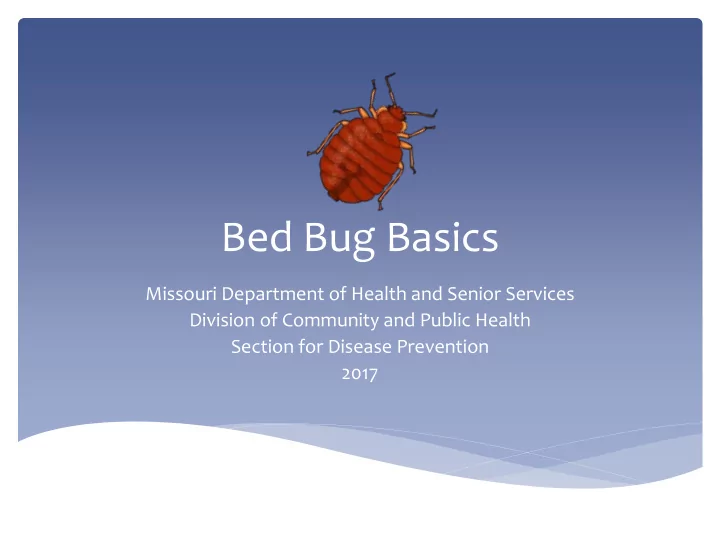
Bed Bug Basics
Missouri Department of Health and Senior Services Division of Community and Public Health Section for Disease Prevention 2017
Bed Bug Basics Missouri Department of Health and Senior Services - - PowerPoint PPT Presentation
Bed Bug Basics Missouri Department of Health and Senior Services Division of Community and Public Health Section for Disease Prevention 2017 Brief Bed Bug History Widespread problem before the 1950s New pesticides available, used widely
Missouri Department of Health and Senior Services Division of Community and Public Health Section for Disease Prevention 2017
∗ New pesticides available, used widely in the 50s, 60s, & 70s
∗ DDT was very effective for a few years, but later outlawed in the 70s
∗ Change in routine pest management practices ∗ More global travel ∗ Less knowledge/awareness of bed bugs
Reddit.com
∗ Small, wingless insects
∗ Range in size from a poppy seed to an apple seed ∗ Flat when unfed
∗ Experts at hiding and hitchhiking!
∗ Seek out cracks, crevices, folds when not feeding ∗ Can fit in a space as thin as a credit card
∗ Generally most active at night (home setting)
∗ Can be active during the day if blood meals are more readily available ∗ Adults can survive for long periods of time (i.e., months!) without a meal
Cuyahogabedbugs.org
∗ Feed exclusively on blood (usually from humans)
∗ Drawn to heat and carbon dioxide release
∗ Do not spread disease!
∗ Pathogens like HIV, Hep B can be infected but not transmit
∗ Can cause:
∗ Red, swollen bites secondary skin infections ∗ Anxiety, stress, fear ∗ Loss of sleep/insomnia
After hatching, bed bugs need to take a blood meal before they can molt and mature to the next stage. All stages are visible to the naked eye.
Nyulocal.com
University of Kentucky Bedbuganswer.com
∗ Dogs can be trained to detect the presence of bed bugs
∗ Bed bugs emit pheromones can be detected, even at low levels ∗ May be most useful in areas where bed bugs are unpredictable
∗ Movie theaters, auditoriums, large office buildings
∗ How successful is canine detection?*
∗ 11 human-canine teams were evaluated
∗ All claimed ≥95% accuracy for detection when promoting their “product”
∗ Actual success rates varied significantly (~43% on average)
∗ Training scenarios are controlled; vary from real-life situations
∗ More expensive, less successful in many cases than monitoring devices
*Cooper, R., Wang, C., & Narinderpal, S. (2014). Accuracy of Trained Canines for Detecting Bed Bugs (Hemiptera: Cimicidae). Journal of Economic Entomology, 107(6), 2171-2181.
∗ In small numbers, bed bugs can be very difficult to detect
∗ May be few signs, if any, in the beginning ∗ Not everyone reacts to bites, so this is also not a reliable sign
∗ Things to consider if you’ve been in an area with bed bugs:
∗ Use monitors in your home to help you detect them ∗ Declutter – eliminate hiding places for bed bugs ∗ Consult with a pest control professional
⊗ Panic ⊗ Ignore the problem ⊗ Throw out your furniture ⊗ Take chemical treatments into your own hands
Remain calm Maintain your routine Eliminate clutter Consult an expert to discuss treatment options
If it is confirmed that you have bed bugs: Anything that is removed from the home should be destroyed to prevent others from getting bed bugs!
∗ Vacuum
∗ Dusts or sprays ∗ Fumigation
∗ Kills all stages (including eggs)
www.mainebedbugsandpestcontrol.com
∗ Many companies have a checklist of items to be done prior to any treatment
∗ Multiple treatments/visits likely
Top Recommendation: Work with a Professional
∗ Address cracked flooring & walls, peeling wallpaper ∗ Seal around baseboards and moldings
∗ Pull away from wall, use interceptor monitors and encasements, keep blankets and bedding off the floor
“DIY” Steps
∗ Wash and then dry on high heat for 30 minutes ∗ Place items in sealable plastic bins or bags, keep closed!
∗ Not a cleanliness issue, but will help to identify hiding spots ∗ Focus on areas where bed bugs are most likely to hide. . .
“DIY” Steps
Illinois Department of Public Health
Likely Hiding Places
∗ Be cautious about DIY use of pesticides in the home
∗ Many over-the-counter products are not effective (e.g., “bug bombs”) ∗ Inexperience in technique or application can cause bugs to spread
∗ DIY treatments can interfere with professional treatments
∗ Overuse of pesticides can be dangerous
∗ Children, pets, immunocompromised family members
∗ Read product labels carefully and completely
∗ “All natural” or alternative treatments
∗ No evidence of efficacy, can be high risk
Pesticides & Precautions
∗ But, the problem is becoming more common
∗ Early detection is difficult ∗ Visual inspections likely to be unproductive ∗ Bed bugs can travel easily ∗ Identifying source is challenging
∗ No blame approach is best!
∗ Monitoring & identification ∗ Education/awareness ∗ Changes in environmental practices ∗ Use of various control tactics ∗ Evaluation of progress/outcomes
∗ Inspect thoroughly!!
∗ Safest to fold/sort in your home
∗ Do a quick inspection of any items they bring home!
Stay Bed Bug Aware!
When traveling:
∗ Keep luggage and other belongings away from walls, beds, and
∗ Ideal if these items can be kept on tile
∗ Check hotel rooms thoroughly for evidence of bed bugs
∗ Headboard, mattress, nightstands ∗ Couches, chairs, curtains
∗ Keep clothing/items in your suitcase
∗ Avoid drawers/closets ∗ Pack plastic bags for dirty laundry
Stay Bed Bug Aware!
When returning home:
∗ Before bringing your items inside, prepare a place to unpack!
∗ Lay out a clean sheet or piece of plastic first ∗ Unpack items onto the sheet or plastic and inspect for bed bugs
∗ Remove clothing from the luggage; place all items that can be dried immediately into the dryer
∗ Dry on high heat for 20-30 minutes kills all stages
∗ Inspect luggage carefully for signs of bed bugs
∗ Special attention on seams, pockets, zippers, and wheels/feet ∗ Vacuum all surfaces of the luggage (inside and out!) to dislodge any bed bugs or eggs ∗ Replace the bag or empty the vacuum bin when done
Stay Bed Bug Aware!
∗ Getting the Bed Bugs Out – A Guide to Controlling Bed Bugs in Your Home (Michigan)
∗ https://www.michigan.gov/documents/emergingdiseases/Getting_the_Bed_ Bugs_Out_Guide_442175_7.pdf
∗ Bed Bug Control in Residences (University of Minnesota)
∗ https://www.bedbugs.umn.edu/sites/bedbugs.umn.edu/files/y2017m04d15_b ed_bug_control_in_residences.pdf
∗ Hiring a Pest Management Professional for Bed Bugs (EPA)
∗ https://www.epa.gov/bedbugs/hiring-pest-management-professional-bed- bugs
∗ Everyday Bed Bug Prevention Tips (PestWorld)
∗ http://www.pestworld.org/all-things-bed-bugs/bed-bug- prevention/everyday-prevention-tips/