
SLIDE 1
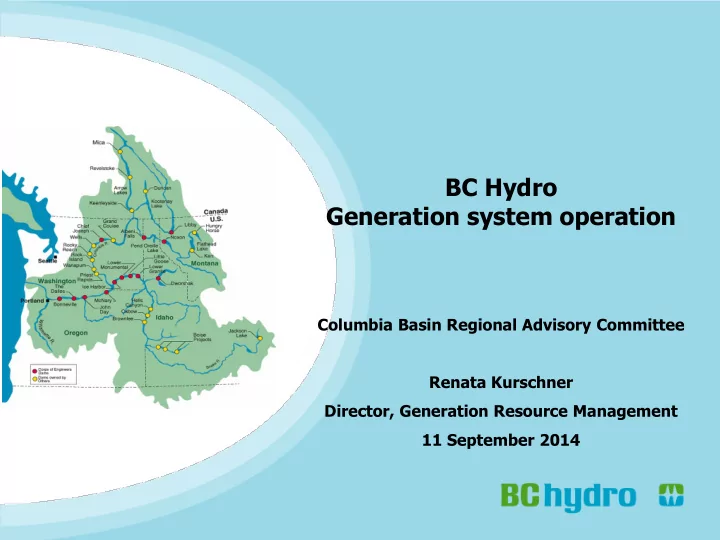
BC Hydro Generation system operation
Columbia Basin Regional Advisory Committee Renata Kurschner Director, Generation Resource Management 11 September 2014
BC Hydro Generation system operation Columbia Basin Regional - - PowerPoint PPT Presentation
BC Hydro Generation system operation Columbia Basin Regional Advisory Committee Renata Kurschner Director, Generation Resource Management 11 September 2014 Generation System Operation Coordination of provincial generation (Heritage
Columbia Basin Regional Advisory Committee Renata Kurschner Director, Generation Resource Management 11 September 2014
2
Generation System Operation
resources, IPPs, partner generation under Canal Plant Agreement)
economic goals on a consolidated basis (domestic and trade activity)
3
Generation system operation
Columbia, Kootenay and Pend d’Oreille ~ 37% Peace ~28% Heritage Hydro ~78%
4
System storage allows BC Hydro to reshape inflows in excess of the load into future periods when inflows are less than the load
Generation system operation
5
Generation system operation Historic System Storage
5000 10000 15000 20000 25000 30000
Apr May Jun Jul Aug Sep Oct Nov Dec Jan Feb Mar
System Storage (GWh)
Historic Envelope 10 Year Historic Average 30 Year Historic Average
Source: Historic System Storage.xls (jdb presentations)
Historic Minimum 6900 GWh Historic Maximum 29000 GWh
6
Generation system operation
Planning (IRP) Energy studies Operations Planning Real Time Dispatch
Forecasts future load, determines supply needs (energy and capacity) and acquires resources Monthly system modeling maximizes long term net revenue from
determines:
capability for trade Short term operations planning
plans for individual plants
and constraints, incl. water conveyance, flood control, WUP requirements Day ahead operating plan and hourly generation dispatch / water conveyance to meet load requirements and trade opportunities in a most economical manner; manages within the day unexpected events
Timeframe: 3 years to real time Timeframe: Beyond 3 years
Informed by forecasts: weather and inflows, market prices, loads, unit outages, transmission availability
7
reservoirs are coordinated with the US (USAC and BPA) under the Columbia River Treaty: the “Treaty Dams”
under the CRT. However, Kootenay Lake is subject to the IJC Order.
8
Generation System Operation
9
Generation system operation
10
Generation system operation
11
Generation system operation
12
Generation system operation
13
Generation System Operation
14
BC Hydro system operations
15
BC Hydro system operations
16
BC Hydro system operations
17
BC Hydro system operations
Columbia River Project
(Mica/Revelstoke/Arrow)
11 Jan 2007
Water Hardman Project 21 Mar 2006
Whatshan Project 15 Jun 2005
Elko Project 7 Apr 2005
Spillimacheen Project 15 Jul 2005
Aberfeldie Project 6 Nov 2006
Seven Mile Project 8 Dec 2006
Duncan Project 20 Dec 2007
18
BC Hydro system operations
19
BC Hydro system operations
20
BC Hydro system operations
Typical Operational drivers: Nov to Mar: high discharge to meet electricity demand, discharge sometimes limited in Feb-Mar by Arrow Reservoir flood control curve. Apr to mid-Jul: low electricity value, so discharge reduced to refill reservoir Jul to Oct*: discharge adjusted as needed to refill reservoir, minimize spill, & maximize electricity value *Note – Mica discharges during Jul-Oct can be quite variable, depending on spill probability at Mica and other reservoirs (e.g. Williston) as well as market electricity values
21
BC Hydro system operations
Typical CRT &
drivers:
Sep-Dec: discharge lower to preserve storage in case of low snowpack. NTSA & STLA activity if economic. Jan-Mar: higher discharges (if snowpack OK); sup. agrmts manage for steadier whitefish spawning flows Jul-Aug: discharge increased to meet CRT needs & release Flow Aug water
Note – Arrow discharge from Jan to July depends on overall basin runoff forecast, and will vary significantly with basin-wide snowpack
Apr-June: lower, stable discharges to refill reservoir, manage trout spawning
22
BC Hydro system operations
Typical CRT &
drivers:
Oct-Dec: discharge limited to manage fish spawning in Duncan River. Res. level must remain below CRT flood curve. Jan-Mar: higher discharges to improve Kootenay Lake inflows & meet CRT flood control needs. Jul-Sep: discharge increased & then adjusted to manage reservoir refill & minimize downstream Can flooding Apr-Jun: discharge reduced to refill reservoir, subject to minimum WUP fish-flow needs in Canada
23
BC Hydro system operations
Typical Operational drivers:
Sep-Dec: discharges adjusted to keep lake level below IJC Curve, with minimum fish flow downstream at Brilliant Jan-Mar: lake drafted to meet IJC
maximized (limited by Grohman Narrows) if lake level above IJC Curve. Jul-Aug: lake drafted in compliance with IJC Order Apr-Jun: typically
discharge to minimize peak lake level (and meet IJC Curve)
24
BC Hydro system operations
Typical
drivers:
Oct-Dec: discharge reduced to minimum, then increased in late Nov to hit 31 Dec flood control level. Jan-Mar: discharges increased above minimum only if needed to stay at/below flood control curve. Jul-Sep: discharge adjusted to manage reservoir refill & provide downstream fish flows Apr-Jun: discharges increased for fish, then high sturgeon flows in late May or
adjusted to maintain flood management space.
25
Generation system operation