BAS Building Accessible Services a Project funded by the DG - - PowerPoint PPT Presentation

bas building accessible services
SMART_READER_LITE
LIVE PREVIEW

BAS Building Accessible Services a Project funded by the DG - - PowerPoint PPT Presentation

BAS Building Accessible Services a Project funded by the DG Employment and Social Affairs, contract no. SI2.390526 DEC. 2004 NOV. 2006 TOTAL PROJECT COST: 519.788,49 EU FINANCING: 415.830,80 COORDINATOR: CNR Construction


slide-1
SLIDE 1

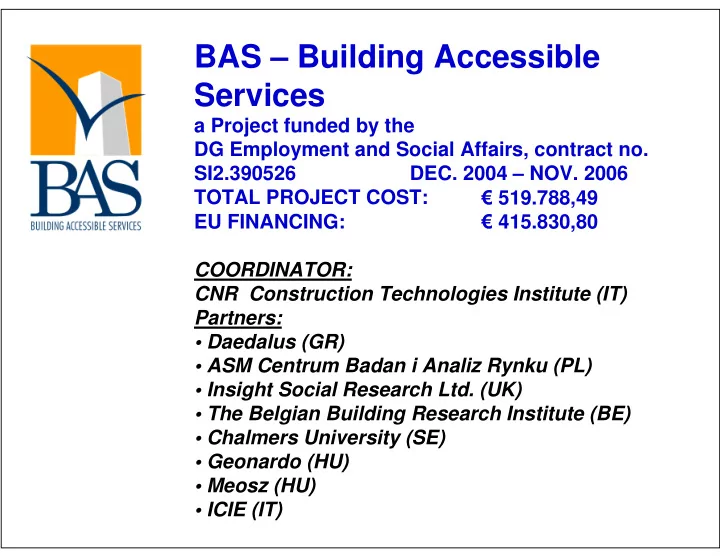
BAS – Building Accessible Services

a Project funded by the DG Employment and Social Affairs, contract no. SI2.390526

  • DEC. 2004 – NOV. 2006

TOTAL PROJECT COST: 519.788,49 EU FINANCING: 415.830,80 COORDINATOR: CNR Construction Technologies Institute (IT) Partners:

  • Daedalus (GR)
  • ASM Centrum Badan i Analiz Rynku (PL)
  • Insight Social Research Ltd. (UK)
  • The Belgian Building Research Institute (BE)
  • Chalmers University (SE)
  • Geonardo (HU)
  • Meosz (HU)
  • ICIE (IT)
slide-2
SLIDE 2

BAS - GENERAL OVERVIEW/1

The BAS aspires to undertake extensive dissemination and training activities in the area of building and urban space accessibility, by means

  • f well defined and self contained case studies on

a number of approximately 15 different type of buildings and their surroundings across the EU, whereby the level of accessibility will be in detail assessed and specific interventions elaborated, cost evaluated and proposed. BAS is essentially a practical awareness raising and dissemination activity novel methodologies for measuring building accessibility.

slide-3
SLIDE 3

BAS - GENERAL OVERVIEW/2

The project observes closely the objectives of the particular priority line in that it goes beyond discussing the problems associated to building accessibility and the discrimination that accompanies them. It wishes to train on the use of the novel accessibility appraisal methodologies and provide a showcase of practical and representative cases that will enable to deeply understand and, in fact eventually, measure, by means

  • f meaningful metrics, the level of the accessibility of

any particular building. Intervention measures can then most naturally be designated and evaluated. It is important to notice that in our approach building accessibility is defined as accessibility to building

  • services. In this sense accessibility to workplaces is by

design embedded in the methodology, as workplaces, when they exist in a building, are, by definition, a key service offered by the building.

slide-4
SLIDE 4

BAS ACTIVITIES

Case-studies in progress by each partner

CNR ITC – School in Firenze (IT) Daedalus – Hotel in Crete (GR) ASM – University in Lodz (PL) Insight – BBRI – Local Government building in Leuven (BE) CHALMERS – School in Goteborg (SE) GEONARDO – MEOSZ – Faculty of Sciences in Budapest (HU) ICIE – Railway Station in Lodi (IT)

Activities Responsibles Up-to-date activities Members and p./months for each A1 - Methodology for auditing building accessibility Daedalus Index draft ITC, ASM, Insight, BBRI, Geonardo, ICIE Chalmers Education Group A2 - Printing the 'Building Accessibility Showcase' - The Orange Book A2a - First results from materials analysis CNR ITC Case-studies collection ASM, Insight, BBRI, ICIE Chalmers Choice of the first case-study A2b - CD production Geonardo ITC, Daedalus, Geonardo, Meosz, ICIE A2c - Web production BBRI Logo and web development Meosz A3 - Demonstration, dissemination and conferences A3a - Four trans-national conferences Daedalus Crete (GR) Responsible for the Greece Conference Insight Manchester (UK) Responsible for the UK Conference BBRI Brussels (BE) Responsible for the Belgium Conference Chalmers Stockholm (SE) Responsible for the Sweden Conference A3b - Two enlarged trans-national conferences ICIE Rome (IT) ITC, ASM, Geonardo, Meosz MEOSZ Budapest (HU)

slide-5
SLIDE 5

BUILDING PICTURES Route system: Tactile paving surfaces Signage system:Tactile and Braille maps First floor BUILDING ACCESSIBILITY CHARACTERISTICS Route system Tactile paving surfaces Signage system Tactile maps Orienting information panels Braille maps Visual signalling of barriers or danger situations Automation system Automated door openings Communication system Video intercom with LCD screen for deaf people and alarm and security alert REFERENCES AVAILABLE MATERIALS Paper Web sites CD 1 CD with pictures DIFFUSION ACTIVITY Books, Articles, Newspapers Seminar, Congress, Workshop 1 National Meeting, May 2004

BEST PRACTICES’ SAMPLES – CNR ITC

FILLED BY BAS PARTNER:

Date

CNR ITC Luigi Biocca, Annalisa Morini Feb.2005

BUILDING DESCRIPTION B uilding T ype Technical High School Building Name Russel Newton Building Location Scandicci (FIRENZE), Italy Project Type and Year Pilot Project 'School without barriers', 2003 Project Frame European Year of People with Disabilities Services included in the Project Atrium, Library, Gymnasium, Auditorium, Meeting Rooms SHORT WORKS DESCRIPTION Upgrading the accessibility level at least for the common Services above defined BUILDING' S FEATURES DESCRIPTION The school was built in 2003. The upgrading overcomes the law, but it is in the direction of an enlargement

  • f Design for All concept. The improvements regard in particular blind and partially blind people.

Ground floor

slide-6
SLIDE 6

BEST PRACTICES’ SAMPLES - BBRI

slide-7
SLIDE 7

BEST PRACTICES’ SAMPLES - ASM

THE FACULTY OF MANAGEMENT The Faculty of Management exists in Lodz from 1996, and from 2002 it has it’s own up-to-date building. It’s architecture and colors outside (composition of orange and grey) draw attention. For today the faculty has above 4 000 students who, together with theirs lecturers, are moving

  • n 16 000 m2. The building has four floors, and in it is one underground.

There is a lot of facilitations for people with motor disability (lifts; access to mirror, wash-basin, toilet; easy access to sockets and phones; benches on each floor; floors without dodges and single steps, comfortable way of opening of door). Flooring gives stability because it isn’t slippery. During lectures there is an ability of using up-to-date audiovisual

  • technics. Combining visual materials and traditional lectures let deliver

knowledge even to blind or deaf people. Source: A lecture of Tomasz Bochenek, General Manager of Microsoft Poland, Webpage of The Faculty of Management: http://wz.uni.lodz.pl/index.php

slide-8
SLIDE 8

THE SIX BAS CONFERENCES – Feb./Nov. 2006

Training Trans-national Conference MANCHESTER (UK) Training Trans-national Conference STOCKHOLM (SE) Training Trans-national Conference BRUSSELS (BE) Training Trans-national Conference ATHENS (GR) Enlarged Trans-national Conference ROME (IT) Enlarged Trans-national Conference BUDAPEST (HU)

slide-9
SLIDE 9

UE: Elizabeth Straw Elizabeth.STRAW@cec.eu.int CNR ITC: Annalisa Morini a.morini@itc.cnr.it Luigi Biocca l.biocca@itc.cnr.it DAEDALUS: Nikos Sakkas nsak@stepc.gr ASM: Katarzyna Swiezawska k.swiezawska@asm-poland.com.pl Kasia Mucha k.mucha@asm-poland.com.pl INSIGHT: Malcolm Fisk malcolm.fisk@researchatinsight.org Greg Morgan gregmorgan44@tiscali.co.uk Martin Harach martin.harach@researchatinsight.org BBRI: Jan Desmyter jan.desmyter@bbri.be Isabelle Lechat isabelle.lechat@bbri.be Katrien Putzeis katrien.putzeis@bbri.be CHALMERS: Jan Paulsson janpaul@arch.chalmers.se GEONARDO: Krisztian Lohr krisztian.lohr@geonardo.hu MEOSZ: Lajos Hegedus international@meoszinfo.hu Eva Caesar international@meoszinfo.hu ICIE: Valerio Nannini v.nannini@bo.icie.it

BAS – People Participants:

slide-10
SLIDE 10

BAS – People Participants:

Joining the project: MARTIN HARACH Insight (UK) EVA CAESAR Meosz (HU) KASIA MUCHA ASM (PL)

Portrait photo missing Portrait photo missing