Barry Baker Latitude 42 Environmental Consultants background - WCA - - PowerPoint PPT Presentation

barry baker latitude 42 environmental consultants
SMART_READER_LITE
LIVE PREVIEW

Barry Baker Latitude 42 Environmental Consultants background - WCA - - PowerPoint PPT Presentation

Research Plan for Aerial Survey of White-capped albatross, Auckland Islands Barry Baker Latitude 42 Environmental Consultants background - WCA endemic NZ species Auckland Islands Disappointment Island (110 000 pairs) SW Cape (3 000


slide-1
SLIDE 1

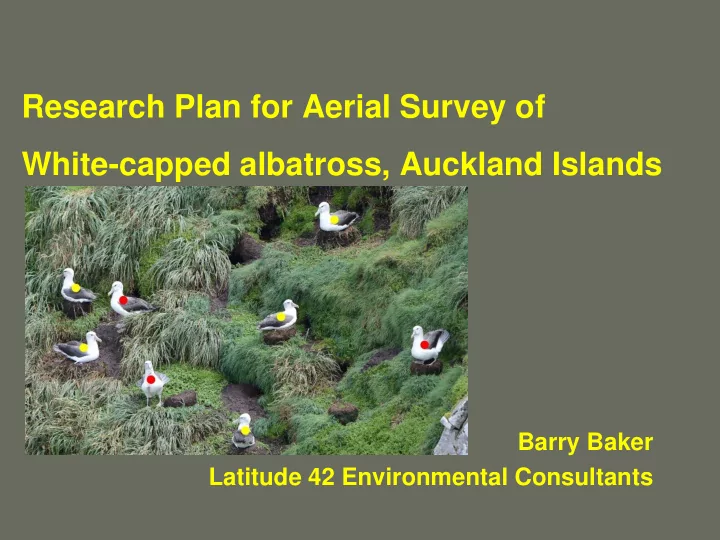
Research Plan for Aerial Survey of White-capped albatross, Auckland Islands

Barry Baker Latitude 42 Environmental Consultants

slide-2
SLIDE 2

background - WCA

― endemic NZ species ― Auckland Islands

Disappointment Island (110 000 pairs) SW Cape (3 000 pairs) Adams Island (100 pairs)

― Antipodes Islands

Bollons Island (50-100 pairs)

― regularly interacts with fisheries in NZ and elsewhere

2

slide-3
SLIDE 3

white-capped albatross

― annual photographic counts of all WCA colonies in the Auckland Islands 2006 - 2012 ― now propose to undertake another count in January 2015 of all Auckland Is colonies ― analyse photos, count breeding birds, determine popn trend

3

slide-4
SLIDE 4

photography WCA

― conduct one photo survey of WCA colonies in

Aucklands Is in January 2015 ― aerial platform Squirrel Helicopter ―Nikon digital cameras & image-stabilized lenses ―series of overlapping photos of all colonies (70 - 200 mm) ―photos to be taken as fine-scale jpeg or raw files of minimum 20 MB size

4

slide-5
SLIDE 5

3 groups of photos

― overall scenic shots of the colony to assist later when building photomontages of the site ― series of overlapping photos of all areas with nesting birds (70 mm) ― close-up photos to examine proportion of empty nests & non-breeding birds (300mm) ― compare close-up photos with ground count to assess proportions of breeding & non-breeders

  • c. 3,000 photos taken each year,

since 2006 with no impact on birds detected

5

slide-6
SLIDE 6

Close- up photos

6

slide-7
SLIDE 7

counting protocol for WCA

―photomontages constructed using Adobe Photoshop software ―paintbrush tool mark off counted birds

7

slide-8
SLIDE 8

data assessment

―all birds on the ground counted. ―each single bird assumed to represent an annual breeding pair. ― close up photos & ground truthing will be used to estimate proportion of birds present but not breeding, so counts can be subsequently adjusted ―all images will be counted by one observer ―repeat counts of randomly selected montages by 2

  • ther observers in previous years has confirmed no

evidence of observer bias in counting

8

slide-9
SLIDE 9

WCA photographic data storage

― photographs will be submitted to DOC for

archiving

― photos will be provided in one directory White-capped albatross 2015 with three sub- directories

― Original photos ― Stitched images ― Counted images

― Two set of photographs also retained by Latitude 42 and stored on and off the office site

9

slide-10
SLIDE 10

White-capped albatross at Disappointment Island

David Thompson & Paul Sagar Presentation to CSP Technical Working Group, December 2014

slide-11
SLIDE 11

White-capped albatross at Disappointment Island, Auckland Islands

  • Largest population, 95% of breeding pairs
  • No pigs, cats or mice
  • Ongoing aerial survey work
  • ACAP funding received to undertake white-chinned

petrel population estimate

  • virtually nothing known about this species at the Auckland

Islands

  • Kalinka Rexer-Huber PhD, Otago University
  • field team on island for ca. 8 days
  • Opportunity to:-
  • carry out ground-truthing of aerial survey
  • establish study population
slide-12
SLIDE 12

White-capped albatross – Disappointment Island

  • Conservation status: At Risk –

Declining

– No conclusive evidence of a decline from aerial surveys

  • ‘Very High’ risk, L2 Seabird Risk

Assessment

  • Draft CSP 5-year seabird

research plan: 2015/15 – review M-R feasibility (Table 4)

slide-13
SLIDE 13

Ground-truthing

  • Temporally-aligned with aerial

survey work in January 2015

  • Experienced 3-person field team
  • Each to walk a transect

encompassing at least 200 nests within 3m either side of transect (at least 600 nest total)

  • At time of day of aerial survey
  • Record:
  • number of pedestals
  • actively breeding
  • on obviously failed nest
  • on empty nest
  • loafing
slide-14
SLIDE 14

Mark-Recapture Feasibility

  • Main issue – access to/from island
  • Burrows
  • No shortage of nesting birds
  • No pests
  • Logistic support
  • January visits would maximise band re-

sights

slide-15
SLIDE 15

January 2015

  • Establish study

population, size only constrained by time, and future time on island for re-sighting

  • Metal band and

large plastic band

  • Defined study area,

topographically and GPS, above