Bank Affiliate Transactions: Navigating Regulation W, Sections 23A - - PowerPoint PPT Presentation

bank affiliate transactions navigating regulation w
SMART_READER_LITE
LIVE PREVIEW

Bank Affiliate Transactions: Navigating Regulation W, Sections 23A - - PowerPoint PPT Presentation

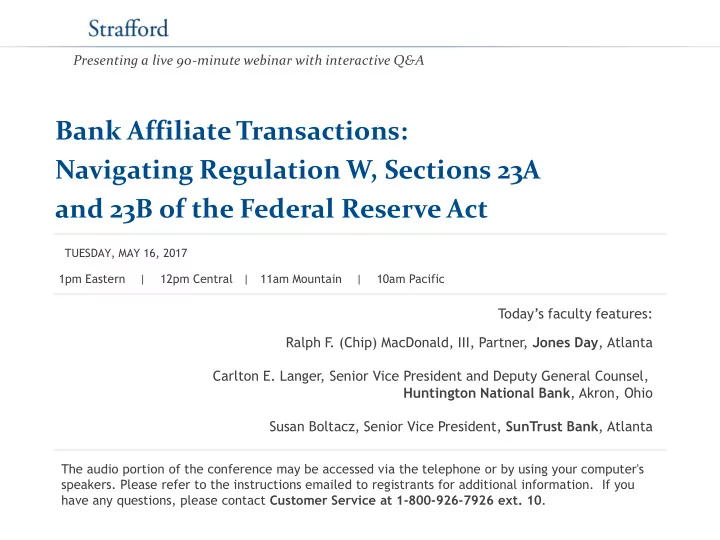
Presenting a live 90-minute webinar with interactive Q&A Bank Affiliate Transactions: Navigating Regulation W, Sections 23A and 23B of the Federal Reserve Act TUESDAY, MAY 16, 2017 1pm Eastern | 12pm Central | 11am Mountain |


slide-1
SLIDE 1

The audio portion of the conference may be accessed via the telephone or by using your computer's

  • speakers. Please refer to the instructions emailed to registrants for additional information. If you

have any questions, please contact Customer Service at 1-800-926-7926 ext. 10.

Presenting a live 90-minute webinar with interactive Q&A

Bank Affiliate Transactions: Navigating Regulation W, Sections 23A and 23B of the Federal Reserve Act

Today’s faculty features:

1pm Eastern | 12pm Central | 11am Mountain | 10am Pacific TUESDAY, MAY 16, 2017

Ralph F . (Chip) MacDonald, III, Partner, Jones Day, Atlanta Carlton E. Langer, Senior Vice President and Deputy General Counsel, Huntington National Bank, Akron, Ohio Susan Boltacz, Senior Vice President, SunTrust Bank, Atlanta

slide-2
SLIDE 2

Tips for Optimal Quality

Sound Quality If you are listening via your computer speakers, please note that the quality

  • f your sound will vary depending on the speed and quality of your internet

connection. If the sound quality is not satisfactory, you may listen via the phone: dial 1-866-873-1442 and enter your PIN when prompted. Otherwise, please send us a chat or e-mail sound@straffordpub.com immediately so we can address the problem. If you dialed in and have any difficulties during the call, press *0 for assistance. Viewing Quality To maximize your screen, press the F11 key on your keyboard. To exit full screen, press the F11 key again.

FOR LIVE EVENT ONLY

slide-3
SLIDE 3

Continuing Education Credits

In order for us to process your continuing education credit, you must confirm your participation in this webinar by completing and submitting the Attendance Affirmation/Evaluation after the webinar. A link to the Attendance Affirmation/Evaluation will be in the thank you email that you will receive immediately following the program. For additional information about continuing education, call us at 1-800-926-7926

  • ext. 35.

FOR LIVE EVENT ONLY

slide-4
SLIDE 4

Program Materials

If you have not printed the conference materials for this program, please complete the following steps:

  • Click on the ^ symbol next to “Conference Materials” in the middle of the left-

hand column on your screen.

  • Click on the tab labeled “Handouts” that appears, and there you will see a

PDF of the slides for today's program.

  • Double click on the PDF and a separate page will open.
  • Print the slides by clicking on the printer icon.

FOR LIVE EVENT ONLY

slide-5
SLIDE 5

Susan Boltacz SunTrust Bank susan.boltacz@suntrust.com Carlton E. Langer Huntington Bank carlton.c.langer@huntington.com Chip MacDonald Jones Day cmacdonald@jonesday.com

Bank Affiliate Transactions – Sections 23A and 23B of the Federal Reserve Act and Federal Reserve Regulation W

May 16, 2017

slide-6
SLIDE 6

Agenda

  • Overview
  • What is an “Affiliate”?
  • What is “Control”?
  • Entities Not Considered Affiliates
  • What are “Covered Transactions”?
  • Section 23A – Limits on Covered Transactions
  • Covered Transactions – Attribution Rule
  • Section 23 – Exemptions
  • Section 23B – Market Terms Requirements
  • Dodd-Frank Act Affiliate Transaction Restrictions
  • Super 23A and 23B
  • Why is This Restriction Called “Super” 23A and 23B?
  • Scenarios
  • Questions and Answers

6

slide-7
SLIDE 7

Overview

  • Sections 23A and 23B of the Federal Reserve Act limit the

risks to banks from transactions with affiliates and limit the ability of banks to transfers their federal subsidy to affiliates (Reg. W Release adopting Final Rule (Nov. 27, 2002) (the “Reg. W Adopting Release”).

  • Section 23A was adopted as part of the Banking Act of 1933,

which also:

– Established the FDIC and deposit insurance, and prohibited the payment of interest on demand deposits and limited rates payable on deposits. – Included the Glass – Steagall Act separating commercial and investment banking. – Established margin lending restrictions on securities.

7

slide-8
SLIDE 8

Overview (continued)

  • Amended by the Gramm-Leach Bliley Act (1999) (“GLB Act”)

and the Dodd-Frank Act (2010), among others.

  • Imposes quantitative limits on “covered transactions”

between a member bank and its “affiliates”

8

slide-9
SLIDE 9

Overview (continued)

  • Section 23B of the Federal Reserve Act

– Adopted by the Competitive Equality Banking Act of 1987 and the GLB Act and the Dodd-Frank Act. – Imposes qualitative limits on transactions between a member bank and its “affiliates.” – “Market terms” include terms and circumstances that are substantially the same or at least as favorable as those prevailing at the time for comparable transactions with non-affiliates. Reg. W Adopting Release.

9

slide-10
SLIDE 10

Overview (continued)

  • Section 18(j) of the Federal Deposit Insurance Act (the

“FDI Act”) makes Sections 23A and 23B equally applicable to state non-member insured banks. – Generally does not apply to U.S. branches of foreign banks.

  • The Home Owners Loan Act (12 U.S.C. 1461) (“HOLA”)

– HOLA, Section 10(d) – transactions with affiliates are subject to HOLA, Section 11’s prohibitions and limitations. – HOLA, Section 11 generally makes Sections 23 and 23B applicable to savings associations in the same manner as member banks.

10

slide-11
SLIDE 11

Overview (continued)

– Reg. W, § 223. 72 implements HOLA, Section 11.

  • Every savings association shall be treated as a bank

for purposes of Section 23A (d)(1)(pre-committed purchases of same quality assets) and Section 23B. – The appropriate federal banking agency may impose additional restrictions on affiliate transactions to protect bank safety and soundness.

11

slide-12
SLIDE 12

Overview continued

  • The Federal Reserve Board’s (the “Federal Reserve”)

Regulation W (“Reg. W”) implements Sections 23A and 23B

  • f the Federal Reserve Act.
  • Reg. W interprets and applies Sections 23A and 23B and is

applicable to all member banks.

  • Regulation W provides a single, comprehensive reference

tool for complying with and analyzing issues arising under sections 23A and 23B. The regulation restates the statutory definitions, restrictions, and exemptions, and also includes Federal Reserve interpretations of the sections.

12

slide-13
SLIDE 13

Overview continued

  • Reg. W has 8 subparts:
  • - Subpart A -- comprehensive glossary of the terms
  • - Subpart B -- principal restrictions and requirements

imposed by Section 23A

  • - Subpart C -- appropriate valuation and timing principles for

covered transactions

  • - Subpart D -- appropriate treatment under Section 23A of

transactions with financial subsidiaries, bank-affiliate derivative transactions, and certain bank-affiliate merger and acquisition transactions

13

slide-14
SLIDE 14

Overview continued

  • Reg. W has 8 subparts (continued):
  • - Subpart E -- available exemptions from certain Section

23A requirements

  • - Subpart F -- operative provisions of section 23B
  • - Subpart G -- the application of Sections 23A and 23B and
  • Reg. W to U.S. branches and agencies of foreign banks
  • - Subpart H -- miscellaneous Federal Reserve

interpretations of Sections 23A and 23B

14

slide-15
SLIDE 15

What is an Affiliate?

  • An “affiliate” is broadly defined in Reg. W, § 223.2(a) as any

company that is owned or “controlled” by a company that owns the bank, including – A parent holding company, including companies that control the bank, or companies that are controlled by shareholders that control the bank, and all the subsidiaries of the company, including depository institutions subsidiaries – Companies controlled by a parent BHC or under common control with the bank – Companies with interlocking directors – Financial subsidiaries of the bank – Portfolio companies held 15% or more by a BHC under its merchant banking authority or insurance company investment authority

15

slide-16
SLIDE 16

What is an Affiliate? (continued)

– Entities sponsored or advised by the bank, including REITS and investment companies. – Any unregistered investment fund for which the bank or any affiliate of the bank serves as an investment advisor, if the bank and its affiliates own or control in the aggregate more than 5% of any class of voting securities or more than 5% of the fund’s equity capital – An insured depository institution subsidiary of the bank – Any subsidiary of the bank, if affiliates (other than insured depository institution affiliates) or controlling shareholders

  • f the bank also control the subsidiary through a non-bank

chain of ownership.

16

slide-17
SLIDE 17

What is an Affiliate? (continued)

– Subsidiaries of affiliates. – Any company that the Board determines by regulation or

  • rder, or that the appropriate Federal banking agency for

the bank determines by order, to have a relationship with the bank, or any affiliate of the bank, such that covered transactions by the bank with that company may be affected by the relationship to the detriment of the bank.

17

slide-18
SLIDE 18

What is “Control”?

  • “Control” is defined in Reg. W, § 223.3(a) based on the Federal

Reserve’s long-standing precedents under Regulation Y, as well as Regulation W – ≥ 25% of voting securities – ≥ 25% of the equity capital – General partner/managing member – Ability to select majority of directors – Controlling influence over management or policies – Management interlocks – Convertible securities – deemed to represent the underlying securities into which they are convertible – A company is deemed to control assets, securities and

  • wnership interests controlled by any subsidiary of the

company

18

slide-19
SLIDE 19

What is “Control”? (continued)

  • Control is interpreted similarly under the Bank Holding

Company Act and Federal Reserve Regulations Y, O and W.

  • Notwithstanding any other provision of Reg. W, no company

will be deemed to control another company by virtue of its

  • wnership or control of shares in a fiduciary capacity, except

as provided in Reg. W, §223.2(a)(3)

  • Reg. W, § 223.2(a)(3) describes a company (including a

bank subsidiary) that is controlled, directly or indirectly, by trust or otherwise, by or for the benefit of shareholders who beneficially or otherwise control, directly or indirectly, by trust

  • r otherwise, the bank or any company that controls the

bank), or if the company owning or controlling the shares is a business trust.

19

slide-20
SLIDE 20

Entities Not Considered Affiliates

  • Subsidiaries of the bank, except for –

– Financial subsidiaries and their subsidiaries – Companies controlled directly by an affiliate or shareholder or group of shareholders that control the bank – Depository institutions – Employee Benefit Plans, ESOPs, trusts, or similar arrangements that benefit shareholders, partners, members or employees of the bank or its affilaites

  • Sister banks (80% or more common control)

– For Section 23B purposes, “affiliate” does not include depository institutions (Reg. W, § 223.2(c) and Subpart F, which implements Section 23B

  • Safe deposit companies

20

slide-21
SLIDE 21

Entities Not Considered Affiliates (continued)

  • Companies engaged solely in holding obligations of, or

fully guaranteed as to principal and interest by, the U.S. government or its agencies

  • Bank premises companies
  • Subsidiaries holding assets etc. as a result of debts

previously contracted in good faith (“DPC”)

  • DPC subsidiaries
  • Bank premises companies

21

slide-22
SLIDE 22

What are Covered Transactions?

  • “Covered Transactions” are defined in Reg. W, § 223.3(h), and

include: – A loan or extension of credit to an affiliate; – A purchase of, or an investment in securities issued by an affiliate; – A purchase of assets from an affiliate, including assets subject to recourse; – The acceptance of securities or debt obligations issued by an affiliate as collateral for a loan or extension of credit; – The issuance of a guarantee, acceptance, or letter of credit on behalf of an affiliate, and a confirmation of a letter or credit issued by an affiliate. – A cross-affiliate netting agreement, including an endorsement

  • r standing letter of credit, as defined in Reg. W., § 223.3(j);

22

slide-23
SLIDE 23

What are Covered Transactions? (continued)

– A securities lending or borrowing transaction with an affiliate to the extent the transaction causes a bank or a bank subsidiary to have credit exposure to an affiliate; – A derivative transaction with an affiliate to the extent the transaction causes a bank or a bank subsidiary to have credit exposure to the affiliate; and – “Keep well” or capital maintenance agreements on behalf

  • f affiliates.

23

slide-24
SLIDE 24

What are Covered Transactions? (continued)

  • “Extensions of credit” to affiliates are broadly defined in Reg.

W, §223.3(o) and include the making or renewal of a loan, the granting of a line of credit, or the extending of credit in any manner whatsoever, including on an intraday basis.

  • Further extensions of credit to an affiliate, include:

– An advance to an affiliate by means of an overdraft, cash item, or otherwise; – A sale of federal funds to an affiliate; – A lease that is the functional equivalent of an extension of credit to an affiliate;

24

slide-25
SLIDE 25

What are Covered Transactions? (continued)

– An acquisition by purchase, discount, exchange, or

  • therwise of a note or other obligation, including

commercial paper or other debt securities, of an affiliate; – Any increase in the amount of, extension of the maturity of,

  • r adjustment to the interest rate term or other material

term of, an extension of credit to an affiliate; and – Any other similar transaction as a result of which an affiliate becomes obligated to pay money (or its equivalent).

  • Reg. W, § 223.16 treats “transactions with any person as a

transaction with an affiliate to the extent the proceeds of the transaction are used for the benefit of, or are transferred to an affiliate.”

25

slide-26
SLIDE 26

Section 23A – Limits on Covered Transactions

  • Quantitative Limits— Reg. W, § 223. limits covered

transactions to: – 10% of the bank’s “capital and surplus” with one affiliate,

  • ther than with the bank’s own financial subsidiaries

– 20% of the bank’s capital and surplus with all affiliates and financial subsidiaries in the aggregate

  • “Capital and surplus” refers to regulatory capital with certain

adjustments: – The bank's tier 1 and tier 2 capital based on the bank's most recent Call Report; plus – The balance of the bank's allowance for loan and lease losses not included in tier 2 capital based on the bank's most recent Call Report; plus

26

slide-27
SLIDE 27

Section 23A – Limits on Covered Transactions (continued)

– The amount of any investment by the bank in a financial subsidiary that counts as a covered transaction and is required to be deducted from the bank's capital for regulatory capital purposes.

27

slide-28
SLIDE 28

Section 23A – Limits on Covered Transactions (continued)

  • Collateral Requirements – extensions of credit to an affiliate

by a bank must be fully collateralized at the time of the transaction by a first priority perfected security interest in “eligible collateral” under Reg. W, § 223.

  • Eligible collateral as a percentage of the credit extended:

– U.S. governmental and agency securities or securities fully guaranteed thereby as to principal and interest - - 100% – Notes, drafts, bill of exchange or bankers’ acceptances eligible for purchase or rediscount by a Federal Reserve Bank - - 100% – A segregated, earmarked deposit account with the bank that solely secures the affiliate’s credit transaction with the bank – 100%

28

slide-29
SLIDE 29

Section 23A – Limits on Covered Transactions (continued)

– Obligations of states and political subdivisions - - 110% – All other debt obligations, including loans and receivables

  • - 120%

– Stocks, leases, realty or personalty 130%

29

slide-30
SLIDE 30

Section 23A – Limits on Covered Transactions (continued)

  • Exceptions from the Collateral Requirements

– Acceptances that are fully secured either by attached documents or by other property that is involved in the transaction and has an ascertainable market value; – The unused portion of an extension of credit to an affiliate where the bank does not have any legal obligation to advance additional funds until the affiliate provides the amount of collateral required with respect to the entire used portion of the credit (including the amount of the requested advance); and – The purchase of a debt security issued by an affiliate, if the member bank purchases the debt security from a nonaffiliate in a bonafide secondary market transaction.

30

slide-31
SLIDE 31

Section 23A – Limits on Covered Transactions (continued)

  • Ineligible collateral includes:

– Low-quality assets; – Securities issued by any affiliate; – Equity securities issued by the bank, and debt securities issued by the bank that represent regulatory capital; – Intangible assets (including servicing assets), unless specifically approved by the Board; and – Guarantees, letters of credit, and other similar instruments.

31

slide-32
SLIDE 32

Section 23A – Limits on Covered Transactions (continued)

  • Timing and Validation - - The timing and valuation of covered

transactions are specified in Reg. W, §§ 223.21–24 and vary depending upon whether the transaction is – an extension of credit, – an asset purchase of or investment in affiliate securities, or – an extension of credit secured by affiliate securities.

  • For example:

– A bank is deemed to enter into a credit transaction with an affiliate at the time during the day that the bank becomes legally obligated to enter into the transaction, not at the end of the day on which the loan agreement is signed or the loan is funded. – Credit transactions with nonaffiliates generally become covered transactions, if and when the nonaffiliate becomes an affiliate of the bank. If the nonaffiliate becomes an affiliate within one year after the bank has entered into the credit transaction with it, the bank must ensure that the collateral requirements of Reg. W are met “promptly” after the nonaffiliate becomes an affiliate.

32

slide-33
SLIDE 33

Section 23A – Limits on Covered Transactions (continued)

– Even though a purchase of or an investment in a debt security issued by an affiliate is considered an extension

  • f credit to the affiliate, these transactions are not valued

like other extensions of credit. Purchases of, or investments in, securities issued by an affiliate are valued at the greater of the bank’s purchase price or the carrying value of the securities. – Loans by a bank to a third party that are secured exclusively by affiliate securities are valued at the lesser

  • f (i) the total amount of the extension of credit and (ii) the

fair market value of the pledged affiliate securities, if such securities have publicly available price quotes.

33

slide-34
SLIDE 34

Section 23A – Limits on Covered Transactions (continued)

– Loans by a bank to a third party that are secured by both affiliate and nonaffiliate securities are valued at the lesser

  • f (i) the total amount of the extension of credit, minus the

fair market value of nonaffiliate collateral; and (ii) the fair market value of the pledged affiliate securities, if such securities have publicly available price quotes. Under this rule, the maximum amount that the bank must count against Reg. W’s quantitative limits is the difference between the full amount of the loan and the fair market value of the nonaffiliate collateral.

34

slide-35
SLIDE 35

Section 23A – Limits on Covered Transactions (continued)

  • Low Quality Asset Prohibition – banks may not purchase “low quality

assets” from an affiliate, and low quality assets may not serve as collateral for a loan from the bank to an affiliate

  • “Low Quality Assets” are:

– An asset (including a security) classified as “substandard,” “doubtful,” or “loss,” or treated as “special mention” or “other transfer risk problems,” either in the most recent report of examination or inspection of an affiliate prepared by either a Federal or State supervisory agency or in any internal classification system used by the bank or its affiliate (including an asset that receives a rating that is substantially equivalent to “classified” or “special mention” in the bank's or its affiliate's internal system of the member bank or affiliate); – A nonaccrual asset; – An asset on which principal or interest payments are more than thirty days past due;

35

slide-36
SLIDE 36

Section 23A – Limits on Covered Transactions (continued)

– An asset whose terms have been renegotiated or compromised due to the deteriorating financial condition of the obligor; and – An asset acquired through foreclosure, repossession, or

  • therwise in satisfaction of a debt previously contracted, if

the asset has not yet been reviewed in an examination or inspection.

  • Qualitative Limitations – all transactions (not just covered

transactions) must be on terms and conditions consistent with safe and sound banking practices

36

slide-37
SLIDE 37

Covered Transactions-Attribution Rule

  • The “attribution rule” of Reg. W, § 223.16 is designed to

prevent banks from evading Section 23A’s requirements by using intermediaries

  • The Attribution Rule applies Section 23A when a bank is

engaged in a transaction with a non-affiliate, but where the proceeds of the transaction are transferred to or used for the benefit of the affiliate

  • Any transactions excepted from the Attribution Rule are

subject to Reg. W’s safety and soundness market terms requirements

37

slide-38
SLIDE 38

Section 23A – Exemptions

  • The following are generally exempt from the quantitative

limitations and collateral requirements (but not the low-quality asset prohibitions): – Transactions with sister, parent or subsidiary banks that are commonly owned 80% or more; – Purchase of loans on a nonrecourse basis from an affiliated bank; and – Transactions approved in connection with certain corporate reorganizations.

38

slide-39
SLIDE 39

Section 23A – Exemptions (continued)

  • The following are generally exempt from the quantitative limitations,

collateral requirements, and low-quality asset prohibitions: – Correspondent banking deposits; – Giving credit for uncollected items; – Transactions secured by cash or U.S. government securities; – Purchasing securities from a servicing affiliate; – Purchasing liquid assets, marketable securities, and muni securities; – Purchasing an extension of credit subject to a repo; – Asset purchases by a newly formed bank; – Transactions approved in connection with a Bank Merger Act transaction; – Purchasing an extension of credit originated by an affiliate; – Intraday extensions of credit; and – Riskless principal transactions.

39

slide-40
SLIDE 40

Section 23B – Market Terms Requirements

  • Reg W, §223.51 sets the "market terms" for Section 23B
  • A bank may not engage in a transaction described in

§223.52 unless the transaction is: – on terms and under circumstances, including credit standards that are substantially the same, or at least as favorable to the bank, as those prevailing at the time for comparable transactions with or involving nonaffiliates;

  • r

– in the absence of comparable transactions, on terms and under circumstances, including credit standards, that in good faith would be offered to, or would apply to, nonaffiliates.

40

slide-41
SLIDE 41

Dodd-Frank Act Affiliate Transactions Restrictions

  • Section 608 of the Dodd-Frank Act imposes additional

restrictions on bank affiliate transactions – Expands the definition of “Affiliate”

  • Any “investment fund” for which a bank or its

affiliates is an “investment adviser” is an affiliate – Expanded definition of “Covered Transaction”

  • Derivative transactions and securities lending and

borrowing transactions between a bank or its subsidiary are included “to the extent” that the transaction causes a credit exposure

41

slide-42
SLIDE 42

Dodd-Frank Act Affiliate Transactions Restrictions

  • Super 23A and 23B -- Section 619 of the Dodd-Frank Act

applies so-called “super” 23A and 23B restrictions to affiliated “covered funds” (as defined under the Volcker Rule)

42

slide-43
SLIDE 43

Super 23A and 23B

  • A “banking entity” (as defined under the Volcker Rule) that advises,

manages, sponsors, organizes or offers covered funds (and all of the banking entity’s affiliates) may not enter into a covered transaction with the “covered fund,” as defined in Volcker Rule, or with any other covered fund that is controlled by the covered fund

  • As applied to covered funds and affiliated banking entities Section

23A prohibits banks from: – Extending credit to the covered fund; – Purchasing or investing in securities issued by the covered fund; – Purchasing assets from the covered fund; – Accepting securities issued by the covered fund as collateral for a loan or extension of credit to any person; and – Issuing a guarantee, acceptance, or letter of credit on behalf of the covered fund.

  • All other transactions between a banking entity and an affiliated

covered fund are subject to Section 23B’s market terms requirements

43

slide-44
SLIDE 44

Why Is This Restriction Called “Super ” 23A and 23B?

  • Under usual Section 23A, banks may generally engage in

covered transactions, subject to certain quantitative and qualitative limits. – Super 23A prohibits all covered transactions between banking entities and affiliated covered fund

  • Sections 23A and Section 23B generally apply to banks and

their subsidiaries only. They do not place prohibitions on other affiliates of the member bank – Super 23A and 23B greatly expand the restrictions on transactions to all affiliates of a “banking entity” as if these were banks

44

slide-45
SLIDE 45

Scenario 1 – Collateral

  • An affiliate of a bank maintains a checking account at the

bank that the affiliate uses to pay certain obligations. The balance of the account never falls below $100,000. Can that account be used as collateral for an extension of credit up to $100,000?

45

slide-46
SLIDE 46

Scenario 2 – Covered Transactions

  • An affiliate of a bank has a checking account that went into

an overdraft position of $10 over one night because of the bank’s funds availability policy. The affiliate had sufficient balances but not sufficient available balance. Is this a violation of Regulation W?

46

slide-47
SLIDE 47

Scenario 3 – Low Quality Assets

  • A bank has decided to consolidate some of its financial

subsidiaries into the bank to reduce expenses. One of the subsidiaries has a loan portfolio that contains classified or criticized loans, loans that are more than 30 days delinquent

  • r loans that have been renegotiated. Can the bank merge

the subsidiary into the bank?

47

slide-48
SLIDE 48

Scenario 4 – Low Quality Assets

  • A bank has decided to consolidate some of its financial

subsidiaries into the bank to reduce expenses. One of the subsidiaries has assets on its books that it acquired through foreclosure, repossession or other similar activity. Can the bank merge the subsidiary into the bank?

48

slide-49
SLIDE 49

Scenario 5 – Covered Transactions

  • A bank has made loans to its customers taking a security

interest in their brokerage account. The brokerage account has stock of the bank’s holding company. Is this a problem?

  • Can the bank loan money secured by affiliate stock?

49

slide-50
SLIDE 50

Scenario 6 - Affiliates

  • A bank has been buying mortgage loans from an unaffiliated

mortgage company for years. The principals of the mortgage company are approaching retirement age and have made inquiry of the bank about whether the bank would be interested in acquiring the mortgage company from them. The bank is desirous of maintaining the pipeline of mortgages and indicates that it is interested. Can the parties continue their relationship while negotiating the acquisition?

50

slide-51
SLIDE 51

Scenario 7 – Underwriting

  • The bank has an affiliated broker-dealer that underwrites
  • securities. The broker-dealer is involved in underwriting a stock
  • ffering for a tech company that is in high demand. All of the

analysts are strongly recommending investors try to get their hands on the stock in this IPO. Can the bank, as a fiduciary for some of the accounts that it acts as trustee, acquire this stock in the IPO?

  • A bank affiliate is a member of an underwriting syndicate that is

making a public offering of debt securities that the bank believes will be an attractive investment for the bank’s own

  • portfolio. Can the bank buy the securities for its own account?
  • Can the bank finance customer purchases of these debt

securities?

51

slide-52
SLIDE 52

Scenario 8 – Underwriting, etc.

  • A bank has an affiliated broker-dealer that is a financial

subsidiary of the same parent bank holding company. The broker-dealer arranges a syndicated loan in which the bank is the lead lender and simultaneously underwrites an issue of high yield debt securities. The markets change and the broker-dealer is left holding unsold high yield securities. Can the bank buy these or finance a customer's purchase of the high yield securities?

  • Same scenario, except the broker-dealer did not engage in a

public underwritten offering of the high yield securities, but instead offered these pursuant to SEC Rule 144A?

  • Can a bank issue a letter of credit or a guarantee with

respect to securities underwritten by the broker-dealer?

52

slide-53
SLIDE 53

Scenario 9 – Covered Transactions

  • Bank has a family of mutual funds that it sponsors and

invests funds from some of its fiduciary accounts. The money market fund in this family of mutual funds is potentially going to “break the dollar.” Can the bank contribute money in the money market fund so as to have it avoid breaking the dollar?

53

slide-54
SLIDE 54

Scenario 10 - Agency and Riskless Principal Transactions

  • A broker-dealer affiliate often sells securities in private

placements or as riskless principal in secondary market

  • transactions. Can the bank buy such securities or finance its

customers‘ purchases of such securities?

  • Can the bank finance secondary market purchases of debt

issued by the bank’s affiliates?

54

slide-55
SLIDE 55

Scenario 11 -- Subsidiaries

  • Can a bank buy assets from or extend credit to a subsidiary
  • f the bank?
  • What if the subsidiary is a 50-50 joint venture?
  • What if the bank owns less than 50% of the subsidiary?

55

slide-56
SLIDE 56

Scenario 12 - Companies Acquired DPC

  • Can credit be modified or renewed, or can new credit be

extended to a company that is controlled by the bank as a result of the bank's exercise of its remedies as creditor under a debt previously contracted in good faith (“DPC”)?

  • What if the lender bank does not own 100% of the DPC

company?

56

slide-57
SLIDE 57

Scenario 13 - Advertisements

  • Can a bank publish an advertisement or enter into an

agreement stating or suggesting that the bank will be in any way responsible for the obligations of its affiliates?

57

slide-58
SLIDE 58

Scenario 14 – Corporate Reorganization

  • The parent of a bank is reorganizing and proposes to sell or

transfer all or substantially all assets of an affiliate and of a division of another affiliate, including securities issued by an affiliate to a bank subsidiary. Is this permissible?

58

slide-59
SLIDE 59

Thank You

59

Susan Boltacz Sun Trust Bank susan.boltacz@suntrust.com Carlton Langer Huntington Bank carlton.c.langer@huntington.com Chris MacDonald Jones Day cmacdonald@jonesday.com