Background Cox-MAZE open chest, cardiac surgery was a very - - PowerPoint PPT Presentation

background
SMART_READER_LITE
LIVE PREVIEW

Background Cox-MAZE open chest, cardiac surgery was a very - - PowerPoint PPT Presentation

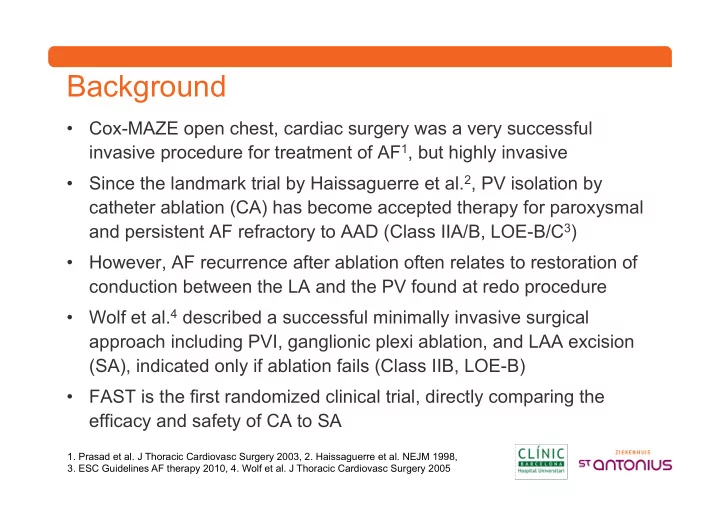
Background Cox-MAZE open chest, cardiac surgery was a very successful invasive procedure for treatment of AF 1 , but highly invasive Since the landmark trial by Haissaguerre et al. 2 , PV isolation by catheter ablation (CA) has become


slide-1
SLIDE 1

Background

  • Cox-MAZE open chest, cardiac surgery was a very successful

invasive procedure for treatment of AF1, but highly invasive

  • Since the landmark trial by Haissaguerre et al.2, PV isolation by

catheter ablation (CA) has become accepted therapy for paroxysmal and persistent AF refractory to AAD (Class IIA/B, LOE-B/C3)

  • However, AF recurrence after ablation often relates to restoration of

conduction between the LA and the PV found at redo procedure

  • Wolf et al.4 described a successful minimally invasive surgical

approach including PVI, ganglionic plexi ablation, and LAA excision (SA), indicated only if ablation fails (Class IIB, LOE-B)

  • FAST is the first randomized clinical trial, directly comparing the

efficacy and safety of CA to SA

  • 1. Prasad et al. J Thoracic Cardiovasc Surgery 2003, 2. Haissaguerre et al. NEJM 1998,
  • 3. ESC Guidelines AF therapy 2010, 4. Wolf et al. J Thoracic Cardiovasc Surgery 2005
slide-2
SLIDE 2

Trial design and selection criteria

  • Two-Center randomized clinical trial with a 12 mo follow-up
  • CA vs. SA, 1:1 randomization, July 2007-July 2011
  • Inclusion:

Drug-refractory AF, documented in the last 12 mo, symptom duration>1 year, high chance of CA failure1 due to:

  • 1. LA diameter >40-44 mm with hypertension, or
  • 2. LA diameter≥45 mm, or
  • 3. Failed prior catheter ablation
  • Exclusion:

longstanding persistent AF>1 yr, permanent AF, LAD>65 mm, LVEF<45%, prior stroke/embolism, significant valvular disease

  • Pre-procedure 7-day Holter, TTE&TEE, and CT/MRI
  • 1. Berruezo et al. Eur Heart J 2007
slide-3
SLIDE 3

Treatment protocol for CA and SA

CA group :

  • Catheter ablation: single tip RF catheter

guided by 3-D mapping1 (NavX/CARTO) under conscious sedation

  • Wide encircling linear antral PV isolation
  • Additional LA lines at the discretion of the

individual operator SA group:

  • Video-assisted thoracoscopic surgery:

Bipolar RF, coolrail, and RF pen (AtriCure)

  • PV isolation, LA ganglionic plexi ablation, and

LA appendage excision2

  • Additional lines at the operator discretion
  • 1. Courtesy of St.Jude medical, 2. Wolf et al. J Thor Cardiovas Surgery,
slide-4
SLIDE 4

Follow-up and Endpoints

Follow-up schedule:

  • ECG at outpatient clinic 1, 3, 6, 12 mo, or anytime during complaints
  • 7-day Holter performed at 6, 12 mo

Primary Efficacy Endpoint after 12-mo:

  • Freedom of LA arrhythmia lasting >30 sec in the absence of Class I&III AAD

Primary Safety Endpoint after 12-mo:

  • Significant Adverse Event rate both procedural and chronic

Statistical analysis:

  • 124 pts were randomized assuming an efficacy of CA 60% and SA 85%,

power of 80% (1-sided Fishers Exact test), significance level 0.025

  • Outcome measures: 2-sided Pearsons’ Chi-square test/Yates continuity

correction, Odds ratios with 95% CI, and Fishers Exact test

slide-5
SLIDE 5

150 pts eligible 21 pts refused randomisation 10 pts catheter ablation registry study 11 pts surgical ablation registry study 129 pts randomised 66 pts catheter ablation 63 pts surgical ablation

1 pt withdrawn consent 1 pt withdrawn PV anomaly 1 pt withdrawn RA flutter 1 pt withdrawn consent 1 pt CABG+MAZE

63 pts catheter ablation in analysis 61 pts surgical ablation in analysis

Screening, inclusion, and randomization

slide-6
SLIDE 6

Baseline characteristics CA and SA - 1

CA N=63 SA N=61 Male 55(87.3%) 45(73.8%) Age, yr 56.0±7.2 56.1±8.0 BMI, Kg/m2 28.6±3.5 27.8±4.6 Prior MI 2(3.2%)

  • LVEF

55.5±8.2% 57.7±6.8% LA diameter, mm 43.2±4.8 42.5±6.5% Prior failed CA 38(60.3%) 45(73.8%) LA diameter 40-44 mm & hypertension 15(23.8%) 8(13.1%) LA diameter ≥45 mm 10(15.9%) 8(13.1%) AF type: PAF 37(58.8%) 45(73.8%) PersAF 26(41.2%) 16(26.2%) Years since diagnosis 6.8±5.3 7.4±6.3

slide-7
SLIDE 7

Baseline characteristics CA and SA - 2

CA N=63 SA N=61 Prior AAD use: 1 28.3% 16.3% 2 41.5% 35.7% 3 15.1% 32.7% ≥4 15.1% 16.3% Amiodarone 26(41.3%) 30(49.2%) CHADS2-score: 0 35(58.3%) 38(63.3%) 1 17(28.3%) 17(28.3%) ≥2 8(13.4%) 4(6.7%) Pre-procedure Holter: No AF 23(40.4%) 29(55.8%) PAF 10(17.5%) 12(23.1%) Continuous AF 24(42.1%) 11(21.2%)

slide-8
SLIDE 8

Procedural data CA and SA

CA N=63 SA N=61 Total procedure time, min 163±55 188±59 (p=0.0177) Flurorscopy time, min 27±11

  • PVI

62 (98.2%) 60 (98.3%) LAA excision

  • 60 (98.3%)

PV reablated redo: 1 1 (2.6%)

  • 2

9 (23.7%)

  • 3

3 (7.9%)

  • 4

25 (65.8% 45 (100%) Additional LA lines: 1 17 (27.4%) 9 (14.8%) 2 14 (22.6%) 2 (3.3%) 3

  • 8 (13.1%)

RF energy PVI 33±20 min 8.9±2.8 applications

slide-9
SLIDE 9

Primary Efficacy Endpoint at 12 mo

Catheter Ablation

Surgical Ablation

Days since index SA/CA Freedom from death, LA arrhthmia, and AAD 0 30 60 90 120 180 240 300 360 0.0 0.2 0.4 0.6 0.8 1.0

N=63 63 63 62 60 56 53 30 30 30 26 26 23 Catheter Ablation N=61 60 60 60 59 58 54 42 41 40 40 40 40 Surgical Ablation

NNT 3.4, 95% CI of 2.3-8.7 p<0.01

slide-10
SLIDE 10

Efficacy CA versus SA during FU

Freedom LA arrhythmia CA N=63 SA N=61 P-value Overall, 12 mo 23(36.5%) 40(65.6%) p=0.0022* Overall, 12 mo allowing AAD 27(42.9%) 48(78.7%) p<0.0001* PAF group 13/37(35.1%) 31/45(68.9%) p=0.0047 PersAF group 9/25 (36.0%) 9/16(56%) p=0.3411 Prior failed CA 14/38(36.8%) 30/44(68.2%) p=0.0089 LA dilation/hypertension 9/25(36.0%) 10/17(58.8%) p=0.3411 Nieuwegein 10/30(33.3%) 18/29(62.1%) p=0.0513 Barcelona 13/33(39.4%) 22/31(70.9%) p=0.0336 Heterogeneity analysis non-significant, p-value>0.2

slide-11
SLIDE 11

Overall Efficacy

Odds Ratio (→ SA better than CA)

St.Antonius Hospital Hospital Clinic Barcelona Paroxysmal AF Persistent AF Prior failed CA LA dilatation/HT Baseline Holter AF NO Baseline Holter AF YES

Subgroup analysis for CA and SA

1 2 4 8

slide-12
SLIDE 12

Procedural Safety CA and SA

Adverse events CA N=63 SA N=61 P-value Pericardial effusion/tamponade 1 1 TIA/Stroke 1 1 Pneumothorax

  • 6

Hematothorax

  • 1

Rib fracture

  • 1

Sternotomy for bleeding

  • 1

Pneumonia

  • 1

PM implant

  • 2

Death

  • Total

2 (3.2%) 14 (23.0%) p=0.001 Minor Groin hematoma/bleed 4 (6.3%)

slide-13
SLIDE 13

Safety CA and SA after 12 mo FU

Adverse events CA N=63 SA N=61 P-value Stroke 1

  • TIA

1

  • Pneumonia

2 2 Hydrothorax

  • 2

Heart failure by AF 2

  • SAB causing death

1

  • Pericarditis
  • 1

Fever unknown origin

  • 1

Ileus 1 1 PV stenosis>70%/symptomatic

  • Total

8 (12.7%) 7 (11.5%) p=1.0 Minor Groin hematoma/bleeding 2 (3.2%)

slide-14
SLIDE 14

Conclusions

  • In a population of patients with AF, with a dilated LA and

hypertension, or a failed prior AF catheter ablation, minimally invasive Surgical Ablation was superior to Catheter Ablation to achieve freedom of LA arrhythmia without anti-arrhythmic drugs during a follow-up of 12 months

  • Surgical ablation was accompanied by a higher adverse event

rate than catheter ablation

  • These findings may be used by physicians and patients to

guide optimal invasive therapy

slide-15
SLIDE 15

Circulation, online