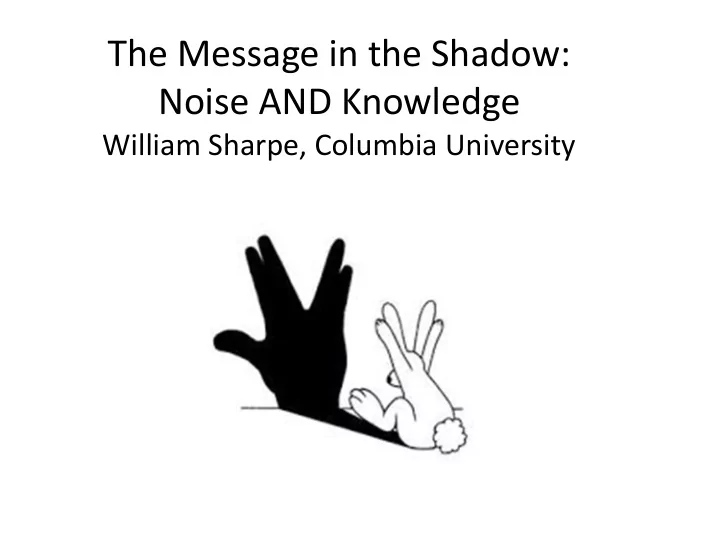
SLIDE 1 The Message in the Shadow: Noise AND Knowledge
William Sharpe, Columbia University
SLIDE 2
- Shadows are found almost everywhere in the
visual arts
- People respond to them on conscious and
subconscious levels, but rarely pause to analyze them
- Viewers derive a lot of emotional and intellectual
pleasure from works in which shadows figure strongly or weakly
- But the complexity of shadows means a certain
amount of “noise” will be part of the artistic message (which in itself will often be debatable)
SLIDE 3
Skillful, Subtle Shadow=Noise Reducer Andrea Previtali, Salvator Mundi, 1519
SLIDE 4 Attention-Getting Shadow =Noisier Shadow
Lois Dodd, Shadow of Painter Painting, 2009
SLIDE 5 Challenges in Shadow Depiction (Technical Noise to Conrol)
- Need to capture accurate shape, location,
direction, perspective, density, edges, texture
- f surface, etc.
- Remember "taboo" of shadow falling on a
person above the waist
- Need to avoid shadow clutter in overall design
- Need to avoid correct shadows that look
wrong and if necessary use incorrect shadows that look right.
SLIDE 6
Masaccio, The Tribute Money, c. 1427
SLIDE 7
- Message in Shadow can be technical or mimetic
(location of objects in space)
- Message can also be semantic/conceptual
- Biblical shadow is protective Isaiah 51.16: "I . . .
have covered you in the shadow of my hand." Luke 1:35, angel to Mary: “The Holy Ghost shall come upon thee, and the power of the Highest shall overshadow thee.”
- Modern shadow is often troubling, threatening,
an unknown impulse or fear, repressed desire
- Generally speaking the shadow is mysterious, a
sort of gap in representation that we fill in with
- ur own personal/cultural interpretation
SLIDE 8
- F. W. Murnau, Nosferatu (1922)
SLIDE 9
- F. W. Murnau, Nosferatu , 1922
SLIDE 10
Emile Friant, Ombres Portées, 1891
SLIDE 11 Global Noise Reduction: Four Visual/Semantic Categories of Art-Shadow
- CONNECTED SHADOW
- Appears to expresses the substance of self = Vital
shadow
- Appears to lack substance, not part of self = Look
Elsewhere shadow
- DISCONNECTED SHADOW
- Caster without shadow, expressing a vital substance
to be lost or gained = Completing shadow
- Shadow without caster, becomes its own substance=
Independent shadow
- All shadows fit in at least one of these categories; a
shadow can belong to more than one category
SLIDE 12
I The Vital Shadow Connected to caster and its inner substance; we perceive that it reveals something essential about caster
SLIDE 13
Joseph Benoit Suvée, The Invention of the Art of Drawing (1793)
SLIDE 14
David Allan, The Origin of Painting, 1775
SLIDE 15
Francine van Hove, Dibutades (2007)
SLIDE 16
Thomas Holloway, A Sure and Convenient Machine for Drawing Silhouettes, 1792
SLIDE 17
- Lavatar, 1783: page featuring Moses Mendelssohn's profile
(top): "My gaze runs from the marvelous arch of the forehead to the sharp bones of the eye. In these depths resides a Socratic soul. Mark the wonderful transition from nose to upper lip […] how all this combines to make the divine truth of physiognomy palpable and visible."
SLIDE 18
Gustave Doré, Poe’s The Raven, 1884 To be in the shadow of something is to feel its power
SLIDE 19
Munch, Puberty (1894)
SLIDE 20
Robert Weine (dir.), The Cabinet of Dr. Caligari, 1919
SLIDE 21
Thomas Roma, 2011: "There was something about the primal nature of the shadows of these little lovable pets of ours. Their shadows, I felt, revealed a wilder side of their nature."
SLIDE 22
SLIDE 23
Baltimore Police in riot gear, Baltimore, Md., April 28, 2015. Photo by Eric Thayer/Reuters
SLIDE 24
II The Look Elsewhere Shadow Connected to caster but is not substance; asks viewer to look instead at caster and/or ponder illusions of shadows (Plato’s cave underlies this usage)
SLIDE 25
Workshop of Robert Campin, Virgin and Child in an Interior, before 1432
SLIDE 26 “Elsewhere” Shadow devices for increasing verisimilitude of a painting (Gombrich)
- Shadows to make objects at bottom of picture
seem to project
- Shadows at base of objects, giving impression of
weight and solidity
- Shadows to increase drama (chiaroscuro;
Caravaggio and Rembrandt)
- Angled shadows to give impression of depth and
perspective
- Dense shadows to give impression of bright
sunlight, etc.
SLIDE 27
Velasquez, “Imperceptible shadows”: The Forge of Vulcan, 1630
SLIDE 28
Shadow adapted to artistic purpose: Bernardo Bellotto, New Market Square in Dresden, 1750
SLIDE 29
Shadow as Lie? 1010 (street artist), Berlin
SLIDE 30
Constructed Shadow: Tim Noble and Sue Webster, Dirty White Trash (with Gulls), 1998
SLIDE 31
Kumi Yamashita, Exclamation Point, 1995
SLIDE 32
Kumi Yamashita, City View, 2003
SLIDE 33
Yamashita, City View, 2003
SLIDE 34 Reduced shadow noise: Newcastle Brown Beer Billboard San Diego, 2011, ad agency Vitro and artists Ellis Gallagher and Pablo Power
SLIDE 35
Trick shadow: Poster for Star Wars Episode I, 1998
SLIDE 36
Old Folks’ Shadows
SLIDE 37
Magritte, The Uncertainty Principle, 1944, "An object is presented against a background on which its shadow falls, with the amendment that the shadow is that of some quite different object.”
SLIDE 38
III The Completing Shadow
Shadow disconnected from caster; shadow represents full humanity of caster but is absent or in the process of being lost or acquired
SLIDE 39
George Cruikshank, Peter Schlemihl Selling His Shadow, 1827
SLIDE 40
EugèneDelacroix, Hamlet, 1848
SLIDE 41
Wendy Sewing On Peter Pan’s Shadow, Disney film, 1953
SLIDE 42
Munch, The Lonely Ones (1889)
SLIDE 43
Alain Resnais, Last Year at Marienbad, 1961
SLIDE 44
Mark Tansey, Triumph Over Mastery II
SLIDE 45 IV The Independent Shadow
- -Shadow stands alone as its own
substance, without a caster visible
- -Begins in 19th c. “If instead of a figure
you put the shadow only of a person, that is an original point of departure, the strangeness of which you have calculated.” -Paul Gauguin, 1888
SLIDE 46
SLIDE 47
Jean-Leon Gerome, Golgotha: Consumatus Est (1867)
SLIDE 48
Renoir, Le Pont des Arts, 1867
SLIDE 49
Hopper, Night Shadows, 1921
SLIDE 50
William Rimmer, Flight and Pursuit, 1872
SLIDE 51
Giorgio De Chirico, Melancholy and Mystery of a Street, 1914
SLIDE 52
Carol Reed, The Third Man, 1949
SLIDE 53
Flatness of shadow lends itself to abstract aesthetic patterns: Paul Strand, Porch Shadows,1916
SLIDE 54
Marcel Duchamp, Shadows of Readymades, 1918
SLIDE 55
Ellis Gallagher in action, Brooklyn NY, 2009
SLIDE 56
Lee Friedlander, Self Portrait (on Maria) (1966)
SLIDE 57
Shadow without context: Andy Warhol, Shadows, 1978
SLIDE 58
Andy Warhol, Shadows, 1978; 102 silkscreen canvases as exhibited at Hirschhorn Museum, 2011
SLIDE 59
Arthur Tress, Andy Warhol at Shadows Installation, 1979
SLIDE 60
Arthur Tress, Shadow: A Novel, 1975
SLIDE 61 In art there is not the same urgency to decode shadow noise as there is in daily life; we can take our time and find music in the silent noise
SLIDE 62
SLIDE 63
SLIDE 64
SLIDE 65
SLIDE 66 Mario Martinelli, Capturing Shadows
SLIDE 67
Konrad Witz, Annunciation, c1445
SLIDE 68
Courbet, Bonjour M. Courbet, 1854
SLIDE 69
Strøk (Anders Gjennestad) is a stencil artist and mural maker from Norway.
SLIDE 70
William Holman Hunt, The Shadow of Death (1870)
SLIDE 71
John Singer Sargent, Corfu: Lights and Shadows, 1909
SLIDE 72
Munch, House in Moonlight, 1895
SLIDE 73
exile from painting from 1967 to 1970)[14] feature single words depicted in a trompe l’oeil technique, as if the words are formed from ribbons of curling paper
SLIDE 74
Ellis Gallagher, Triple Bike, 2009
SLIDE 75
John Singer Sargent, El Jaleo, 1882
SLIDE 76
Jacob Collins, Grimaldi In Studio, c2000
SLIDE 77
Ellis Gallagher
SLIDE 78
Lois Dodd, Self Portrait
SLIDE 79
Rook Floro, I’m Sitting Here Casting My Shadow
SLIDE 80
Louis Nemerth, Thanksgiving (Coming Events Cast Their Shadows Before) c. 1950
SLIDE 81
Emile Bernard, Iron Bridges at Asnieres, 1887
SLIDE 82
Sheet Music cover, Me and My Shadow, 1927
SLIDE 83
William Collins, Rustic Civility, 1833