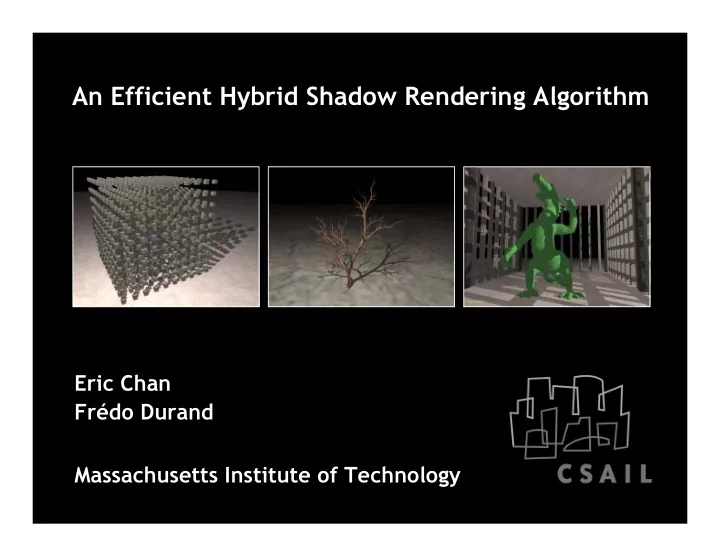
SLIDE 1
Eric Chan Frédo Durand Massachusetts Institute of Technology
An Efficient Hybrid Shadow Rendering Algorithm
SLIDE 2 Not Another Talk on Shadows?!
Main ideas:
- combination of shadow maps + shadow volumes
- computation masks
+
SLIDE 3 Classic Shadow Algorithms
Shadow maps (Williams 1978)
- fast and simple
- undersampling artifacts
- lots of recent research!
Shadow volumes (Crow 1977)
- bject-space
- accurate
- accelerated by stencil buffer
- high fillrate consumption!
NVIDIA
SLIDE 4 Fillrate Problem
Lots and lots of fillrate!
- rasterization
- stencil updates
Why?
- polygons have large screen area
- polygons overlap
SLIDE 5 Fillrate Problem
Lots and lots of fillrate!
- rasterization
- stencil updates
Why?
- polygons have large screen area
- polygons overlap
But is this really a problem?
SLIDE 6
But Is This Really A Problem?
Case study: Doom 3 engine (id Software)
SLIDE 7 But Is This Really A Problem?
Case study: Doom 3 engine (id Software)
SLIDE 8 But Is This Really A Problem?
Case study: Doom 3 engine (id Software)
- bump mapping
- per-pixel surface shading
SLIDE 9 But Is This Really A Problem?
Case study: Doom 3 engine (id Software)
- bump mapping
- per-pixel surface shading
- dynamic and projected lights
SLIDE 10 But Is This Really A Problem?
Case study: Doom 3 engine (id Software)
- bump mapping
- per-pixel surface shading
- dynamic and projected lights
- atmospheric effects
SLIDE 11 But Is This Really A Problem?
Case study: Doom 3 engine (id Software)
- bump mapping
- per-pixel surface shading
- dynamic and projected lights
- atmospheric effects
- particle effects
SLIDE 12 But Is This Really A Problem?
Case study: Doom 3 engine (id Software)
- bump mapping
- per-pixel surface shading
- dynamic and projected lights
- atmospheric effects
- particle effects
- shadow volumes
SLIDE 13 But Is This Really A Problem?
Case study: Doom 3 engine (id Software)
- bump mapping
- per-pixel surface shading
- dynamic and projected lights
- atmospheric effects
- particle effects
- shadow volumes
50% 50%
“Shadowing accounts for about half of the game’s rendering time.” — John Carmack
SLIDE 14
Two Observations
SLIDE 15
Two Observations (shadow maps)
Shadow-map aliasing is ugly But — only noticeable at shadow silhouettes shadow silhouette
SLIDE 16
Two Observations (shadow volumes)
Shadow volumes are accurate everywhere But — accuracy is only needed at silhouettes few silhouette pixels
SLIDE 17 Hybrid Approach
Decompose the problem:
- use shadow volumes at silhouettes
- use shadow maps everywhere else
shadow map + shadow volume
SLIDE 18
Algorithm
1. 3. 2. 4.
SLIDE 19
Algorithm
1. 3. 2. 4. create a shadow map
SLIDE 20
Algorithm
1. 3. 2. 4. find silhouette pixels
SLIDE 21
Algorithm
1. 3. 2. 4. apply shadow volumes only at silhouette pixels
SLIDE 22
Algorithm
1. 3. 2. 4. apply shadow maps everywhere else
SLIDE 23 Algorithm Details
Questions:
- how to find silhouette pixels?
- how to rasterize only silhouette pixels?
SLIDE 24
Find Silhouette Pixels
Silhouette pixels Look for depth discontinuities Use nearest 2x2 depth samples of the shadow map
SLIDE 25
Find Silhouette Pixels (example)
shadow map query point Check results:
2 in shadow 2 visible
Disagreement!
silhouette pixel
SLIDE 26 Restricted Rasterization
Use a mask to limit rasterization:
- tag silhouette pixels in framebuffer
- mask off all other pixels
example scene mask
SLIDE 27 Computation Mask
We need a computation mask
- user-specified mask
- hardware early pixel rejection
- reduces rasterization, shading, memory bandwidth
rasterizer framebuffer shading pixel tests normal pixel rejection early pixel rejection (e.g. per tile of 4x4 pixels)
SLIDE 28 Hardware Support
Current hardware doesn’t have computation mask
- but — hardware already has early z culling!
- minimal changes needed for native mask support
- ur implementation uses a simulated mask
SLIDE 29 Results
- 2.6 GHz Pentium 4
- NVIDIA GeForce 6 (NV40) + crazy blue power supply
SLIDE 30
Hybrid Algorithm Example
standard shadow map Aliased shadow of a ball
SLIDE 31
Hybrid Algorithm Example Hybrid Algorithm Example
visualization Blue and red regions handled by shadow maps
SLIDE 32
Hybrid Algorithm Example Hybrid Algorithm Example
visualization Blue and red regions handled by shadow maps Black and green regions handled by shadow volumes
SLIDE 33
Hybrid Algorithm Example
hybrid algorithm standard shadow map
SLIDE 34
Test Scenes
SLIDE 35
Image Quality
SLIDE 36
Shadow maps
SLIDE 37
Silhouettes
SLIDE 38
Reconstruction
SLIDE 39
Hybrid Shadow maps Time: 19 ms Time: 5 ms
SLIDE 40
Shadow volumes Hybrid Time: 48 ms Time: 19 ms
SLIDE 41
Artifacts
Low-resolution shadow map discretization errors Misclassified silhouette pixels missing features Difficult cases: fine geometry
SLIDE 42
SLIDE 43
SLIDE 44
Example of Missing Features
256x256 1024x1024 result visualization
SLIDE 45 Discussion
Algorithm designed to help fillrate-bound applications:
- requires an extra rendering pass
- 30% to 100% speedup in our test scenes
- performance depends a lot on culling hardware
More details in the paper and web page ...
- tradeoff analysis
- comparison to related work
- implementation details
- more performance and image comparisons
SLIDE 46 Summary
Hybrid shadow algorithm Screen-space decomposition:
- most pixels use fast (but inexact) algorithm
- a few pixels use accurate (but expensive) algorithm
+
SLIDE 47 Computation Masks
Why?
- pixels are not created equal
- programmer marks “interesting” pixels
- fast reject all other pixels
- not just for shadows!
- useful in general for multipass algorithms
- hardware is (mostly) already there
SLIDE 48
Acknowledgments
Nick Triantos and Mark Kilgard (NVIDIA) Jan Kautz and Addy Ngan (MIT) Timo Aila ASEE NDSEG Fellowship