Numerical relativity simulations for GW Astrophysics Harald - - PowerPoint PPT Presentation

numerical relativity simulations for gw astrophysics
SMART_READER_LITE
LIVE PREVIEW

Numerical relativity simulations for GW Astrophysics Harald - - PowerPoint PPT Presentation

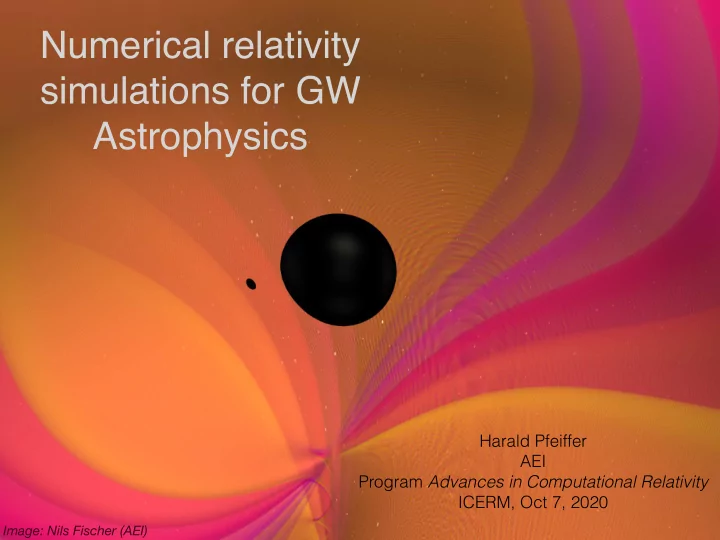
Numerical relativity simulations for GW Astrophysics Harald Pfeiffer AEI Program Advances in Computational Relativity ICERM, Oct 7, 2020 Image: Nils Fischer (AEI) GW150914 Abbott+ PRL 12016 Waveform knowledge essential for GW astronomy

slide-1
SLIDE 1

Numerical relativity simulations for GW Astrophysics

Harald Pfeiffer AEI Program Advances in Computational Relativity ICERM, Oct 7, 2020

Image: Nils Fischer (AEI)

slide-2
SLIDE 2

Waveform knowledge essential for GW astronomy

2

  • H. Pfeiffer

“GW150914” Abbott+ PRL 12016

Detection by matched filtering Parameter estimation Testing GR

LIGO+Virgo, PRX 2016 (1606.04856) LIGO+Virgo, PRL 2017 (1706.01812) LIGO & Virgo: CQG 2017 (1611.07531)

Validation

slide-3
SLIDE 3

In future, need higher accuracy for more diverse systems

3

  • H. Pfeiffer

3G & LISA: expected SNRs needed accuracy ~ 1/SNR GWIC, https://gwic.ligo.org/3Gsubcomm/documents/science-case.pdf LISA among sources: BBH 
 among science targets:
 eccentricity measurement to

q = 1…10−6 δe < 0.001

LISA proposal 2017

slide-4
SLIDE 4

Methods for modeling BBH

4

  • H. Pfeiffer

frequency

Inspiral Ringdown Merger

slide-5
SLIDE 5

Methods for modeling BBH

4

  • H. Pfeiffer

0 mass-ratio q 1

perturbation theory in 1/q

frequency

BH perturbation
 theory post-Newtonian theory (and PM & EOB)

Inspiral Ringdown Merger

e c c e n t r i c i t y , 
 s p i n , …

slide-6
SLIDE 6

Methods for modeling BBH

4

  • H. Pfeiffer

0 mass-ratio q 1

perturbation theory in 1/q

frequency

BH perturbation
 theory post-Newtonian theory (and PM & EOB)

Inspiral Ringdown Merger

e c c e n t r i c i t y , 
 s p i n , …

slide-7
SLIDE 7

Methods for modeling BBH

4

  • H. Pfeiffer

0 mass-ratio q 1

perturbation theory in 1/q

frequency

BH perturbation
 theory post-Newtonian theory (and PM & EOB)

Inspiral Ringdown Merger

e c c e n t r i c i t y , 
 s p i n , …

x

LISA

slide-8
SLIDE 8

Role of NR

  • Solution of GR


for late inspiral + merger

  • Provide error estimates
  • Determine regions of validity

  • f perturbative methods
  • all available perturbation 

  • rders needed for science
  • No extra order for error estimate
  • Validate GW data-analysis
  • Black holes, neutron stars


… and exotic objects, alternative theories

5

  • H. Pfeiffer
slide-9
SLIDE 9

Role of NR

  • Solution of GR


for late inspiral + merger

  • Provide error estimates
  • Determine regions of validity

  • f perturbative methods
  • all available perturbation 

  • rders needed for science
  • No extra order for error estimate
  • Validate GW data-analysis
  • Black holes, neutron stars


… and exotic objects, alternative theories

5

  • H. Pfeiffer
slide-10
SLIDE 10

Solving Einstein Equations - Basic idea

  • Goal: Space-time metric


gab satisfying


  • Split spacetime into 


space and time

  • Evolution equations
  • Constraints


6

  • H. Pfeiffer
  • cf. Maxwell’s equations


slide-11
SLIDE 11

Why is this hard?

  • ADM equations ill-posed; rewrite


as hyperbolic system

  • Singularities inside black holes
  • Constraints difficult to preserve
  • Coordinate freedom
  • How to choose coordinates for a


space-time one does not know yet?

  • Many common numerical challenges
  • 20-50 variables
  • 10,000 FLOP / grid-point / time-step
  • Different length scales, high accuracy requirements

7

  • H. Pfeiffer
slide-12
SLIDE 12

The very beginning

8

  • H. Pfeiffer
slide-13
SLIDE 13

The first 50 Years of numerical relativity for BBH


2011
 Lousto ea


q=100

1994 Cook 


Bowen-York 
 initial data

1989-95 
 Bona-Masso 


modified ADM, (hyperbolicity)

1999-2005 York, Cornell, Caltech, LSU 


hyperbolic formulations

1975-77
 Smarr-Eppley


head-on collision 


1962 ADM 


3+1 formulation

1994-95
 NCSA-WashU


improved
 head-on collision

1999 
 BSSN 


evolution 
 system

1964 
 Hahn-Lindquist


2 wormholes

2000-02
 Alcubierre


gauge conditions

Courtesy Carlos Lousto, updated by HP

1999 York


conformal thin sandwich ID

2003-08
 Cook, Pfeiffer ea


improved ID

2006,07
 Baker ea;
 Gonzalez ea


non-spinning BBH kicks

2007-11
 RIT; Jena; AEI;…


BBH superkicks

2000 Ashtekar 


isolated horizons

2008
 all of NR


NINJA

2007 SXS


PN-NR
 comparison

2006-08 


Scheel..HP+ SXS
 IMR w/ spectral

2005-06 


Campanelli+; Baker+
 IMR w/ BSSN &
 moving punctures

2000-04


AEI/UTB-NASA
 revive crashing codes (Lazarus)

1984
 Unruh 


excision

1997 
 Brandt- Brügmann 


puncture data

2004
 Brügmann ea 


  • ne orbit

2005 Pretorius


inspiral-merger-
 ringdown (IMR) 
 w/ harmonic

1999-00
 AEI/PSU 


grazing collisions

2007-
 Ajith, AEI, Jena


phenom GW models

2009-
 UMD, SXS


EOB GW models

2011 
 Schmidt ea; Boyle ea


Radiation aligned frame

1992,3 
 Choptuik;

Abrahams+Evans


critical phenomena

~2000 Choptuik;
 Schnetter;Brügmann


mesh refinement

9

  • H. Pfeiffer

1994-98


BBH Grand Challenge

2015 ~1999 1964

1979 York 


kinematics and dynamics of GR

~2005

2005
 Gundlach ea


constraint damping

2015
 Szilagyi ea


175 orbits

2014-


precessing 
 GW models

2011
 Lovelace ea


S/M2=0.97

2011-
 Le Tiec ea

self-force studies

2009-11 
 Bishop, ...


Cauchy 
 characteristic extraction

2010 
 Bernuzzi ea


C4z

2013
 GaTech; SXS

Precessing parameter studies

slide-14
SLIDE 14

2005: First working BBH inspirals

10

  • H. Pfeiffer

Pretorius 05

Important early result: Simplicity of merger Continuous transition 
 inspiral → ringdown

Campanelli+06 Baker+07 Baker+06

slide-15
SLIDE 15

Two approaches towards BBH simulations

11

  • H. Pfeiffer

“BSSN & Moving punctures” “generalized harmonic & spectral” LazEv, Maya, BAM, Goddard SpEC (SXS collaboration) Puncture initial-data Quasi-equilibrium excision data (but see Zlochower+ 17) BSSN or CC4z Generalized-Harmonic Evolution System Moving puncture BH excision mergers “easy” mergers difficult Sommerfeld outer BC Constraint preserving, minimally reflective outer BC 4th to 8th order finite-difference Spectral methods BHs advect through static grids Moving grid long, phase-accurate inspirals GW extrapolation GW extrapolation & COM correction (Healy,Lousto ’20 for LazEv COM correction) Cauchy-characteristic extraction accurate m=0 modes, GW memory

χ ≲ 0.9 χ ≲ 0.999

slide-16
SLIDE 16

Spectral Einstein Code (SpEC)

12

  • H. Pfeiffer

Simulating eXtreme Spacetimes collaboration

http://www.black-holes.org/SpEC.html

slide-17
SLIDE 17

Spectral methods

u(x, t) =

N

  • k=1

˜ u(t)kΦk(x)

Spectral Finite differences

  • Expand in basis-functions,


solve for coefficients


  • Compute derivatives exactly


  • Compute nonlinearities in 


physical space

  • For smooth problems, exponential convergence

13

  • H. Pfeiffer

u0(x, t) =

N

X

k=1

˜ u(t)kΦ0

k(x)

slide-18
SLIDE 18

Domain-decomposition

  • Many sub-domains, 


each with own 
 basis-functions

  • Spheres
  • Blocks
  • Cylinders
  • Advantages:
  • Excision of 


BH singularities

  • Adaptive 


Resolution

  • Parallelization

http://www.black-holes.org/SpEC.html

14

  • H. Pfeiffer
slide-19
SLIDE 19

Domain-decomposition

  • Many sub-domains, 


each with own 
 basis-functions

  • Spheres
  • Blocks
  • Cylinders
  • Advantages:
  • Excision of 


BH singularities

  • Adaptive 


Resolution

  • Parallelization

http://www.black-holes.org/SpEC.html

14

  • H. Pfeiffer
slide-20
SLIDE 20

Domain-decomposition

  • Many sub-domains, 


each with own 
 basis-functions

  • Spheres
  • Blocks
  • Cylinders
  • Advantages:
  • Excision of 


BH singularities

  • Adaptive 


Resolution

  • Parallelization

http://www.black-holes.org/SpEC.html

14

  • H. Pfeiffer
slide-21
SLIDE 21

Domain-decomposition

  • Many sub-domains, 


each with own 
 basis-functions

  • Spheres
  • Blocks
  • Cylinders
  • Advantages:
  • Excision of 


BH singularities

  • Adaptive 


Resolution

  • Parallelization

http://www.black-holes.org/SpEC.html

14

  • H. Pfeiffer
slide-22
SLIDE 22

Einstein constraints: Formalism

15

  • H. Pfeiffer

g = ψ4˜ g

Lichnerowicz 44 York(+) 72;74;99, HP ,York 03

˜ r2ψ = . . . ˜ r·( 1

˜ σ ˜

LV ) = . . .

conformal scaling conformal scaling

TT decomp. conformal
 TT decomp.

˜ A

A = ATT + 1 σ (LV ) ˜ A = ˜ ATT + 1 ˜ σ (˜ LV )

A = ψ−10 ˜ A

ATT = ψ−10 ˜ ATT σ = ψ6˜ σ

A

Hamiltonian picture ≡ Lagrangian picture

R + (trK)2 K2 = 0 r · (K g trK) = 0

K = 1

3trK g + A

coupled nonlinear 
 elliptic PDEs in 3D

slide-23
SLIDE 23

Applied to binary black holes

  • Asymptotics/boundary conditions
  • Elliptic solver
  • Spins > 0.9

16

  • H. Pfeiffer
  • Control eccentricity

HP+ 02, Ansorg 04 Brandt, Brügmann 97; Cook,HP 04 Lovelace..HP+ 08

HP+ 05; Buonanno..HP+ 08 Chatziiouannou, HP+ (in prep)

˜ r2ψ = . . . ˜ r·( 1

˜ N ˜

Lβ)= . . . ˜ r2 ˜ N = . . .

Erot / Erot, max

0.25 0.5 0.75 1 0.2 0.4 0.6 0.8 1

S/M

2

w/ conformal flatness

0.9995

slide-24
SLIDE 24

Einstein Evolution Equations

17

  • H. Pfeiffer
slide-25
SLIDE 25

BH Excision

  • Excise inside BH horizons
  • Domain-decomposition 


follows BHs continuously, 
 conforms to shape of AH

18

  • H. Pfeiffer

al., 2006

x Horizon Horizon Outside t x Horizon Horizon Outside x Horizon Horizon Outside t x Horizon Horizon Outside

Scheel, HP+ 08, Szilagyi+ 08, Hemberger+ 13

slide-26
SLIDE 26

Outer boundary

  • In SpEC:
  • Constraint preserving
  • Minimally reflective

  • Causally connected for


long simulations

19

  • H. Pfeiffer

Δ GW-phase (radians)

Buchman, HP , Scheel, Szilagyi, 2012 Lindblom, Rinne+ 06

slide-27
SLIDE 27

Accuracy of SpEC

20

  • H. Pfeiffer

Scheel,HP+ 09

GW precision data

slide-28
SLIDE 28

Accuracy of SpEC

20

  • H. Pfeiffer

Scheel,HP+ 09

  • Rapid convergence due to spectral methods
  • Small errors due to moving grid
  • Best code for long inspirals (but mergers hard)

GW precision data

slide-29
SLIDE 29

post-Newtonian vs. NR

21

  • H. Pfeiffer

1200 2400 3600

  • 0.6
  • 0.3

0.3 26 18 10 2

TaylorT1 TaylorT2 TaylorT3 TaylorT4

PN order 2.0

GW-cycles to merger

φPN - φNR (radians)

t/m

PN order 2.5 PN order 3.0 PN order 3.5

Boyle..HP+ 07

PN approximants Equally justified approaches to derive inspiral rate from energy balance

dE dt = −FGW

slide-30
SLIDE 30

post-Newtonian vs. NR

21

  • H. Pfeiffer

1200 2400 3600

  • 0.6
  • 0.3

0.3 26 18 10 2

TaylorT1 TaylorT2 TaylorT3 TaylorT4

PN order 2.0

GW-cycles to merger

φPN - φNR (radians)

t/m

PN order 2.5 PN order 3.0 PN order 3.5

Boyle..HP+ 07

PN approximants Equally justified approaches to derive inspiral rate from energy balance

dE dt = −FGW

slide-31
SLIDE 31

post-Newtonian vs. NR

21

  • H. Pfeiffer

1200 2400 3600

  • 0.6
  • 0.3

0.3 26 18 10 2

TaylorT1 TaylorT2 TaylorT3 TaylorT4

PN order 2.0

GW-cycles to merger

φPN - φNR (radians)

t/m

PN order 2.5 PN order 3.0 PN order 3.5

Boyle..HP+ 07

PN approximants Equally justified approaches to derive inspiral rate from energy balance

dE dt = −FGW

slide-32
SLIDE 32

post-Newtonian vs. NR

21

  • H. Pfeiffer

1200 2400 3600

  • 0.6
  • 0.3

0.3 26 18 10 2

TaylorT1 TaylorT2 TaylorT3 TaylorT4

PN order 2.0

GW-cycles to merger

φPN - φNR (radians)

t/m

PN order 2.5 PN order 3.0 PN order 3.5

Boyle..HP+ 07

PN approximants Equally justified approaches to derive inspiral rate from energy balance

dE dt = −FGW

slide-33
SLIDE 33

Parameter space exploration

22

  • H. Pfeiffer

NINJA

Aylott .. HP+ 09

slide-34
SLIDE 34

Parameter space exploration

22

  • H. Pfeiffer

NINJA

Aylott .. HP+ 09

1st SXS Catalog Mroue .. HP+ 13

slide-35
SLIDE 35

Improve analytical waveform models

23

  • H. Pfeiffer

2nd SXS Catalog

Chu .. HP+ 15

SEOBNRv2 SEOBNRv4 error error

Taracchini..HP+ 14

Bohe..HP+ 17

slide-36
SLIDE 36

SXS waveform catalog 2019 edition

24

  • H. Pfeiffer

2018 Waveforms
 all at multiple resolutions 
 to assess numerical errors

SXS Collaboration (Boyle, ..HP+) 
 CQG 2019 (1904.04831)

1/q q<1/4 rare q=1/10 highest public SpEC run

slide-37
SLIDE 37

More parameter space exploration efforts

25

  • H. Pfeiffer

SXS Collaboration (Boyle, ..HP+) 
 CQG 2019 (1904.04831)

And Palma group around Husa+ (data not public)

2020 777 1-15

q ≥ 1/15

highest
 spins longest
 sims

slide-38
SLIDE 38

Main use for BBH simulations: waveform models

  • state of the art: Precession and higher modes
  • EOB models, Phenom models
  • new kid on the block: NR surrogate models
  • need O(1000) NR sims
  • nearly “automatic” model construction
  • model-accuracy ~ NR-accuracy

26

  • H. Pfeiffer

Varma..HP 1812.07865 and refs therein

slide-39
SLIDE 39

Community is beginning to explore eccentricity

27

  • H. Pfeiffer

Huerta+ 1901.07038 Ramos-Buades+ 1909.11011 Eccentric waveform models w/ NR input: 
 Hinder+ 08, Huerta+ 16, Hinder+ 17, energy emission remnant properties

q ≥ 1/10, e0 ≤ 0.18


 hybridization & PE studies

q ≥ 1/4, χ1,2 ≤ 0.75

Injection: 
 Recovery with quasi-circular waveform models

q = 1, χ1,2 = 0, e0 ≠ 0

slide-40
SLIDE 40

SpEC: highly eccentric inspirals (q=1)

  • NR phase-accurate to ~0.1rad
  • eccentric PN expected to converge

more slowly (Damour+ 04)

28

  • H. Pfeiffer

HP , Hannes Rüter, SXS

e0 = 0.79 e0 = 0.53

slide-41
SLIDE 41

SpEC: highly eccentric inspirals (q=1)

  • NR phase-accurate to ~0.1rad
  • eccentric PN expected to converge

more slowly (Damour+ 04)

28

  • H. Pfeiffer

HP , Hannes Rüter, SXS

e0 = 0.79 e0 = 0.53

slide-42
SLIDE 42

SpEC: hyperbolic scattering

29

  • H. Pfeiffer

v∞ = 0.16, Dmin = 10M

fits: Scattering angle from :

Error dominated by coordinate effects entering fits

Ongoing: translate NR simulation into harmonic coordinates

r(Φ) = p 1 + e cos(Φ − Φ0) r(Φ) → ∞

α = 1.405 ± 0.0001 ± 0.005

NR truncation 
 error fi t

  • u

n c e r t a i n t y Hannes Rüter, HP , SXS

slide-43
SLIDE 43

SpEC: hyperbolic scattering

29

  • H. Pfeiffer

v∞ = 0.16, Dmin = 10M

fits: Scattering angle from :

Error dominated by coordinate effects entering fits

Ongoing: translate NR simulation into harmonic coordinates

r(Φ) = p 1 + e cos(Φ − Φ0) r(Φ) → ∞

α = 1.405 ± 0.0001 ± 0.005

NR truncation 
 error fi t

  • u

n c e r t a i n t y Hannes Rüter, HP , SXS

slide-44
SLIDE 44

Bridging mass-ratio gap

30

  • H. Pfeiffer

q=1 q=0 GW150914 GW190814 Intermediate mass BH


(10 + 1000)M⊙ (103 + 106)M⊙

NASA Fischer, HP

  • S. Drasco

EMRI

(10 + 106)M⊙

NR 


q ≳ 1/20

Small-mass-ratio
 approximation (SMR) expansion in or

q ν = q/(1 + q)2

LVC

slide-45
SLIDE 45

Challenge for NR at small q

  • Scaling of number of time-steps 


31

  • H. Pfeiffer

200days 100days 70days 50days

q — more steps per orbit
 (Courant limit — numerics) q — more orbits per inspiral 
 (physics) (MΩ)8/3 — start frequency χ≳0.6: extra factor ~1/(1-χ1)(1-χ2) χ2 larger impact than χ1

: only one resolution each, errors must be estimated

q ≤ 1/32

Nsteps ∝ 1 q2 1 (MΩi)8/3

Lousto & Healy 2006.04818: q=1/15 .. 1/128 (!) q = 1/20, χ1 = 0, χ2 = 0 SpEC, 4 resolutions
 Ossokine, Fischer, Rüter, HP

slide-46
SLIDE 46

World-tube excision

  • Ongoing research w/


Mekhi Dhesi, Hannes Rüter, 
 Leor Barack, Adam Pound

  • Idea:
  • Excise region with radius

around from NR domain

  • In excised region, use tidally

perturbed BH metric

  • Courant limit increased by

factor

Δ ≫ m2 m2 Δ/m2 ≫ 1

32

  • H. Pfeiffer

m1 m2

2Δ TPBH Numerical 
 Relativity

slide-47
SLIDE 47

Toy problem

  • Scalar point-charge orbiting Schwarzschild BH
  • modal decomposition gives 1+1D problem
  • two schemes implemented

33

  • H. Pfeiffer

Mekhi Dhesi, Hannes Rüter w/ L. Barack, A. Pound, HP

Characteristic Slicing Finite Difference Methods Cauchy Slicing Spectral Methods

slide-48
SLIDE 48

l=2,m=0

Δ = 1.6 Δ = 0.4 Δ = 0.1

Toy problem

  • Scalar point-charge orbiting Schwarzschild BH
  • modal decomposition gives 1+1D problem
  • spectral discretization

34

  • H. Pfeiffer

Mekhi Dhesi, Hannes Rüter w/ L. Barack, A. Pound, HP

slide-49
SLIDE 49

Toy problem: convergence

35

  • H. Pfeiffer

At fixed , exponential convergence

Δ

For , convergence 
 to analytical solution

Δ → 0

Worldtube excision looks very promising Much work remains for BBH

Mekhi Dhesi, Hannes Rüter w/ L. Barack, A. Pound, HP

slide-50
SLIDE 50

Methods for modeling BBH

36

  • H. Pfeiffer

0 mass-ratio q 1

perturbation theory in q

frequency

BH perturbation
 theory post-Newtonian theory (and PM & EOB)

Inspiral Ringdown Merger

At what

At what mass-ratios
 is small-mass-rato perturnation theory accurate?

slide-51
SLIDE 51

q

SMR in :

q K0 + qK1q + …

Periastron advance

37

  • H. Pfeiffer

Mroue..HP+ 09; Le Tiec..HP+ 2011

Δφ=2π(K-1) K=1.28

slide-52
SLIDE 52

Expressed in symmetric mass-ratio ν=q/(1+q)2, perturbation theory works at equal masses!

q

SMR in :

q K0 + qK1q + …

Periastron advance

37

  • H. Pfeiffer

Mroue..HP+ 09; Le Tiec..HP+ 2011

Δφ=2π(K-1) K=1.28

SMR in :

ν K0 + ν K1ν + O(q2)

slide-53
SLIDE 53

SMR orbital phasing

38

  • H. Pfeiffer

Φ(MΩ) = 1 ν Φ0(MΩ) + Φ1(MΩ) + ν Φ2(MΩ) + … + 1 ν1/2 Φresonances + 1 ν1/5 Φplunge

adiabatic order: generic orbits known

Schmidt 02, Fujita+Hikida 09 Drasco+Hughes 06

1-PA: needs parts of second order GSF

circular orbits around Schwarzschild (Pound+ 1908.07419) full 1-GSF from van de Meent

2-PA BBH resonances

Flanagan, Hinderer 10

transition to plunge

Buonanno+Damour 00
 Ori+Thorne 00

slide-54
SLIDE 54

SMR orbital phasing

  • from 55 SXS simulations

with

  • Fit to
  • agrees with 0PA
  • hereby computed
  • remarkably small
  • contributes 10s of radians to orbital phase

⇒ significant at any

  • small only if expanded in (not in q) and

written as function of (not

ΦNR(MΩ) q = 1…1/10 Σkνk−1Φk(MΩ)

Φ0(MΩ) Φ1(MΩ) Φ2(MΩ)

Φ1 ν Φ2 ν MΩ m1Ω)

39

  • H. Pfeiffer

Φ(MΩ) = 1 ν Φ0(MΩ) + Φ1(MΩ) + ν Φ2(MΩ) + … + 1 ν1/2 Φresonances + 1 ν1/5 Φplunge

van de Meent, HP 2006.12036

slide-55
SLIDE 55

Applicability of approximation schemes

  • For non-spining,


quasi-circular,
 at phase-errors
 ~0.1 rad:
 
 mass-ratio gap
 bridged!

  • Note: eccentric PN

expected to converge more slowly (Damour+ 04)

40

  • H. Pfeiffer

van de Meent, HP 2006.12036

slide-56
SLIDE 56

Summary

  • NR simulations accurate for today’s GW detectors and at parameters
  • f GW events so far
  • Improvements under way for 


future GW detectors:

  • accuracy
  • length
  • parameter space
  • high spins
  • Biggest challenges
  • high mass-ratio
  • near extreme spins
  • New approaches are explored for high mass-ratio; and the mass-

ratio gap between NR and 2nd order SMR (once computed) may be small or even absent.

41

  • H. Pfeiffer

Visualisation of GW190814 by Nils Fischer

slide-57
SLIDE 57

Summary

  • NR simulations accurate for today’s GW detectors and at parameters
  • f GW events so far
  • Improvements under way for 


future GW detectors:

  • accuracy
  • length
  • parameter space
  • high spins
  • Biggest challenges
  • high mass-ratio
  • near extreme spins
  • New approaches are explored for high mass-ratio; and the mass-

ratio gap between NR and 2nd order SMR (once computed) may be small or even absent.

41

  • H. Pfeiffer

Visualisation of GW190814 by Nils Fischer