Background Dietary intervention is an alternative therapy proposed - - PDF document

background
SMART_READER_LITE
LIVE PREVIEW

Background Dietary intervention is an alternative therapy proposed - - PDF document

6/18/2015 Impact of Nutrition on Quality of Life, Fatigue and Functional Mobility in MS; A Case Series Analysis Lacey Bromley, PT, DPT, NCS, MSCS Susan E Bennett, PT, DPT, EdD, NCS, MSCS Background Dietary intervention is an alternative therapy


slide-1
SLIDE 1

6/18/2015 1

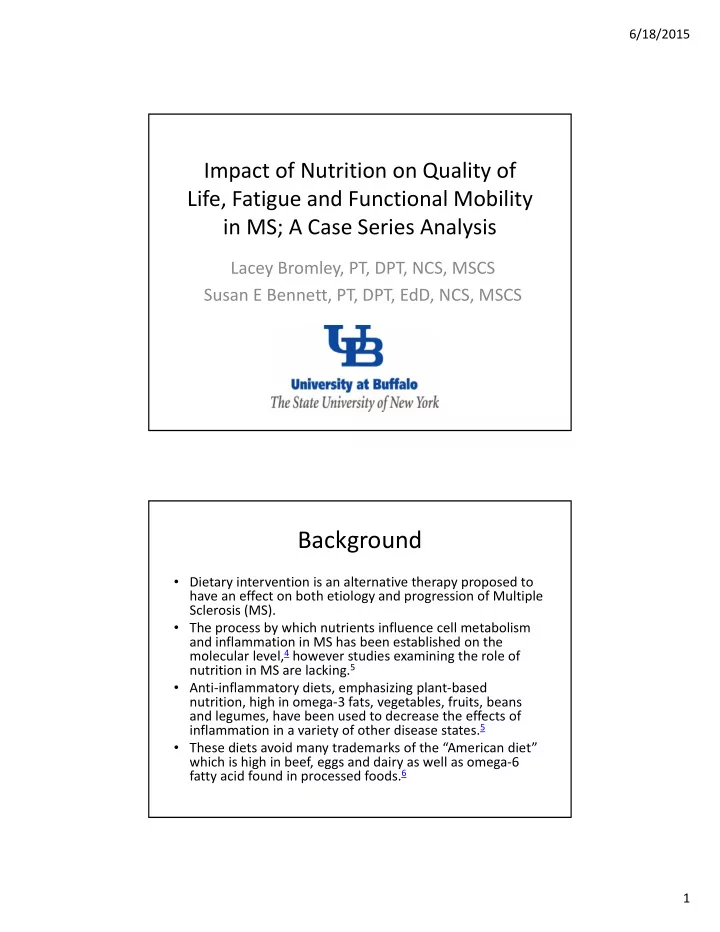
Impact of Nutrition on Quality of Life, Fatigue and Functional Mobility in MS; A Case Series Analysis

Lacey Bromley, PT, DPT, NCS, MSCS Susan E Bennett, PT, DPT, EdD, NCS, MSCS

Background

  • Dietary intervention is an alternative therapy proposed to

have an effect on both etiology and progression of Multiple Sclerosis (MS).

  • The process by which nutrients influence cell metabolism

and inflammation in MS has been established on the molecular level,4 however studies examining the role of nutrition in MS are lacking.5

  • Anti‐inflammatory diets, emphasizing plant‐based

nutrition, high in omega‐3 fats, vegetables, fruits, beans and legumes, have been used to decrease the effects of inflammation in a variety of other disease states.5

  • These diets avoid many trademarks of the “American diet”

which is high in beef, eggs and dairy as well as omega‐6 fatty acid found in processed foods.6

slide-2
SLIDE 2

6/18/2015 2

TLC diet

  • The Therapeutic Lifestyle Change (TLC), created

by the National Institute of Health (NIH) is a dietary guideline that emphasizes reducing dietary cholesterol, total fat, saturated fat, and trans fats. Complementing the diet with soluble fibers and fish while monitoring sodium intake is also suggested in the TLC protocol.7

  • The TLC diet has many components of an anti‐

inflammatory diet and has been shown to enhance T cell‐mediated immune functions.8

TLC Diet

slide-3
SLIDE 3

6/18/2015 3

AIM

  • To assess the change of self‐reported

measures of quality of life, fatigue and functional mobility in a group of subjects living with MS who follow the TLC diet.

Methods

  • Case series of 5 subjects with MS
  • Over the age of 20 years with an EDSS between

2.0 and 6.5.

  • Education regarding the TLC diet and sample

menus are provided to each subject.

  • Diet is monitored over 3 months using computer

based dietary logs

  • Diet is assessed using 3‐day food diaries and the

MEDFICTS questionnaire which is 87.5% sensitive in identifying adherence the TLC diet. 9

slide-4
SLIDE 4

6/18/2015 4

Measures Used

  • Primary outcome measures:

– Short Form ‐36 (SF‐36) – Modified Fatigue Impact Scale (MFIS) – Twelve Item MS Walking Scale (MSWS‐12) – Functional Assessment in MS (FAMS) – Fatigue Scale for Motor and Cognitive Functions (FSMC) – Multiple Sclerosis Impact Scale (MSIS‐29)

  • Assessment at baseline, 4, 8 and 12 weeks

Subject 1

  • 61 year old female
  • Rates overall health as good
  • Weight 216.5 lbs
  • Height 69 inches

– BMI = 32

  • After 2 months: 204.5 lbs

– BMI= 30.2

  • Carb/Fats/Protein

– Baseline: 43/39/18 – 2 months: 54/30/16

Baseline

Carbs Fat Protein

2 Month

Carbs Fats Proteins

slide-5
SLIDE 5

6/18/2015 5

Subject 2

  • 53 year old female
  • Rates overall health as fair
  • Weight 218 lbs
  • Height 68 inches

– BMI = 33.1

  • After 2 month: 210 lbs

– BMI = 31.9

  • Carb/Fats/Protein

– Baseline: 53/35/11 – 2 months: 43/30/26

Baseline

Carbs Fats Protein

2 Months

Carbs Fats Protein

Subject 3

  • 54 year old female
  • Rates overall health as good
  • Weight 102 lbs
  • Height 61.75 inches

– BMI = 18.8

  • No change in weight
  • Carb/Fats/Protein

– Baseline: 42/37/21 – 2 months: 44/31/25

2 Months

Carbs Fats Protein

Baseline

Carbs Fats Proteins

slide-6
SLIDE 6

6/18/2015 6

Subject 5

  • 50 year old female
  • Rates overall health as Fair
  • Weight: 300 lbs
  • Height: 66 inches

– BMI = 48.4

  • After 2 months: 272 lbs

– BMI = 43.9

  • Carb/Fats/Protein

– Baseline: 56/28/16 – 2 months: 51/29/19

Baseline

Carbs Fats Proteins

Baseline

Carbs Fats Proteins

Subject 6

  • 65 year old female
  • Rates her overall health as fair
  • Weight: 155lbs
  • Height: 71 inches

– BMI = 21.6

  • After 2 months: 145lbs

– BMI = 20.2

  • Carb/Fats/Protein

– Baseline: 21/57/22 – 2 months: 45/36/19

Baseline

Carbs Fats Proteins

2 Month

Carbs Fats Proteins

slide-7
SLIDE 7

6/18/2015 7

Results

  • This is an on going study; only preliminary

results are reported – no statistical analysis has been run.

Self Reported measures

10 20 30 40 50 60 70 80 Baseline 1 month 2 month Total MFIS MSWS‐12 raw score MSIS‐29 FSMC‐ Total

slide-8
SLIDE 8

6/18/2015 8

SF‐36 Subscales

10 20 30 40 50 60 70 80 90 100 Baseline 1 month 2 month Physical Functioning Limitation PH Limitation EP Energy/Fatigue Emotional Well Being Social functioning Pain General Health

Functional Assessment in MS (FAMS)

20 40 60 80 100 120 140 160

Total

Total 5 10 15 20 25 30 35 Baseline 1 Month 2 Month Symptom Thinking/Fatigu e Emotional Wellbeing Mobility General Contenetment Family/Social

slide-9
SLIDE 9

6/18/2015 9

Conclusions

  • Adherence to the TLC diet was reasonable for

the patients

  • Online food records may prove very useful in

sensitizing patients to their eating habits

  • While adhering to the TLC diet all functional

self report measures trended towards improvement

Strengths/Limitations

Strengths Limitations Multiple self reported measures assessed Reporting bias Online food entry for monitoring dietary habits Food not supplied Diet used has been shown to reduce inflammation Small case series – no cause and effect can be established Diet affordable and easy to adhere to No objective measures used First study to attempt to change overall diet in Multiple Sclerosis to assess functional measures All confounders not accounted for (sleep scale included) No control group

slide-10
SLIDE 10

6/18/2015 10

References

1. Embrey N. Multiple sclerosis: managing a complex neurological disease. Nursing standard (Royal College of Nursing (Great Britain) : 1987) 2014;29:49‐58. 2. Utz KS, Hoog J, Wentrup A, et al. Patient preferences for disease‐modifying drugs in multiple sclerosis therapy: a choice‐based conjoint analysis. Therapeutic advances in neurological disorders 2014;7:263‐75. 3. Weinstock‐Guttman B. An update on new and emerging therapies for relapsing‐remitting multiple sclerosis. The American journal of managed care 2013;19:s343‐54. 4. Riccio P. The molecular basis of nutritional intervention in multiple sclerosis: a narrative review. Complementary therapies in medicine 2011;19:228‐37. 5. Pauwels EK. The protective effect of the Mediterranean diet: focus on cancer and cardiovascular risk. Medical principles and practice : international journal of the Kuwait University, Health Science Centre 2011;20:103‐11. 6. Maker‐Clark G, Patel S. Integrative therapies for multiple sclerosis. Disease‐a‐month : DM 2013;59:290‐301. 7. Executive Summary of The Third Report of The National Cholesterol Education Program (NCEP) Expert Panel on Detection, Evaluation, And Treatment of High Blood Cholesterol In Adults (Adult Treatment Panel III). Jama 2001;285:2486‐97. 8. Han SN, Leka LS, Lichtenstein AH, Ausman LM, Meydani SN. Effect of a therapeutic lifestyle change diet on immune functions of moderately hypercholesterolemic humans. Journal of lipid research 2003;44:2304‐10. 9. Mochari H, Gao Q, Mosca L. Validation of the MEDFICTS dietary assessment questionnaire in a diverse

  • population. Journal of the American Dietetic Association 2008;108:817‐22.