Background World rice production in year 2007 was about 645 MT. 10% - - PDF document

background
SMART_READER_LITE
LIVE PREVIEW

Background World rice production in year 2007 was about 645 MT. 10% - - PDF document

21/07/54 Oral Presentation CRDC 5 Effect of stabilization methods on antioxidant activity in rice bran By Patiwit Loypimai Food Science & Technology Faculty of Science & Technology, Bansomdejchaopraya Rajabhat University Background


slide-1
SLIDE 1

Oral Presentation CRDC 5 21/07/54 1

Effect of stabilization methods

  • n antioxidant activity in rice bran

By Patiwit Loypimai

Food Science & Technology Faculty of Science & Technology, Bansomdejchaopraya Rajabhat University

Background

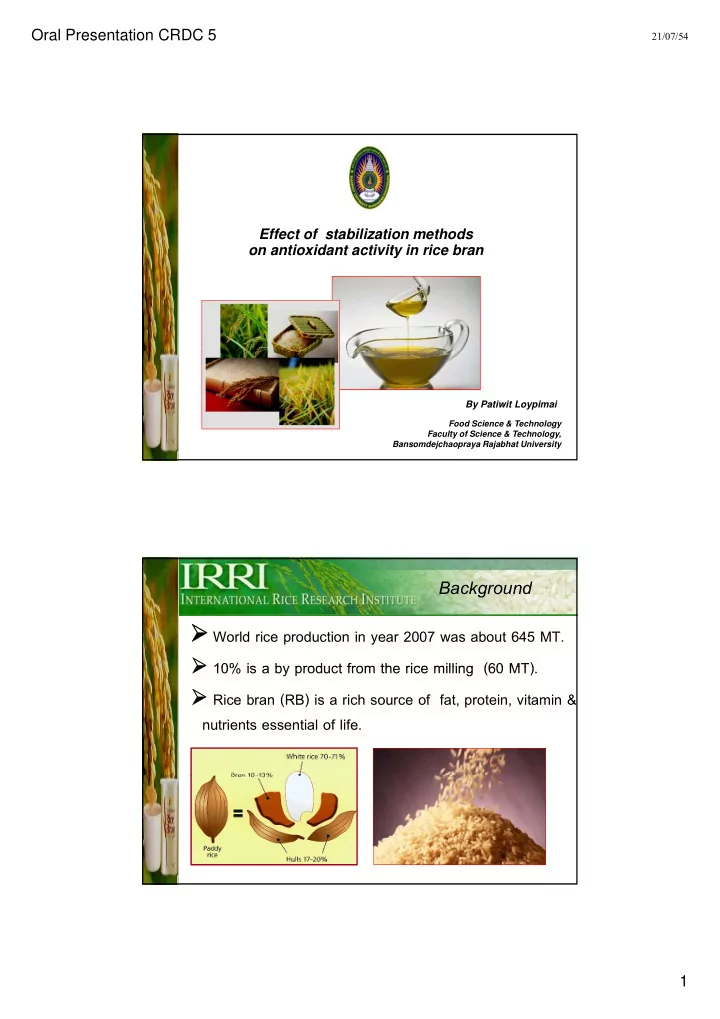
World rice production in year 2007 was about 645 MT.

10% is a by product from the rice milling (60 MT) 10% is a by product from the rice milling (60 MT). Rice bran (RB) is a rich source of fat, protein, vitamin & nutrients essential of life.

slide-2
SLIDE 2

Oral Presentation CRDC 5 21/07/54 2

Saturated Fatty Acid : Monounsaturated Fatty Acid : Polyunsaturated Fatty Acid Equal 10 : 10-15 : < 10

RB has great potential as a supplementary source of many

valuable substances, such as Vitamin E, γ-Oryzanol Nutraceuticals ppm Nutraceuticals ppm Phytosterols 2,230-4,400 γ-Oryzanol 2,200-3,000 Tocopherols Tocotrienols 210-440 Tocopherols, Tocotrienols 210 440 Polyphenols 305-309 Squalene 4,000

slide-3
SLIDE 3

Oral Presentation CRDC 5 21/07/54 3

Drawback of RB

RB Rancidity

Oxidative Hydrolytic (lipase) Enzymatic (lipoxygenase) Non Enzymatic (Autoxidation)

slide-4
SLIDE 4

Oral Presentation CRDC 5 21/07/54 4

Therefore, immediately after milling process, inactivation

enzyme and inhibition the formation of FFA are necessary. The process in doing so is called “stabilization” Such as Steaming

Stabilization methods

Extrusion Microwave heating

Disadvantage

Thermodegradation Thermodegradation Substantial moisture

removal

slide-5
SLIDE 5

Oral Presentation CRDC 5 21/07/54 5

Oh i h ti (OHM)

Alternative method

Ohmic heating (OHM) OHM occurs when alternating current is passed through a food sample, and h t i t d b i t f heat is generated by virtue of sample’s electrical resistance (Lakkakula et al., 2004)

Advantages

Rapid and uniform treatment Preventing overcooking (minimal heat damages) Environmentally friendly Reduced maintenance costs

Potential future applications exist for OHM, including its use in blanching, evaporation, dehydration, fermentation, and extraction (FAD, 2001).

slide-6
SLIDE 6

Oral Presentation CRDC 5 21/07/54 6

The objective :

To investigate the effect of different stabilization g methods on antioxidant activity in rice bran percent yield of the extracted oil

RB l

Materials and Methods

Materials

RB sample

Sieved with 20 mesh (remove broken pieces and husks) RB characteristics Stabilizations

8

slide-7
SLIDE 7

Oral Presentation CRDC 5 21/07/54 7

  • 2. Steaming

Rice Bran MC adjusted (21%)

  • 1. Microwave heating

Rice Bran MC adjusted (21%) 2450 MHz 900 W, 3 min

RB

Autoclave (105 o C, 15 min)

13

Hot air oven (60 ºC, MC~8%)

RB

Cooling (25 °C) Cooling (25 °C)

Rice Bran MC adjusted (30%)

3.Ohmic heating

Electrical field strength (E) (150 Vcm-1)

60 Hz

Data logger controller

Hot air oven (60 ºC, MC~8%) Cooling (25 °C)

RB

slide-8
SLIDE 8

Oral Presentation CRDC 5 21/07/54 8

Stabilized RB and raw RB Polyethylene zip bag Antioxidant activities DPPH radical scavenging % Oil yield Lipid peroxidation Total antioxidant capacity

Results

slide-9
SLIDE 9

Oral Presentation CRDC 5 21/07/54 9

  • 1. Rice bran characteristics
  • 1. RB particles
  • 2. Chemical compositions

Table 1. The size distribution of raw rice bran particles.

RB size % Mesh um Mesh um < 20 > 750 3.75 20 - 35 750 - 500 8.50 35 - 50 500 - 300 50.85 50 - 70 300 - 212 33.15 > 70 < 212 3.75

slide-10
SLIDE 10

Oral Presentation CRDC 5 21/07/54 10

Table 2. Chemical compositions of raw rice bran.

Chemical compositions g/ 100 g RB M i t t t 8 16 0 06 Moisture content 8.16 ± 0.06 Fat 12.38 ± 0.15 Protein 12.76 ± 0.21 Ash 11.57 ± 0.11 Carbohydrate 55.13 ± 0.20

  • 2. Effect of stabilization methods

(SM) on antioxidant activities

slide-11
SLIDE 11

Oral Presentation CRDC 5 21/07/54 11

Table 3. Effect of SMs on antioxidant activity by DPPH• scavenging & lipid peroxidation assay.

Stabilization methods DPPH radical IC50(mg/ml) Lipid peroxidation IC50(mg/ml) Raw rice bran (No heating) 160.1d 212.4d Steaming 100.2c 138.2c Microwave heating 79.1b 115.7b

21

a, b means within a column with different letters are different (p< 0.05)

Ohmic heating 65.3a 81.6a % CV 7.10 4.81 %CV : %Coefficient of variance (n=3)

2.26 2.47 2.68 2 2.5 3

weight)

1.5 0.5 1 1.5 2

Gallic eq. mg/ g (dry w

22

Raw rice bran Steaming Microwave Ohmic

Fig 1. Effect of SM on antioxidant activity by total antioxidant capacity (Gallic acid quivalent)

slide-12
SLIDE 12

Oral Presentation CRDC 5 21/07/54 12

  • 3. Effect of SMs on %yield of the

extracted RB oil

Table 4. Effect of SMs on %yield of the oil.

Stabilization methods Oil yield (%)

Raw rice bran (No heating) 12.8 c Steaming 15.8 b Microwave heating 16.1 b

a

24

a, b means within a column with different letters are different (p< 0.05)

Ohmic heating 17.4a % CV 5.21 %CV : %Coefficient of variance (n=3).

slide-13
SLIDE 13

Oral Presentation CRDC 5 21/07/54 13

Conclusion

Stabilized rice bran with OHM is an effective stabilization method. To improve the stability and preserve the antioxidant activity OHM obtained the highest percent yield of the extracted

25

OHM obtained the highest percent yield of the extracted RB oil.

26