B uchi Complementation 2 ( n log n ) BA B BA B Automata Theory - - PDF document

b uchi complementation
SMART_READER_LITE
LIVE PREVIEW

B uchi Complementation 2 ( n log n ) BA B BA B Automata Theory - - PDF document

B uchi Complementation 2 ( n log n ) BA B BA B Automata Theory Seminar BA: B uchi Automaton B uchi Complementation via AA: Alternating Alternating Automata Automaton AA A AA A Fabian Reiter Expensive: If B has n states, B has 2


slide-1
SLIDE 1

Automata Theory Seminar

B¨ uchi Complementation via Alternating Automata

Fabian Reiter July 16, 2012

B¨ uchi Complementation BA B BA B AA A AA A

2Θ(n log n)

BA: B¨ uchi Automaton AA: Alternating Automaton

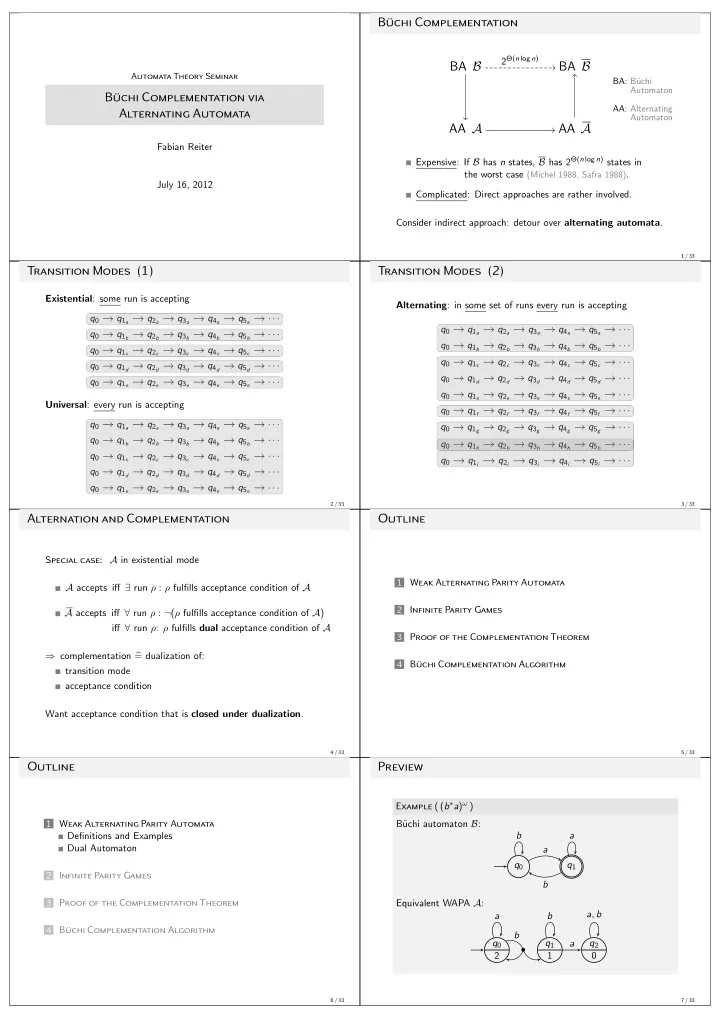
Expensive: If B has n states, B has 2Θ(n log n) states in the worst case (Michel 1988, Safra 1988). Complicated: Direct approaches are rather involved. Consider indirect approach: detour over alternating automata.

1 / 33

Transition Modes (1)

Existential: some run is accepting q0 q1a q2a q3a q4a q5a · · · q0 q1b q2b q3b q4b q5b · · · q0 q1c q2c q3c q4c q5c · · · q0 q1d q2d q3d q4d q5d · · · q0 q1e q2e q3e q4e q5e · · · Universal: every run is accepting q0 q1a q2a q3a q4a q5a · · · q0 q1b q2b q3b q4b q5b · · · q0 q1c q2c q3c q4c q5c · · · q0 q1d q2d q3d q4d q5d · · · q0 q1e q2e q3e q4e q5e · · ·

2 / 33

Transition Modes (2)

Alternating: in some set of runs every run is accepting q0 q1a q2a q3a q4a q5a · · · q0 q1b q2b q3b q4b q5b · · · q0 q1c q2c q3c q4c q5c · · · q0 q1d q2d q3d q4d q5d · · · q0 q1e q2e q3e q4e q5e · · · q0 q1f q2f q3f q4f q5f · · · q0 q1g q2g q3g q4g q5g · · · q0 q1h q2h q3h q4h q5h · · · q0 q1i q2i q3i q4i q5i · · ·

3 / 33

Alternation and Complementation

Special case: A in existential mode A accepts iff ∃ run ρ : ρ fulfills acceptance condition of A A accepts iff ∀ run ρ : ¬(ρ fulfills acceptance condition of A) iff ∀ run ρ: ρ fulfills dual acceptance condition of A ⇒ complementation = dualization of: transition mode acceptance condition Want acceptance condition that is closed under dualization.

4 / 33

Outline

1

Weak Alternating Parity Automata

2

Infinite Parity Games

3

Proof of the Complementation Theorem

4

B¨ uchi Complementation Algorithm

5 / 33

Outline

1

Weak Alternating Parity Automata Definitions and Examples Dual Automaton

2

Infinite Parity Games

3

Proof of the Complementation Theorem

4

B¨ uchi Complementation Algorithm

6 / 33

Preview

Example ( (b∗a)ω ) B¨ uchi automaton B: q0 q1 b a a b Equivalent WAPA A: q0 2

  • q1

1 q2 b a b a a, b

7 / 33

slide-2
SLIDE 2

Weak Alternating Parity Automaton

Definition (Weak Alternating Parity Automaton) A weak alternating parity automaton (WAPA) is a tuple A := Q, Σ, δ, qin, π where Q finite set of states Σ finite alphabet δ : Q × Σ → B+(Q) transition function qin initial state π : Q → N parity function

(Thomas and L¨

  • ding, ∼ 2000)

B+(Q): set of all positive Boolean formulae over Q (built only from elements in Q ∪ {∧ , ∨, ⊤, ⊥})

8 / 33

  • Transitions

Example (aω) q0 2

  • q1

1

  • q2

a a a a a δ : Q × Σ → B+(Q) q0, a → q0 ∨ (q1 ∧ q2) q1, a → (q0 ∧ q1) ∨ (q1 ∧ q2) q2, a → q2 Definition (Minimal Models) Mod↓(θ) ⊆ 2Q: set of minimal models

  • f θ ∈ B+(Q), i.e. the set of minimal

subsets M ⊆ Q s.t. θ is satisfied by q →

  • true

if q ∈ M false

  • therwise

Example Mod↓(q0 ∨ (q1 ∧ q2)) = {{q0}, {q1, q2}}

9 / 33

  • Run Graph (1)

Example (aω) q0 2

  • q1

1

  • q2

a a a a a Accepting run: q0, 0 q0, 1 q0, 2 q0, 3 q0, 4 q0, 5 · · · Rejecting run: q0, 0 q0, 1 q0, 4 q1, 2 q1, 3 q1, 4 q1, 5 · · · q2, 2 q2, 3 q2, 4 q2, 5 · · ·

10 / 33

  • Run Graph (2)

Definition (Run) A run of a WAPA A = Q, Σ, δ, qin, π on a word a0a1a2 . . . ∈ Σω is a directed acyclic graph R := V , E where V ⊆ Q × N with qin, 0 ∈ V V contains only vertices reachable from qin, 0. E contains only edges of the form

  • p, i, q, i + 1
  • .

For every vertex p, i ∈ V the set of successors is a minimal model of δ(p, ai)

  • q ∈ Q |
  • p, i, q, i + 1
  • ∈ E
  • ∈ Mod↓(δ(p, ai))

11 / 33

  • Acceptance

Definition (Acceptance) Let A be a WAPA, w ∈ Σω and R = V , E a run of A on w. An infinite path ρ in R satisfies the acceptance condition of A iff the smallest occurring parity is even, i.e. min{π(q) | ∃ i ∈N:q, i occurs in ρ} is even. R is an accepting run iff every infinite path ρ in R satisfies the acceptance condition. A accepts w iff there is some accepting run of A on w.

12 / 33

  • Infinitely many a’s

Example ( (b∗a)ω ) q0 2

  • q1

1 q2 b a b a a, b

Run on bω: q0, 0 q0, 1 q0, 2 q0, 3 q0, 4 q0, 5 q0, 6 · · · q1, 1 q1, 2 q1, 3 q1, 4 q1, 5 q1, 6 · · · b b b b b b b Run on (ba)ω: q0, 0 q0, 1 q0, 2 q0, 3 q0, 4 q0, 5 q0, 6 · · · q1, 1 q1, 3 q1, 5 · · · q2, 2 q2, 3 q2, 4 q2, 5 q2, 6 · · · b a b a b a b

13 / 33

Dual Automaton (1)

Definition (Dual Automaton) The dual of a WAPA A = Q, Σ, δ, qin, π is A := Q, Σ, δ, qin, π where δ(q, a) is obtained from δ(q, a) by exchanging ∧ , ∨ and ⊤, ⊥ π(q) := π(q) + 1 for all q ∈ Q and a ∈ Σ

14 / 33

  • Dual Automaton (2)

Example ( (b∗a)ω ) WAPA A: q0 2

  • q1

1 q2 b a b a a, b

δ(q0, a) = q0 δ(q0, b) = q0∧q1 δ(q1, a) = q2 δ(q1, b) = q1 δ(q2, a) = q2 δ(q2, b) = q2

Dual A: q0 3 q1 2 q2 1 a, b b b a a, b

δ(q0, a) = q0 δ(q0, b) = q0∨q1 δ(q1, a) = q2 δ(q1, b) = q1 δ(q2, a) = q2 δ(q2, b) = q2

15 / 33

slide-3
SLIDE 3

Complementation Theorem

Main statement of this talk: Theorem (Complementation) The dual A of a WAPA A accepts its complement, i.e. L(A) = Σω \ L(A)

(Thomas and L¨

  • ding, ∼ 2000)

16 / 33

Outline

1

Weak Alternating Parity Automata

2

Infinite Parity Games

3

Proof of the Complementation Theorem

4

B¨ uchi Complementation Algorithm

17 / 33

Automaton vs. Pathfinder

18 / 33

c a b

player A find accepting run R player P find rejecting path in R

Infinite Parity Game (1)

Example (aω) q0 2

  • q1

1

  • q2

A: w = aω a a a a a Game GA,w: q0, 0 {q0}, 0 q0, 1 {q0}, 1 q0, 2 · · · {q1, q2}, 1 · · · q1, 1 {q0, q1}, 1 q1, 2 · · · {q1, q2}, 0 q2, 1 {q2}, 1 q2, 2 · · ·

19 / 33

  • Infinite Parity Game (2)

Definition (Game) A game for a WAPA A = Q, Σ, δ, qin, π and w = a0a1a2 . . . ∈ Σω is a directed graph GA,w := VA ˙ ∪ VP, E where VA := Q × N (decision nodes of player A) VP := 2Q × N (decision nodes of player P) E ⊆ (VA × VP) ∪ (VP × VA) s.t. the only contained edges are

q, i, M, i

  • iff

M ∈ Mod↓(δ(q, ai))

M, i, q, i + 1

  • iff

q ∈ M

for q ∈ Q, M ⊆ Q, i ∈ N

(Thomas and L¨

  • ding, ∼ 2000)

20 / 33

  • Playing a Game

Definition (Play) A play γ in a game GA,w is an infinite path starting with qin, 0. Definition (Winner) The winner of a play γ is player A iff the smallest parity of occurring VA-nodes is even player P · · · · · · · · · · · · · · · · · · · · · · · · · · · · · · · · odd X ∈ {A, P}: a player, X: its opponent Definition (Strategy) A strategy fX : VX → VX for player X selects for every decision node of player X one of its successor nodes in GA,w. fX is a winning strategy iff player X wins every play γ that is played according to fX.

21 / 33

  • Strategies

Example

Winning strategy for player A (so far): q0, 0 {q0}, 0 q0, 1 {q0}, 1 q0, 2 · · · q0 → 2 {q1, q2}, 1 · · · q1, 1 {q0, q1}, 1 q1, 2 · · · q1 → 1 {q1, q2}, 0 q2, 1 {q2}, 1 q2, 2 · · · q2 → 0 parities Not a winning strategy for player A: q0, 0 {q0}, 0 q0, 1 {q0}, 1 q0, 2 · · · {q1, q2}, 1 · · · q1, 1 {q0, q1}, 1 q1, 2 · · · {q1, q2}, 0 q2, 1 {q2}, 1 q2, 2 · · ·

22 / 33

Outline

1

Weak Alternating Parity Automata

2

Infinite Parity Games

3

Proof of the Complementation Theorem Lemma 1 Lemma 2 Lemma 3

Sublemma

Putting it All Together

4

B¨ uchi Complementation Algorithm

23 / 33

slide-4
SLIDE 4

Lemma 1

Let A be a WAPA and w ∈ Σω. Lemma 1 Player A has a winning strategy in GA,w iff A accepts w. Explanation (oral):

Player A wins every play γ played according to fA. There is a run graph R in which every path ρ is accepting. · · · q, i + 1 p, i {q, q′, q′′}, i q′, i + 1 · · · q′′, i + 1 GA,w: q, i + 1 p, i q′, i + 1 q′′, i + 1 R:

24 / 33

Lemma 2

Let A be a WAPA and w ∈ Σω. Lemma 2 Player P has a winning strategy in GA,w iff A does not accept w.

(pointed out by Jan Leike)

Explanation (oral):

Player P wins every play γ played according to fP. Every run graph R contains a rejecting path ρ. · · · {.., q, ..}, i q, i + 1 · · · · · · p, i {.., q′, ..}, i q′, i + 1 · · · · · · {.., q′′, ..}, i q′′, i + 1 · · · GA,w: · · · p, i q, i + 1 · · · R: · · · p, i q′, i + 1 · · · R′: · · · p, i q′′, i + 1 · · · R′′:

25 / 33

Sublemma

Let θ ∈ B+(Q) be a formula over Q. Sublemma S ⊆ Q is a model of θ iff for all M ∈ Mod↓(θ): S ∩ M = ∅. Proof: W.l.o.g. θ is in DNF, i.e. θ =

  • M∈Mod↓(θ)
  • q∈M

q Then θ is in CNF, i.e. θ =

  • M∈Mod↓(θ)
  • q∈M

q Thus S ⊆ Q is a model of θ iff it contains at least one element from each disjunct of θ.

26 / 33

  • Lemma 3 (1)

Let A be a WAPA, A its dual and w = a0a1a2 . . . ∈ Σω. Lemma 3 Player A has a winning strategy in GA,w iff player P has a winning strategy in GA,w. Proof: ⇒ Construct a winning strategy fP for player P in GA,w. · · · ⇐ Construct a winning strategy fA for player A in GA,w. · · ·

27 / 33

Lemma 3 (2)

⇒ Construct a winning strategy fP for player P in GA,w.

At position S, i∈VP in GA,w: · · · · · · p, i S, i q, i + 1 · · · · · · · · · · · · in GA,w: · · · · · · p, i M, i q, i + 1 · · · · · · · · · · · · fA: winning strategy for player A in GA,w Assume there is p, i∈VA occurring in a play γ in GA,w played according to fA s.t. S ∈ Mod↓(δ(p, ai)) (otherwise don’t care). fA

  • p, i
  • =M, i ⇒ M ∈ Mod↓(δ(p, ai))

(sublemma)

= ⇒ There exists a q ∈S ∩ M. Define fP

  • S, i
  • := q, i + 1

∀ γ: play in GA,w played according to fP ∃ γ: play in GA,w played according to fA s.t. γ and γ contain the same VA-nodes.

  • Player A wins γ in GA,w.
  • ∀ q ∈Q : π(q) = π(q) + 1

⇒ Player P wins γ in GA,w.

28 / 33

Lemma 3 (3)

⇐ Construct a winning strategy fA for player A in GA,w.

At position p, i∈VA in GA,w: · · · q, i + 1 p, i M, i q′, i + 1 · · · q′′, i + 1 · · · in GA,w: · · · S, i q, i + 1 · · · · · · p, i S′, i q′, i + 1 · · · · · · S′′, i q′′, i + 1 · · ·M∗ fP: winning strategy for player P in GA,w M∗ :=

  • q ∈ Q | ∃ S ∈Mod↓(δ(p, ai)) :

fP

  • S, i
  • = q, i + 1
  • (sublemma)

= ⇒ M∗ is a model of δ(p, ai). M: subset of M∗ that is a minimal model M ⊆ M∗, M ∈ Mod↓(δ(p, ai)) Define fA

  • p, i
  • := M, i

∀ γ: play in GA,w played according to fA ∃ γ: play in GA,w played according to fP s.t. γ and γ contain the same VA-nodes.

  • Player P wins γ in GA,w.
  • ∀ q ∈Q : π(q) = π(q) − 1

⇒ Player A wins γ in GA,w.

29 / 33

All Three Lemmas

Let A be a WAPA, A its dual and w ∈ Σω. Lemma 1 Player A has a winning strategy in GA,w iff A accepts w. Lemma 2 Player P has a winning strategy in GA,w iff A does not accept w. Lemma 3 Player A has a winning strategy in GA,w iff player P has a winning strategy in GA,w.

30 / 33

  • Complementation Theorem

Theorem (Complementation) The dual A of a WAPA A accepts its complement, i.e. L(A) = Σω \ L(A)

(Thomas and L¨

  • ding, ∼ 2000)

Proof: A accepts w

(lemma 1)

⇐ ⇒ player A has a winning strategy in GA,w

(lemma 3)

⇐ ⇒ player P has a winning strategy in GA,w

(lemma 2)

⇐ ⇒ A does not accept w

31 / 33

slide-5
SLIDE 5

Outline

1

Weak Alternating Parity Automata

2

Infinite Parity Games

3

Proof of the Complementation Theorem

4

B¨ uchi Complementation Algorithm

32 / 33

B¨ uchi Complementation Algorithm BA B BA B WAPA A WAPA A

2Ω(n log n) O(n2) O(1) 2O(n) Total complexity: 2O(n2) Can reach 2O(n log n) (lower bound) by improving A → B.

33 / 33

  • References

Thomas, W. (1999) Complementation of B¨ uchi Automata Revisited.

In J. Karhum¨ aki et al., editors, Jewels are Forever, Contributions on Th.

  • Comp. Science in Honor of Arto Salomaa, pages 109–122, Springer.

Klaedtke, F. (2002) Complementation of B¨ uchi Automata Using Alternation.

In E. Gr¨ adel et al., editors, Automata, Logics, and Infinite Games, LNCS 2500, pages 61-77. Springer.

  • ding, C. and Thomas, W. (2000)

Alternating Automata and Logics over Infinite Words.

In J. van Leeuwen et al., editors, IFIP TCS 2000, LNCS 1872, pages 521–535. Springer.

Kupferman, O. and Vardi, M. Y. (2001) Weak Alternating Automata Are Not that Weak.

In ACM Transactions on Computational Logic, volume 2, No. 3, July 2001, pages 408–429.

Appendix From BA to WAPA

Given: B = Q, Σ, δ, qin, F: BA n = |Q| Construction (BA → WAPA) A :=

  • Q×{0, . . . , 2n}
  • O(n2)

, Σ, δ′, qin, 2n, π

  • where

δ′(p, i, a) :=           

  • q∈δ(p,a) q, 0

if i = 0

  • q∈δ(p,a) q, i ∧ q, i − 1

if i even, i > 0

  • q∈δ(p,a) q, i

if i odd, p / ∈ F

  • q∈δ(p,a) q, i − 1

if i odd, p ∈ F π(p, i) := i for p ∈ Q, a ∈ Σ, i ∈ {0, . . . , 2n}

(Thomas and L¨

  • ding, ∼ 2000)

Back

  • From WAPA to BA

Given: A = Q, Σ, δ, qin, π: stratified WAPA, i.e. ∀p ∈Q ∀a∈Σ : δ(p, a) ∈ B+ {q ∈ Q | π(p) ≥ π(q)}

  • E ⊆ Q: all states with even parity

Construction (WAPA → BA) B :=

  • 2Q×2Q

2O(n)

, Σ, δ′, {qin}, ∅, 2Q×{∅}

  • where

δ′(M, ∅, a) :=

  • M′, M′\E
  • M′ ∈ Mod↓

q∈M δ(q, a)

  • δ′(M, O, a) :=
  • M′, O′\E
  • M′ ∈ Mod↓

q∈M δ(q, a)

  • ,

O′ ⊆ M′, O′ ∈ Mod↓

q∈O δ(q, a)

  • for a ∈ Σ, M, O ⊆ Q, O = ∅

(Miyano and Hayashi, 1984)

Back