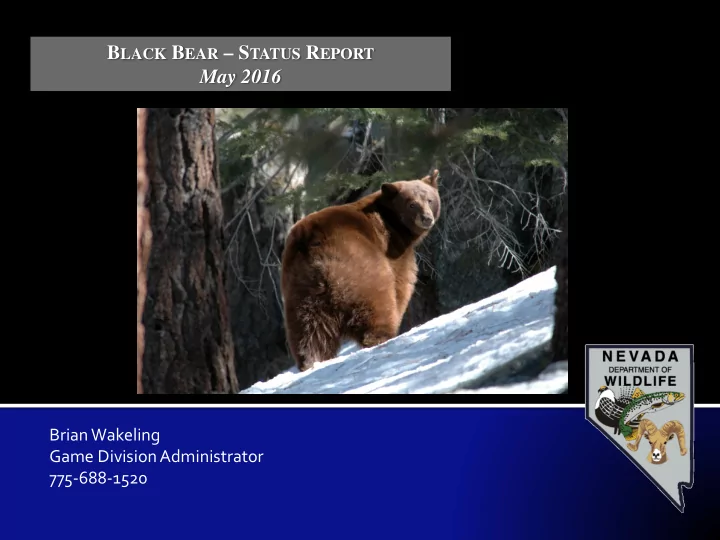
B LACK B EAR S TATUS R EPORT May 2016 Brian Wakeling Game - - PowerPoint PPT Presentation
B LACK B EAR S TATUS R EPORT May 2016 Brian Wakeling Game Division Administrator 775-688-1520 Public safety 9 Hit by vehicle 21 H ISTORICAL AND C URRENT R ANGE Original distribution derived from historical articles and
Public safety – 9 Hit by vehicle – 21
HISTORICAL AND CURRENT RANGE
Original distribution derived from historical articles and pioneer journals Current distribution - those areas containing known viable populations Extirpated from states’ interior by early 1900s Recolonization occurring since probably early 1980s
Lackey et al. 2013
HISTORICAL AND CURRENT RANGE
Original distribution derived from historical articles and pioneer journals Current distribution - those areas containing known viable populations Extirpated from states’ interior by early 1900s Recolonization occurring since probably early 1980s
Lackey et al. 2013
Expansion into historic habitat noted
Long-Term Black Bear Research – Twentieth Year
Data collection since 1997 Management Plan 2012 Two approaches to population assessment
- Population monitoring
- Harvest monitoring
Sample size of 825 individual bears to date Individually marked 499 bears Deployed >100 radiotelemetry collars Among the most intensively studied populations in
the US
Cooperative Research with University of Nevada,
Reno and Wildlife Conservation Society
PUBLICATIONS AND PRODUCTS
- Three internationally recognized experts associated with this work over the 20 year period
Jon Beckmann, Joel Berger, and Jim Sedinger
- Eight peer refereed manuscripts in professional
journals plus three more in draft.
- Four population estimates generated
- 2002 - 180 ± 117 4 years n = 99 bears
- 2008 - 253 ± 27
12 years n = 420
- 2011 - 456 ± 39
15 years n = 532
- 2014 - 445 ± 14
18 years n = 601 500-700 bears in state – current estimate
Study area plus surrounding ranges
Results in population models are inherently conservative Heterogeneity in capture probabilities Uncertainty is a given, but it decreases with higher sample sizes Further conservatism built into analysis
337 bears removed from model
- dead on first encounter
- dependent cubs with no further encounters
Current levels of mortality accounted for Estimates based on results from study area which excludes surrounding ranges due to very low sample sizes in those areas
POPULATION ESTIMATES ARE CONSERVATIVE
- Bear population will be monitored and adaptive
management will be applied.
- Involves analyzing available information and applying a
management action followed by a thorough evaluation and adjustment of management programs as needed. Trends in population demographics Mortality data evaluated on a running 3-year average per NDOW Black Bear Management Plan
SPECIES MANAGEMENT PLAN
HARVEST DATA TO DATE 2011-2015
2011 2012 2013 2014 2015 3 yr Current Harvest All Years
number males 9 10 10 12 8
30
49 number females 5 1 4 6 6
16
22 total killed 14 11 14 18 14
46
71 available tags 45 45 45 45 45 harvest limit 20 20 20 20 20
% females
36% 9% 29% 33% 43%
35%
Moderate 31%
% adult females ≥5 in female harvest
80% 100% 75% 100% 83%
75%
Light 77% #females ≥5 4 1 1 6 5
Mean age males
5.9 5.1 6.1 7 8.5
7.1
Light 6.6 Mean age females 6.9 9.0 7.8 10.5 6.5
8.3
7.8 Mean age - all 5.9 5.5 6.6 8.2 7.6
7.5
6.9 Male/Female 1.8 10.0 2.5 2.0 1.3
1.9
2.2 Success rate 31% 24% 31% 40% 31%
34%
32%
HARVEST DATA TO DATE 2011-2015
69% used dogs (49 of 71) 15 tagged bears taken 2 citations issued 56 bears pursued and treed but not killed 55% killed in Unit 291 – Pinenuts
ADDITIONAL HUNT STATISTICS
2011 2012 2013 2014 2015 3 yr
Current Harvest All Years
number males 4 4 4 8 5
17
25 number females 3 1 3 6
10
13 total killed 7 4 5 11 11
27
38 available tags 45 45 45 45 45 harvest limit 20 20 20 20 20
% females
43% 0% 20% 0.3 55%
37%
Moderate 34%
% adult females ≥5 in female harvest
67% 0% 0% 100% 83%
80%
Light 77% #females ≥5 2 3 5
Mean age males
7.0 4.8 5.3 7.4
6.9
Light 6.6 Mean age females 5.7 0.0 2.0 7.0 7.0
6.5
6.3 Mean age - all 6.4 4.8 4.6 7.3 7.3
6.8
6.5 Male/Female 1.3 #DIV/0! 4.0 2.7 0.8
1.7
1.9 Success rate 16% 9% 11% 0.2 24%
20%
17%
PINENUT RANGE - HARVEST DATA 2011-2015
APPLICATION STATISTICS 2011-2016
- 11,935 total applications (not including bonus
point only apps)
Applicants representing 36 states and 1
foreign country
- > 11,300 Nevada resident applications
- 1,230 from Clark County (10% of total apps)
- > 600 non-resident applications
POPULATION STATISTICS
SEDINGER 2014
Population continues to grow but at a slower rate compared to earlier period. Reaching K? Growth in population is representative of both sexes.
λ > 1
“I checked for a change in survival following implementation of the hunting season in 2011 and could find no effect.”
- Dr. James Sedinger – population ecologist, UNR
CONTINUED MONITORING AND RESEARCH
Habitat modeling - RSFs Columbia University DNA mapping – immigration & population connectivity University Nevada, Reno Isotope analysis University of Tennessee
Tim Torell