
SLIDE 1
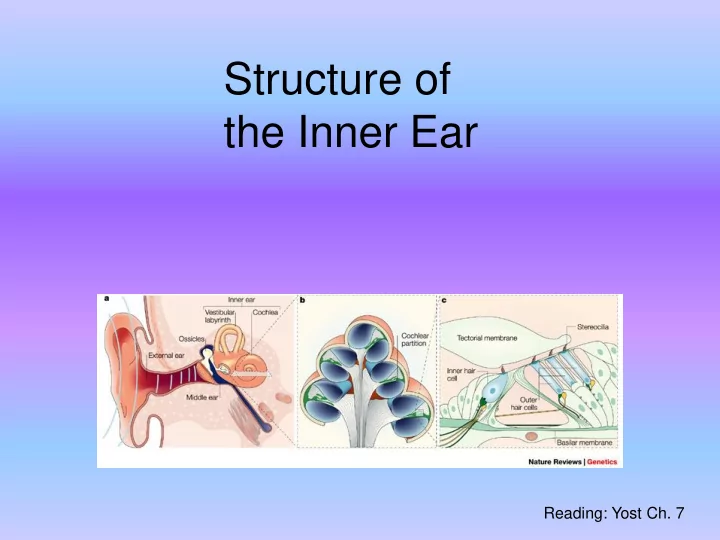
Structure of the Inner Ear
Reading: Yost Ch. 7
the Inner Ear Reading: Yost Ch. 7 The Mammalian Ear The Inner Ear - - PowerPoint PPT Presentation
Structure of the Inner Ear Reading: Yost Ch. 7 The Mammalian Ear The Inner Ear Inner ear contains two sensory structures in one organ: Vestibular apparatus , which contains mechanosensory organs for balance (orientation re gravity), head
Reading: Yost Ch. 7
Inner ear contains two sensory structures in one organ:
contains mechanosensory
re gravity), head acceleration in three dimensions.
mechanosensory epithelium for hearing (“Organ of Corti”). Vestibular and cochlear output fibers gather to become the VIIIth cranial nerve (vestibulocochlear).
Transduction:
sound frequencies along the basilar membrane
bank” of auditory receptors (“hair cells”), which convert sound energy into neurophysiological responses.
Transmission:
auditory nerve fibers (ANFs).
frequency, amplitude, and timing of the acoustic stimulus, and relay that encoded information to the central auditory system.
A bony, three-chambered tubular structure. Coiled into a 2.5-turn helix, 35 mm long (human) from base (stapes/oval window) to apex. Central axis of helix is refered to as the modiolus (mō-dī´-ō-lus). The cell bodies
fibers) are located in the modiolus. Basilar membrane (BM; “cochlear partition”) extends along entire length Organ of Corti (sensory epithelium) rests on the BM.
Basilar membrane Oval window Stapes Round window
Apex Base
Oval window membrane attached to stapes, faces into the vestibule. The bony labyrinth is the rigid
consists of three parts: the vestibule, semicircular canals and cochlea. They contain a clear fluid (brown), called the perilymph, in which floats the membranous labyrinth (blue). Vestibule leads into the upper duct of the cochlea, called the scala vestibuli.
Scala vestibuli
is a perilymph-filled cavity inside the cochlea of the inner ear that conducts sound vibrations to the cochlear duct (S. media).
by Reissner’s membrane, and extends from the vestibule of the inner ear to the helicotrema at the apex of the cochlea, where it joins the tympanic duct (S. tympani). Scala tympani
the basilar membrane
round window at the base (middle ear)
Scala media: closed tube bounded by Reissner’s and basilar membranes. It includes:
containing the auditory hair cell receptors.
and metabolic composition of fluid (“endolymph”) in scala media.
Perilymph:
vestibuli.
extracellular fluid (high Na+, low K+). Endolymph:
intracellular fluid (high K+, low Na+).
against concentration gradients to maintain ion balance in endolymph.
P E P
Basilar membrane: membrane extending from spiral ligament (attached to outer wall) to osseous spiral lamina, a bony shelf or ledge which projects from the modiolus. Basilar membrane changes in width and thickness along
0.5 mm wide 0.04 mm wide
The organ of Corti is the receptor organ for hearing. It is composed of mechano- sensory cells, known as hair cells. There are three rows of outer hair cells (OHCs) and one row of inner hair cells (IHCs). Deiter’s (phalangeal) cells support the hair cells.
Sound is transduced by mechanoreceptors called hair cells. Two types of auditory hair cells in mammals: Outer HC (n = ~12,000) Inner HC (n = ~3000)
Confocal image of organ of Corti (Dr. Sonja Pyott; UNC Wilmington). Hair cells are stained green (fluorescent phalloidin; actin): IHC – lower left; OHC – upper right; note the stereocilia at their tips. Nuclei of the IHCs are stained blue (DAPI). Auditory nerve fibers are stained red.
IHCs form a single, uninterrupted row along basilar membrane, medial to the supporting pillar cells. OHCs form 3 – 4 rows, lateral to pillar cells.
Top view of Organ of Corti, tectorial membrane removed (Raphael et al. 1991) Top of Pillar Cells
Border cells: support modiolar side of IHCs. Pillar cells: one on each side of “tunnel of Corti”, support basilar membrane Deiter’s cells: support base of OHCs, phalangeal process extends to reticular lamina Henson’s cells: reinforce outer wall of Organ of Corti. Claudius’ cells: overlie the basilar membrane.
Pillar Border Deiter’s Henson’s
Claudius’
Tectorial Membrane (TM):
embedded in TM.
Kiang 1984
Reticular lamina:
HCs, pillar cells, phalangeal processes of Deiter’s cells.
ion flow in extracellular space, electrically isolating scala media from soma of hair cell.
Hair cells (epithelial cells) are the sensory receptors of both the auditory and vestibular systems. Through mechanotransduction, hair cells detect movement in their environment. Auditory hair cells are located within the organ of Corti on the basilar
from the tufts (bundles) of stereocilia that protrude from the apical surface
Pre- and postsynaptic structures located at basal pole.
Geisler (1998) Hackney et al. (1993)
Organized in rows of increasing length on apical surface of hair cell. Longest stereocilia (kinocilia) face away from modiolus (toward stria vascularis). Base of hair bundle supported by mechanically stiff “cuticular plate”. IHCs: rows of cilia, arranged in a shallow “U”. OHCs: rows of cilia arranged in “V”
Stereocilia (SC) filled with rod- like structural proteins (e.g., actin) that make them resistant to bending. Flanks are inter-connected (by glycoproteins). Protein tip links (e.g. cadherin- 23; protocadherin-15) connect tips of shorter SC to flanks of taller SC. Tip links are critical to transduction: mutations cause deafness.
length of cochlea.
& Outer (3/4 rows)
tips.