Automatic Synthesizer Preset Generation with PresetGen Kvan Tatar, - - PowerPoint PPT Presentation

automatic synthesizer preset generation with presetgen
SMART_READER_LITE
LIVE PREVIEW

Automatic Synthesizer Preset Generation with PresetGen Kvan Tatar, - - PowerPoint PPT Presentation

Automatic Synthesizer Preset Generation with PresetGen Kvan Tatar, Matthieu Macret, Philippe Pasquier ENGAGING THE WORLD The preset generation problem Modern synthesizers are very powerful and have many parameters resulting in a vast


slide-1
SLIDE 1

ENGAGING THE WORLD

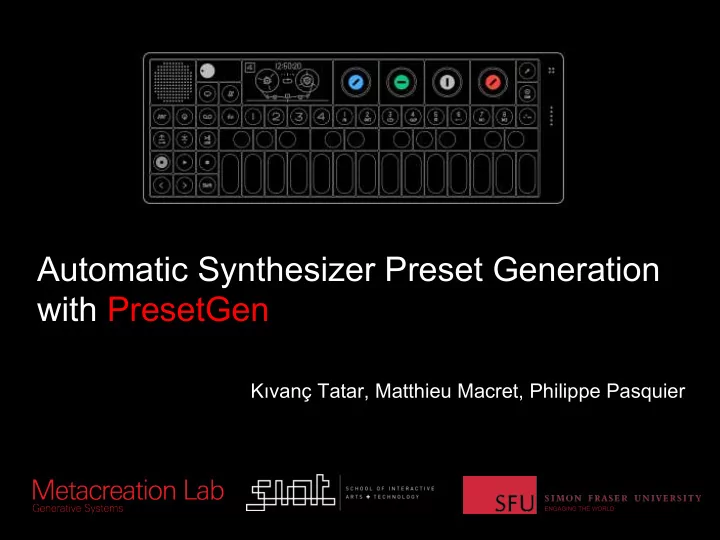
Automatic Synthesizer Preset Generation with PresetGen

Kıvanç Tatar, Matthieu Macret, Philippe Pasquier
slide-2
SLIDE 2

2

The preset generation problem

  • Modern synthesizers are very powerful and have many

parameters resulting in a vast and complex search space.

  • The possibilities of a given synthesizer are unknowns and

the search space is beyond human grasp.

  • Preset search is time-consuming and tedious.

– Musicians and sound designers spend time tuning parameters instead of making music. – The solution found might not be optimal

We want to automate preset generation: Given a target sound, and a synthesizer, give me a preset for that sound.

slide-3
SLIDE 3

Example synthesizer: the OP-1

  • The OP-1 is a commercial synthesizer that has a very large presets search space:
  • 7 synthesis engines
  • 3 types of LFO (Low frequency oscillators)
  • 4 types of special effects
  • 120 keys
  • The total number of distinct presets is of the order of 1076
  • Added challenges: The space is highly discontinuous and the synthesis

engines are non-deterministic (adding warmth to the sound).

Each with 4 parameters with 32767 possible values each

slide-4
SLIDE 4

4

Our solution: PresetGen

  • We use evolutionary algorithms to locate multiple distinct

OP-1 presets to replicate a given target sound

  • We minimize the 3 objectives distances (Envelope, FFT,

STFT) using a multi-objective genetic algorithm: the Non- dominated Sorting Genetic Algorithm-II (NSGA-II)

NSGA-II

Target sound ... OP-1 presets

slide-5
SLIDE 5

5

1st Objective: Temporal envelope distance

Target sound OP-1 generated sound Euclidian distance

slide-6
SLIDE 6

6

2nd objective: FFT distance for spectral signature

slide-7
SLIDE 7

7

3rd objective: STFT distance for spectral content dynamic

slide-8
SLIDE 8

8

Results

  • 2. We evolve presets
  • 3. We cluster the Pareto front
  • 4. We return a variety of presets

that approximate the target sound using various synthesis methods!

  • 1. We analyse the target

sound

slide-9
SLIDE 9

9

Examples

Engine FX LFO Key Octave Cluster InacCve InacCve 12 Engine FX LFO Key Octave Cluster Punch InacCve 0 1 Engine FX LFO Key Octave FM Grid Element 0 1

slide-10
SLIDE 10

10

Engine FX LFO Key Octave Digital Delay Tremolo 9 1

Examples of instruments

Engine FX LFO Key Octave String Delay Tremolo 44 1

slide-11
SLIDE 11

Empirical Evaluation

  • PresetGen compared to

human sound designers.

– 8 target sounds: – 3 human sound designer – 14 auditors judge similarity across dimensions.

  • Results:

– PresetGen sounds rated more similar to target (avg 17%) – PresetGen outperform humans at the task both in competency and efficiency.

11

slide-12
SLIDE 12

12

In Conclusion: PresetGen automates a creative task to human competitive levels and would fit well at a computer-assisted creativity tools in many synthesizers.

DEAP