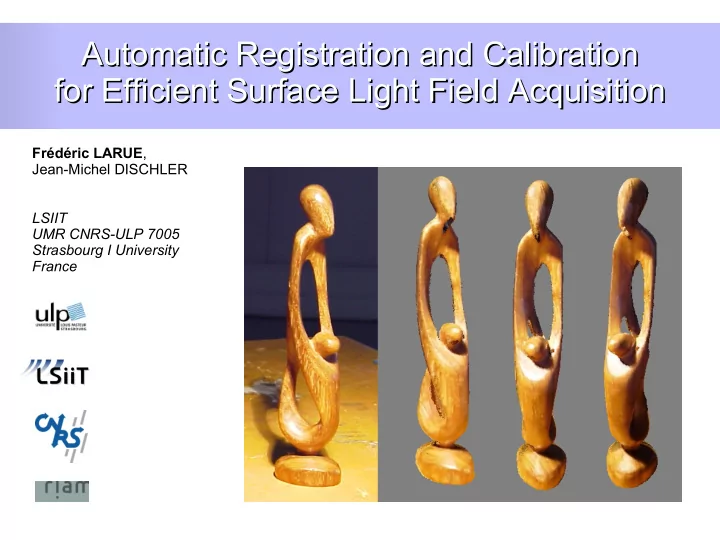
SLIDE 1 Automatic Registration and Calibration for Efficient Surface Light Field Acquisition Automatic Registration and Calibration Automatic Registration and Calibration for Efficient Surface Light Field Acquisition for Efficient Surface Light Field Acquisition
Frédéric LARUE, Jean-Michel DISCHLER LSIIT UMR CNRS-ULP 7005 Strasbourg I University France
SLIDE 2
Motivations Motivations
Context:
National project funded by the french ministry of research. RIAM-project AMI3D (no. 04 C 292). Archiving and Micro-Identification in 3 Dimensions: Visualization (virtual galleries). Authentication.
Goals:
Visualization: capturing the shape and the appearance. Measurements made by non specialist operators: Automated processings.
SLIDE 3
Motivations Motivations
Why surface light fields? Why surface light fields? Surface light field:
Representation of the radiance over the surface. Free walkthrough within a fixed lighting environment.
Our choice:
Rendering of art pieces in the conditions of the museum.
Geometry and radiance must be captured.
SLIDE 4
Shape measurement Shape measurement
Problematic Problematic Digitization devices:
Not able to capture a whole surface at a time. Require several acquisitions. Each one is defined in its own local frame.
Using a digitization bench:
Register the movement of the scanner wrt. the object. Expensive device. Mobility constraints: cannot be displaced to a measurement site.
Numerical solutions are prefered.
SLIDE 5 Shape measurement Shape measurement
Related work Related work Iterative methods:
[Besl 92], [Turk 94], [Benjemaa 99], [Greenspan 00], [Greenspan 01]
Accurate but not automatic (require an initial alignement).
Feature extraction:
[Zhang 04], [Rusinkiewicz 02]
Automatic but scene dedicated methods.
Invariant characteristics:
[Johnson 97], [Chen 98], [Zhang 99]
No assumption about the scene but computationnally expensive
Global registration:
[Pulli 99], [Huber 01], [Nishino 02], [Zhang 04]
Often based on iterative methods: not totally automatic.
SLIDE 6
Radiance measurement Radiance measurement
Problematic Problematic Capturing effects due to the observer's displacements:
Sampling from multiple viewpoints.
Interpreting the resulting data:
Determining viewpoint for each picture. Registering pictures with the acquired geometry.
Solved by using a camera calibration solution:
Point-pixel correspondences must be known.
SLIDE 7 Radiance measurement Radiance measurement
Related work Related work Target extraction:
[Chen 02]
Occlusion problems. Image segmentation may fail.
Silhouette matching:
[Matsushita 99]
May fail with symetrical object.
Infering image-to-geometry correspondences:
[Franken 05]
Able to automatically generate new correspondences. But an initial set must be provided.
SLIDE 8
Acquisition of surface light fields Acquisition of surface light fields
Method overview Method overview Our acquisition protocol:
Automatic range image registration / camera calibration. Mobility constraint – only a lightweight device involved. Suited to the measurement of art pieces. Fast – interactive feedback during the measurement.
SLIDE 9 Acquisition of surface light fields Acquisition of surface light fields
Structured light & parameterization Structured light & parameterization Phase-shifting structured light:
Projection of a gray-scale sinusoid. Capture of the sinusoid phase at each surface point.
Induce a 1D-parameterization of the surface:
Produce a set of strictly different iso-phase lines.
Iso-phase lines observed
Projection of a gray scale sinusoidal pattern
SLIDE 10 Acquisition of surface light fields Acquisition of surface light fields
Structured light & parameterization Structured light & parameterization Extension to a 2D-parameterization:
Projection for two stripes orientations. Each surface point is the intersection of two iso-phase lines. Defines a unique couple of coordinates.
1D-parameterization for the first stripes orientation A unique couple of coordinates is defined at each surface point 1D-parameterization for the second stripes orientation
SLIDE 11 Acquisition of surface light fields Acquisition of surface light fields
Structured light & parameterization Structured light & parameterization
Projection of the 2D-parameterization Search inside the two viewpoints the elements whose phase coordinates are similar Acquisition of the 2D-parameterization from two different viewpoints
Extraction of correspondences:
SLIDE 12 Acquisition of surface light fields Acquisition of surface light fields
Step 1 – Local sampling block Step 1 – Local sampling block
The radiance is locally sampled by a set of pictures calibrated with respect to the current range image
SLIDE 13 Acquisition of surface light fields Acquisition of surface light fields
Step 1 – Local sampling block Step 1 – Local sampling block
The example of an acquired local sampling block, made of a range image and a set of locally calibrated viewpoints
SLIDE 14 Acquisition of surface light fields Acquisition of surface light fields
Step 2 – Block registration Step 2 – Block registration
The use of the external camera as a fixed reference between two successive scanner poses
SLIDE 15
Acquisition of surface light fields Acquisition of surface light fields
Step 3 – Merge data Step 3 – Merge data Mesh reconstruction:
Merging the overlapping registered range images. VRIP algorithm [Curless 96].
Set radiance on geometry:
Associate the appropriate sampling to each geometric primitive. Image space reprojection of the reconstructed mesh. Use the optical parameters fitted during viewpoints calibration.
SLIDE 16 Results Results
Renderings Renderings
The African wood statue: 6 range images, 42 viewpoints The Greek vase: 5 range images, 23 viewpoints
Renderings of two acquired surface light fields:
SLIDE 17 Our method is less accurate... But ICP is not totally automatic. May fall into a local minimum.
Results Results
Registration accuracy Registration accuracy
Angel Greek 1 Greek 2 African 0,025 0,05 0,075 0,1 0,125 0,15 0,175 0,2 0,225 0,25 0,275 0,3 0,325 0,35
Comparison against ICP
ICP Φ-param.
Data set Avg.dist. between reg. surf. (mm)
SLIDE 18 Two scanners One scanner ICP 0,05 0,1 0,15 0,2 0,25 0,3 0,35
Comparison of two variants The intermediate camera introduces additionnal uncertainties. Two scanners: more accurate, but less than ICP.
Results Results
Registration accuracy Registration accuracy
SLIDE 19 Evaluation of the error accumulation:
Venus at bath: chained registration of 23 range images: The accumulation has a low incidence. Induces no significant reconstruction artifact.
Results Results
Registration accuracy Registration accuracy
Measurement of the error accumulation for the registration chain of the Venus at Bath, made of 23 range images
SLIDE 20 Timings for pairwise registration:
Many registration points available. Fast compared to iterative methods. Provide an interactive feedback.
Results Results
Registration speed Registration speed
Number of correspondences found and the registration time for several pairs of scans
SLIDE 21
Timings for viewpoint calibration:
Many calibration points available. Fast enough to be used interactively.
Results Results
Camera calibration Camera calibration
SLIDE 22
Acquisition of surface light fields from real objects:
Automatic camera calibration Automatic range image registration.
Suited to digitize art pieces:
No contact. No displacement.
Interactive speeds:
Provide an interactive feedback during the measurement.
Conclusion Conclusion
Contribution Contribution
SLIDE 23
Chained pairwise registration:
Cumulative error. But: good starting point for a global registration solution.
Radiance acquisition:
For each viewpoint: 1 picture + 2D-parameterization. Forbids the use of a hand-held camera. Acquisition time may be increased.
Conclusion Conclusion
Drawbacks Drawbacks
SLIDE 24
Full bi-directional acquisition:
Take account of the lighting variations. Must to localize a light source. Evaluation of the incidence of the sampling density.
Conclusion Conclusion
Future works Future works
SLIDE 25
Questions? Questions?
Thank you for your attention.