Radioactive Source Calibration Radioactive Source Calibration - - PowerPoint PPT Presentation

radioactive source calibration radioactive source
SMART_READER_LITE
LIVE PREVIEW

Radioactive Source Calibration Radioactive Source Calibration - - PowerPoint PPT Presentation

Radioactive Source Calibration Radioactive Source Calibration Jonathan Asaadi University of Texas at Arlington Bryce Littlejohn 1 Illinois Institute of Technology Radioactive Source Calibration Radioactive Source Calibration The original


slide-1
SLIDE 1

1

Radioactive Source Calibration Radioactive Source Calibration

Jonathan Asaadi University of Texas at Arlington Bryce Littlejohn Illinois Institute of Technology

slide-2
SLIDE 2

2

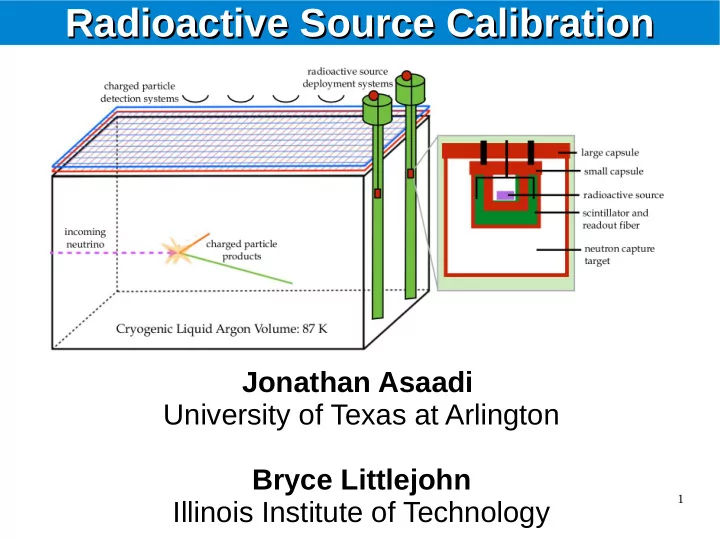
  • The original idea we were working on was a system

which could

– Provide low energy calibration for both TPC and light

collection system

– Provide sample for matching between between TPC and light

system

– Demonstrate low energy reconstruction algorithms with a fixed

source

– plus many others……

  • We originally proposed this idea for SBND and would

be happy to work with others to adapt this for DUNE

– I’ll be showing some slides Bryce (IIT) and I (UTA) put

together and work we’ve done recently on LArIAT

Radioactive Source Calibration Radioactive Source Calibration

slide-3
SLIDE 3

3

  • “Dry” calibration axes positioned along side the TPC

– Allow for the deployment of different radioactive sources at

various vertical distances

– Multiple ports allow for different drift direction locations – Significant portion of the gammas from the radioactive sources

deposit their full energy in the TPC

– Minimal impact on TPC design

The idea for the system The idea for the system

slide-4
SLIDE 4

4

  • Neutrons from the source

capture on target in the outer canister and produce gammas in the range of 1-10 MeV

– Can deploy a gamma source in a

simplified canister in the same axis

  • Plastic scintillator around the

source can provide a trigger for the readout system

Calibration Peaks Calibration Peaks

Some thoughts on sources and their corresponding signal

slide-5
SLIDE 5

5

  • Did a quick study of what percentage of events leave their full energy

inside the TPC

– 32% of 10 MeV gammas @ 10 cm outside the TPC – 22% of 10 MeV gammas @ 30 cm outside the TPC

  • Did a similar study to see what percentage of neutrons capture on the

intended target

Signals Signals

slide-6
SLIDE 6

6

  • Low energy gammas are a difficult signal to see

in LArTPC

– IIT student is continuing a study using ArgoNeuT data

looking at de-excitation gamma candidates to help develop these tools

  • These small blips can be reconstructed and

identified, but dedicated tools and running probably necessary

What do these signals look like What do these signals look like

slide-7
SLIDE 7

7

  • Worked with Bo Yu (BNL) to determine the

electric field for a 6” OD steel pipe at various locations along the SBND field cage

– Closest distance seems to be 10cm to keep things

safe

– Could go closer in regions closer to the anode

Worrying about Electric Fields Worrying about Electric Fields

slide-8
SLIDE 8

8

  • As a first test we wanted to see if these low energy events could

be seen with the LArIAT detector

– Deployed a Cf 252 source at various points around the cryostat

  • Distances between the active volume and the source varied between 20 cm – 70 cm

– Utilized various configurations of carbon steel and plastics to thermalize the

neutrons

– Ran with just a strobe trigger configuration

  • This was actually a problem due to the size and shape of the source used at FNAL

where we couldn’t use our canisters

  • Ultimately limited the useful data we could get from this study

Trying a simple deployment in LArIAT Trying a simple deployment in LArIAT

Source Giant Pole

slide-9
SLIDE 9

9

  • Could we see the activity from the source in the TPC?

– Yes!

  • Greater activity in the hits seen when source is present compared to cosmic background
  • Activity tracks the location of the source
  • Source related hits seem to be 3-5 wires long

Some outcomes of the study Some outcomes of the study

Work done by IIT graduate student Ivan Lepetic

slide-10
SLIDE 10

10

  • Did we see activity in the PMT’s?

– No :-( – Because we weren’t triggering based on the source,

the timing of the LArIAT readout made it difficult to match PMT data to TPC data

  • This is something we could fix if/when we attempt this

study again (we were doing this during the last days of running in 2016 and didn’t have time to fix it

Some outcomes of the study Some outcomes of the study

LArIAT TPC w/ WLS Foils

slide-11
SLIDE 11

11

  • We’ve been working on mock-up, cryo-tests, and

trigger work at IIT and UTA

– Things have been progressing (slowly) while we are working

  • n many other things
  • If there are interests in pursuing these ideas further

with tests in LArIAT / Test-stands / other detectors we are happy to continue and collaborate with

  • thers

Ongoing R&D Ongoing R&D

Triggered pulses seen from canister in cryostat Triggered pulses seen from canister in cryostat Diagram of UTA cryo test-stand Mock-up canister at IIT

slide-12
SLIDE 12

12

Thoughts / Questions / Comment Thanks!