
SLIDE 1
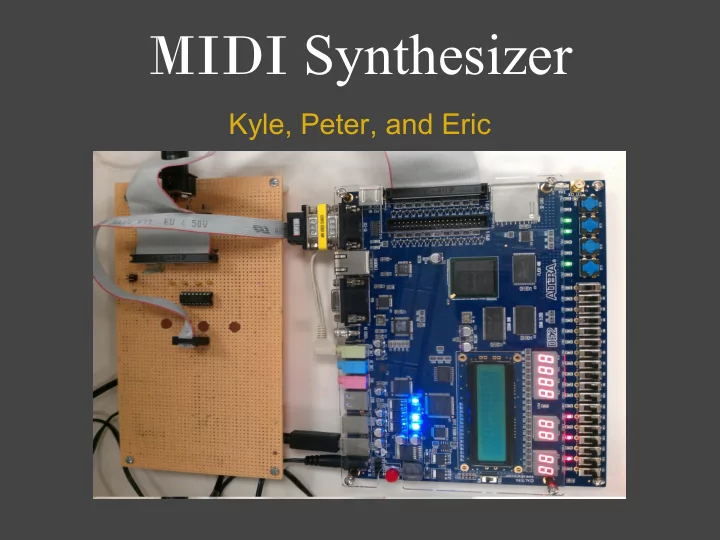
MIDI Synthesizer Kyle, Peter, and Eric Motivation Interest in - - PowerPoint PPT Presentation
MIDI Synthesizer Kyle, Peter, and Eric Motivation Interest in digital audio applications . A good way to learn about the hardware and software aspects of system design Interactive and fun demo. Nice way to learn about an
up to 12.5 KHz)
and Square
NOTE 0 1 2 ... 126 127 NAME C -2 C# -2 D -2 ... F# 8 G 8
MIDI format has 128 notes, ranging from a C -2 to a G 8. Both of these values aren't really in the range of normal hearing/music. The lower values are useful for effects such as tremolo and vibrato
and Aftertouch (hitting the key harder after it reaches the bottom).
INCOMING MESSAGE STATUS DATA
10010111 00001000 01111111 10010111 Message Type = Note Is being turned on 00001000, 01111111 Note = 8 Velocity = 127
Wave Addition: This is the method we use for playing multiple notes at once. We add the waves together and then create a normalized output. Wave Multiplication: This method would be used for effects like tremolo. Our current RAM limitations did not allow us to implement this in the end.
Images from http://www.jjgifford.com/expressions/geometry/wave_addition.html
61 keys, which range from a C1 (32.703 Hz) to a C7 (2.093 KHz). Acts as our MIDI Controller
http://www.tronaudio.com/assets/Uploads/Images/waveforms.png
(S)ustain (R)elease envelope generator.
decay stage to reduce memory usage.
http://abletonempire.com/wp-content/uploads/2011/08/adsr_envelope01.gif
○ Use Hardware Interrupts for all Inputs ○ Use Separate Task For Each Function
○ Output Devices are Memory Mapped
○ MIDI Task Finds Unused Hardware
○ Modular Design Allows Us To Input Task and Write Directly to Audio Hardware
○ Current=1 - No Current=0
○ Insufficient RAM space to have all features implemented at once. ○ Had to cut some effects from final version.
○ We tried to create additional instruments by using a combination of harmonics in at various levels ○ As shown below, instruments are not a simple waveform (Clarinet at 156 Hz vs 233 Hz)