The synpad a position sensing midi drum interface I will be - - PowerPoint PPT Presentation

the synpad a position sensing midi drum interface
SMART_READER_LITE
LIVE PREVIEW

The synpad a position sensing midi drum interface I will be - - PowerPoint PPT Presentation

The synpad a position sensing midi drum interface I will be talking today about my attempts to build a cheap, playable, midi drum interface with position sensing capability. Overview Motivations why build this? Research


slide-1
SLIDE 1

The synpad – a position sensing midi drum interface

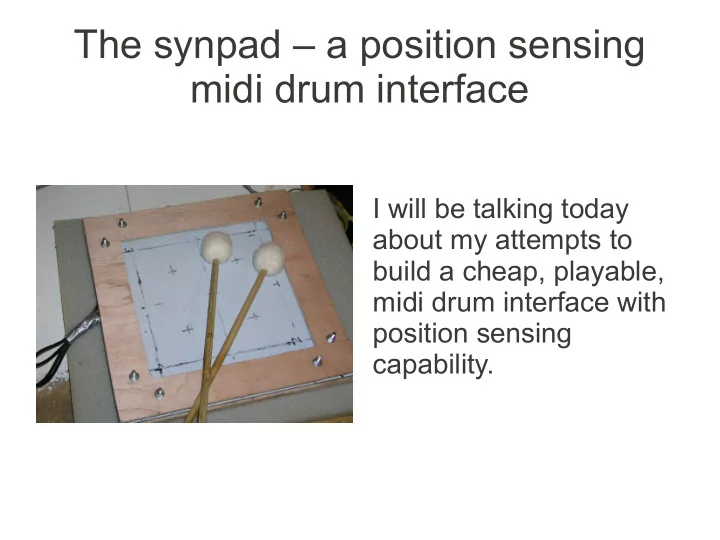
I will be talking today about my attempts to build a cheap, playable, midi drum interface with position sensing capability.

slide-2
SLIDE 2

Overview

  • Motivations – why build this?
  • Research – previous designs.
  • Physical design.
  • Electronics.
  • Driver software – firmware and position mapper.
  • Synth software – using supercollider.
  • Results.
  • Similar work.
  • Future directions.
  • Conclusion.
slide-3
SLIDE 3

Motivations

Why build something like this?

  • I find drum machines limiting and awkward.
  • I wanted something more immediate and

responsive.

  • Drum triggers are good but you can't change

the tone.

  • Wanted something more like a real drum.
slide-4
SLIDE 4

Research

  • Tried a couple of other designs.
  • Voltage gradients in a conductive rubber sheet.
  • Time of flight of pressure waves.
  • Just sensing transferred pressure worked ok.
slide-5
SLIDE 5

Physical design

  • Playing surface is an

aluminium sheet.

  • The sheet moves freely

in a wooden frame.

  • Piezo sensors under

each corner detect differences in transferred strike pressure.

  • The signals are brought
  • ut to an arduino board.
slide-6
SLIDE 6

Electronics

  • Quite simple electronics.
  • Provides a false ground level.
  • Prevents voltage drift on the piezos.
slide-7
SLIDE 7

Circuit diagram

slide-8
SLIDE 8

Driver software - firmware

  • Firmware turns analogue signals into 4

velocities.

  • ADC sample rate: 76 kHz across 4 lines.
  • Trigger level for detection.
  • Absolute values summed for 16 samples = 0.84

ms

  • Summed values are written to USB at 230400

baud (0.34 ms)

  • 1300 sample / 68ms release period.
slide-9
SLIDE 9

Position mapping software

  • Python program maps

sensor readings into x, y and velocity coordinates.

  • Pad calibrated by striking

at known positions.

  • Least squares curve fit

for position and velocity.

  • X,Y and V are converted

to midi note and controller values.

The position mapping equation. # s[n] = reading for sensor n # x = x or y return value. # k[n] | f[n] = adjustable coefficients. f1=s1 f2=s2*k2 f3=s3*k3 f4=s4*k4 x=(l1*f1+l2*f2+l3*f3+l4*f4)/ (f1+f2+f3+f4) return x

slide-10
SLIDE 10

Synth software

  • The pad is just an interface.
  • Existing synths not suitable.
  • I wrote my own in SuperCollider.
  • Could have used CSound or PureData.
  • Could also use a graphical modular synth like

Ingen.

  • Learning to write synthdefs.
  • 'Synth Secrets' series from 'Sound on sound'.
slide-11
SLIDE 11

SynthDef.new("MidiDrum", { |vel=100, x=64, y=64,out=0| // resonant snare sound var sndbuf= Buffer.readChannel(s, "/home/andy/Desktop/music/supercollider/samples/84001__s andyrb__KBSD_C42_VELOCITY9.wav", channels:0); var rq=10**((16-y) / 41); var env,amp; var noteMin=30;//54; var noteMax=128;//66; var note=(x*(noteMax-noteMin)/127)+noteMin; //note=(note/12).floor*12; vel=vel+((127-note)/40)+((127-y)/50); amp=((vel-96)/3).dbamp; env=EnvGen.kr(Env.triangle(1,4),1,doneAction:2); Out.ar(out,amp*env*Pan2.ar(RLPF.ar(PlayBuf.ar(1,sndbuf), note.floor.midicps, rq ), 0) ); } ).store;

slide-12
SLIDE 12

SynthDef.new("MidiDrum", { |vel=100, x=64, y=64,out=0| // synth drum with pink noise, comb delay line and low pass filter. var rq=10**((y-40) / 41); var env,amp; var noteMin=55; // 200Hz var noteMax=128;//66; var note=(x*(noteMax-noteMin)/127)+noteMin; var baseFreq=100; amp=16*((vel-96)/3).dbamp; env=EnvGen.kr(Env.perc(0.01,0.5,1),1,doneAction:2); Out.ar(out,amp*env*Pan2.ar(LPF.ar(CombC.ar(PinkNoise.ar( 0.1),1,1/baseFreq,rq),note.midicps), 0) ); } ).store;

slide-13
SLIDE 13

SynthDef.new("MidiDrum", { |vel=100, x=64, y=64, out=0| // bass drum patch with variable square wave / saw wave ratio. var baseFreq=50, baseDelayMin=0.1, baseDelayMax=3, baseAmp=1, attack=0.01; var baseFreqMod=1, harmLPFreqMin=baseFreq, harmLPFreqMax=baseFreq*10; var fmBaseFreq=500, fmModSig=250, fmAmp=0.5, fmDelay; var amp,ampEnv, baseFreqEnv, harmSig, harmLPFreq, baseDelay, sawRatio,

  • scSig;

baseDelay=0.5; //((y/128)*(baseDelayMax-baseDelayMin))+baseDelayMin; fmDelay=baseDelay/5; amp=((vel-32)/3).dbamp; harmLPFreq=((x/128)*(harmLPFreqMax-harmLPFreqMin))+harmLPFreqMin; ampEnv=amp*EnvGen.kr(Env.perc(attack,baseDelay,baseAmp),1,doneAction:2) ; baseFreqEnv=EnvGen.kr(Env.perc(attack,baseDelay,baseFreqMod,'sine')); sawRatio=(y/128);

  • scSig=sawRatio*LFTri.ar(baseFreq+baseFreqEnv)+(1-

sawRatio)*Saw.ar(baseFreq+baseFreqEnv); harmSig=LPF.ar(oscSig,harmLPFreq); Out.ar(out,Pan2.ar(ampEnv*harmSig,0)); } ).store;

slide-14
SLIDE 14

SynthDef.new("MidiDrum", { |vel=100, x=64, y=64, out=0| // snare drum from synth secrets (based on roland 909). // different version with fixed noise delay and low pass filter. var part1Freq=180, part1Amp=0.1, part2Freq=330, part2Amp=0.05, minDistortPow=0, maxDistortPow=3, partDelay=0.7; var attack=0.01, noiseLPFreq=10000, noiseHPFreq=2000, noiseAmp1=0.005, noiseAmp2Ratio=2; var noiseDelay=0.4; var partSig, partEnv, amp, noiseEnv, noiseSig1, noiseSig2, noiseSig,

  • utSig,lpFreq;

var distort; distort=10**(((x/128)*(maxDistortPow-minDistortPow))+minDistortPow); amp=((vel/4)-28).dbamp; partEnv=amp*EnvGen.kr(Env.perc(attack,partDelay,1),1,doneAction:2); partSig=part1Amp*atan(SinOsc.ar(part1Freq, 0, distort)) +part2Amp*atan(SinOsc.ar(part2Freq,0,distort)); noiseSig1=noiseAmp1*LPF.ar(WhiteNoise.ar(1),noiseLPFreq); noiseSig2=(amp**0)*HPF.ar(noiseSig1*noiseAmp2Ratio,noiseHPFreq); noiseSig=(noiseSig1+noiseSig2); noiseEnv=amp*EnvGen.kr(Env.perc(attack,noiseDelay,1),1,doneAction:0); lpFreq=((y*3/5)+51).midicps;

  • utSig=RLPF.ar(partSig*partEnv+noiseSig*noiseEnv,lpFreq,0.5);

Out.ar(out,Pan2.ar(outSig,0)); } ).store;

slide-15
SLIDE 15

SynthDef.new("MidiDrum", { |vel=100, x=64, y=64,out=0| // interfering oscillators. var env,amp; var noteMin=54; var noteMax=66; var note=(x*(noteMax-noteMin)/128)+noteMin; var noteMiny=66; var noteMaxy=78; var notey=(y*(noteMaxy-noteMiny)/128)+noteMiny; amp=((vel-96)/3).dbamp; env=EnvGen.kr(Env.perc(0.1,0.5,1),1,doneAction:2); Out.ar(out,amp*env*Pan2.ar(SinOsc.ar(note.midicps)*SinOsc .ar(notey.midicps), 0) ); } ).store;

slide-16
SLIDE 16

Results

  • Physically easy to construct.
  • Low cost (approx 50-60 pounds)
  • Playability is not bad.
  • The accuracy of position mapping is about 15-

20%.

  • Velocity mapping is ok in practice. Lower cutoff.
  • Latency of the firmware is about 1.1ms.
  • Have written some playable synths.
slide-17
SLIDE 17

Similar Work

  • Various people have produced similar

instruments.

  • Korg Kaoss pad and Kaoscillator.
  • Mandala drum from Synaesthesia Corp.
  • Randall Jones's MSc thesis.
slide-18
SLIDE 18

Future Directions

  • Physical design could be improved.
  • Might try a different design.
  • A graphical interface would be good.
  • Morphing presets.
  • Synth design.
slide-19
SLIDE 19

Conclusions

  • The basic concept is sound.
  • However this particular design has some

weaknesses.

  • Not much interest from people building their
  • wn.
  • I enjoyed making it.
  • I intend to develop the idea further.
  • Learning to play it.
slide-20
SLIDE 20

Acknowledgements

Thanks to Alaric Best and Dave Leack of Veraz

  • Ltd. for their ideas and support with this project.

Thanks also to the Supercollider developers.

slide-21
SLIDE 21

For more information and updates see: http://highfellow.org/synpad