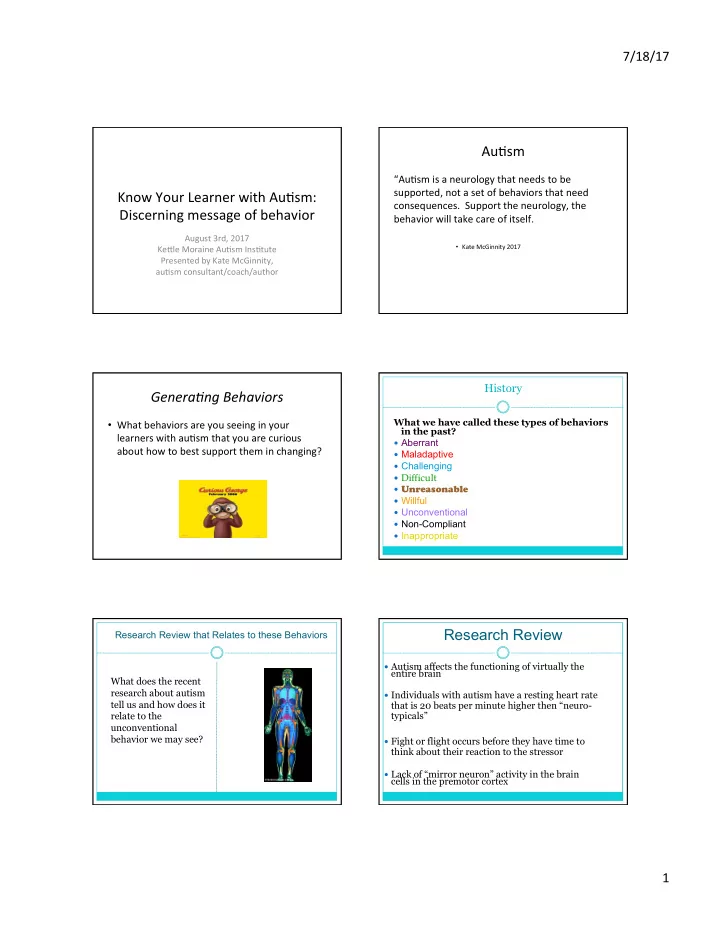
Au4sm Au4sm is a neurology that needs to be - - PDF document

au4sm
SMART_READER_LITE
LIVE PREVIEW

Au4sm Au4sm is a neurology that needs to be - - PDF document

7/18/17 Au4sm Au4sm is a neurology that needs to be supported, not a set of behaviors that need Know Your Learner with Au4sm:


slide-1
SLIDE 1

7/18/17 ¡ 1 ¡

Know ¡Your ¡Learner ¡with ¡Au4sm: ¡ ¡ Discerning ¡message ¡of ¡behavior ¡

August ¡3rd, ¡2017 ¡ KeCle ¡Moraine ¡Au4sm ¡Ins4tute ¡ Presented ¡by ¡Kate ¡McGinnity, ¡ ¡ au4sm ¡consultant/coach/author ¡

Au4sm ¡

“Au4sm ¡is ¡a ¡neurology ¡that ¡needs ¡to ¡be ¡ ¡ supported, ¡not ¡a ¡set ¡of ¡behaviors ¡that ¡need ¡ ¡

  • consequences. ¡ ¡Support ¡the ¡neurology, ¡the ¡

behavior ¡will ¡take ¡care ¡of ¡itself. ¡

  • Kate ¡McGinnity ¡2017 ¡

Genera&ng ¡Behaviors ¡

  • What ¡behaviors ¡are ¡you ¡seeing ¡in ¡your ¡

learners ¡with ¡au4sm ¡that ¡you ¡are ¡curious ¡ about ¡how ¡to ¡best ¡support ¡them ¡in ¡changing? ¡ History

What we have called these types of behaviors in the past?

— Aberrant — Maladaptive — Challenging — Difficult — Unreasonable — Willful — Unconventional — Non-Compliant — Inappropriate

What does the recent research about autism tell us and how does it relate to the unconventional behavior we may see? Research Review that Relates to these Behaviors

— Autism affects the functioning of virtually the

entire brain

— Individuals with autism have a resting heart rate

that is 20 beats per minute higher then “neuro- typicals”

— Fight or flight occurs before they have time to

think about their reaction to the stressor

— Lack of “mirror neuron” activity in the brain

cells in the premotor cortex

Research Review

slide-2
SLIDE 2

7/18/17 ¡ 2 ¡

Would punishment be used to change the behavior of a person with a recognized neurological symptom? Would criticism and discouraging descriptions such as “laziness” be applied to a person in a catatonic stupor? Would a person with Parkinson’s disease be scolded for reacting slowly when instructed to do something?

Donnellan, Robeldao, 2007

Are the behaviors really

Given the Biology of Autism

÷ Whole body differences ÷ Sensory differences ÷ Movement differences

Given the misunderstandings, misconceptions, and stereotypes

So if these behaviors are

Reasonable Solutions

…What behaviors do we consider supporting people to change?

  • 1. Is the behavior hurtful to the individual or
  • thers?
  • 2. Does the behavior interfere with the progress,

learning, or growth of the individual or others?

  • 3. Does the behavior infringe on the individual’s or
  • ther’s ability to make or maintain social

relationships?

“Rule of Three”

  • K. McGinnity (from DPI)

When multiple behaviors are identified, it is important to choose the most severe and/or dangerous behavior on which to focus initial interventions.

“Worst First”

  • K. McGinnity (from DPI)

Ways people without autism can make life harder on people with autism:

¡ Communicating in a way that ‘cannot be

trusted’ (i.e. don’t verbally express what they are really feeling all the time, such as “I’m fine” when they’re not).

¡ Using sarcasm, metaphors, colloquialisms or other

figures of speech (e.g. “Oh, that’s a great idea…”)

¡ Presenting something as a choice that isn’t (e.g.

“Do you want to do your math now?”)

¡ Asking questions the student does not have a

means of answering. (i.e. communication system)

slide-3
SLIDE 3

7/18/17 ¡ 3 ¡

Ways people without autism can make life harder on people with autism:

— Assuming intent (e.g. refusal; escape) and

missing actual trigger

— Assuming inference (e.g. “You can come to

my office anytime.”)

¡ Measuring another person’s reaction based

  • n your own perspective or experience

¡ Responding to the words or behavior instead

  • f underlying messag of the behavior.

Learning Relationships Communication Emotional Sensory Physiological Fulfillment

  • What this includes:

– Health / Illness – Exercise – Diet / Nutrition – Sleep – Sex – Shelter

Physiological

  • Considerations

– Be aware of co-existing conditions

  • Seizures
  • Digestive Issues
  • Anxiety and Depressive Disorders
  • OCD and ADHD

– Be aware of side effects of medications

Physiological

  • Supporting

– Way to express pain or discomfort – Regular medical and dental check-up – Exercise routines – Balanced diet – Adequate sleep – Way to express sexuality

Physiological

  • “One of the most

common reasons why people engage in aggressive or self- injurious behavior is that they are in pain.”

David Pitonyak, July 2007

Physiological

slide-4
SLIDE 4

7/18/17 ¡ 4 ¡

What behaviors do we have listed that might fit with a lack of support in this area?

Physiological

What possible messages might exist in this area?

  • I’m tired.
  • My stomach hurts.
  • I’m sick.
  • I’m hungry.
  • I’m uncomfortable.

Physiological

  • Fill in your own worksheet

– Issues your individual might have in this area – How can you support them in this area?

Physiological Learning Relationships Communication Emotional Sensory Physiological Fulfillment

  • The nervous system’s ability to

attain, maintain and change levels of arousal or alertness

Sensory

  • Considerations:

– Differences in Processing Sensory Input – Differences in Maintaining Level of Arousal – Differences in Modulation – May experience build-up of sensory insults throughout the day

Sensory

slide-5
SLIDE 5

7/18/17 ¡ 5 ¡

  • Supporting:

– Sensory Diet – Breaks – Visual Regulation Strategies – Physical set up of the environment – Changes (how many, how often, what kinds) – Number of people

Sensory

What behaviors do we have listed that might fit with a lack of support in this area?

Sensory

What possible messages might exist in this area?

  • It is too loud!
  • I can’t feel where my body is.
  • The lights hurt my eyes.
  • I love how this feels!
  • I need to move.

Sensory Learning Relationships Communication Emotional Sensory Physiological Fulfillment

  • Emotional Regulation:

– The ability to recognize and respond to emotions in self and others in a predictable and conventional manner. – Identification of emotions – Responding to others emotions – Expression of emotions

Emotional

  • Considerations:

– Difficulty perceiving shades of gray – May have same emotional reactions to different sized events – “World people” might not always communicate what they are really feeling – Different ways of perceiving emotions

  • Colors, Synesthesia

– May have need to have a physical action accompanying an emotion – May actually be over-sensitive to emotions

Emotional

slide-6
SLIDE 6

7/18/17 ¡ 6 ¡

  • Supporting:

– Ways to calm, cope and modulate – Visual way to communicate – Visual way to asses what is happening – Yoga – Meditation – Writing, drawing… – Cognitive Picture Rehearsal – Exercise

Emotional

What behaviors do we have listed that might fit with a lack of support in this area?

Emotional

What possible messages might exist in this area?

  • I’m really excited!
  • I’m afraid.
  • I feel out of control.
  • I’m anxious.
  • I’m depressed.

Emotional Learning Relationships Communication Emotional Sensory Physiological Fulfillment

  • What this includes:

– Expressive language – Receptive language – Not just formal language

  • (countless ways to communicate besides using

language)

Communication

Considerations:

– Continuum of access – May have individualized means of communication – Even verbal individuals may lose access to words – Individuals with autism usually report that they think in pictures – May have a processing delay

Communication

slide-7
SLIDE 7

7/18/17 ¡ 7 ¡

  • Supporting - Expressively:
  • Individuals need a reliable way to

communicate across

– Environments – Situations – Communicative Partners – Variability in access

Communication

  • Supporting - Receptively:

– Individuals need visual supports in place to help process language

  • Schedules, organizers, outlines

– Talk less, use more gestures – Limit use of questions, use fill-ins or choices – Use first - then language – Use less idioms, colloquialisms & metaphorical speech

Communication

What behaviors do we have listed that might fit with a lack of support in this area?

Communication

What possible messages might exist in this area?

  • I want __________.
  • Stop!
  • I need help.
  • Look! I like that!
  • Please stop talking.
  • Give me more time to think.
  • I don’t want to do this now.

Communication

  • Fill in your own worksheet

– Issues your individual might have in these areas – How can you support them in these areas?

Emotional Communication Sensory Learning Relationships Communication Emotional Sensory Physiological Fulfillment

slide-8
SLIDE 8

7/18/17 ¡ 8 ¡

  • People with autism have told us that

successful supportive relationships in their lives should include:

– TRUST – UNITY – SUPPORT

Jodi Robledo

Relationships Jodi Robledo Relationships

  • Considerations:

– Individuals with autism may have the majority of their relationships with individuals who are paid to be with them – Spoken language may not be primary mode of communication, relationships may need to be developed outside of this

Relationships

  • Supporting:

– Sensitivity Exercises – Access to peers – Ways to connect – Consider the personal style of those interacting with the student – Inclusion – Age of individual – Teach specific social skills – Start with their passions

Relationships

What behaviors do we have listed that might fit with a lack of support in this area?

Relationships

What possible messages might exist in this area?

  • I’m lonely.
  • I want to play with you.
  • Look at what I can do!
  • I realize I am different.
  • I want to connect with others.

Relationships

slide-9
SLIDE 9

7/18/17 ¡ 9 ¡

Learning Relationships Communication Emotional Sensory Physiological Fulfillment

  • What this includes:

– Curriculum – Environment – Response Format – Instructional Style – Learning Styles

Learning

  • Considerations:

– Many people with autism think in pictures – Automatic imitation can be difficult to access – Neurology that does not always allow for automatic integration of information and generalization of learned skills may be complicated – Sometimes attention is dispersed differently

Learning

  • Supporting:

– Use passions to teach – Individual/staff match – Discrete trial/direct instruction – Learner’s style – Instructional ratio – Teach for generalization – Teach independence

Learning

What behaviors do we have listed that might fit with a lack of support in this area?

Learning

What possible messages might exist in this area?

  • I don’t understand what you want me to

do.

  • I already know this.
  • I’m stuck.
  • Show it a different way.

Learning

slide-10
SLIDE 10

7/18/17 ¡ 10 ¡

  • Fill in your own worksheet

– Issues your individual might have in these areas – How can you support them in these areas?

Communication Relationships Learning Learning Relationships Communication Emotional Sensory Physiological Fulfillment

  • What this includes:

– Freedom – Meaning – Happiness – Independence – Feeling Valued and Understood

Fulfillment

  • Considerations:

– Many times we forget about fulfillment, especially for those without reliable communication systems – Many times individuals may not have a reliable way to articulate their needs in this area – Opportunities for fulfillment might not happen as naturally as they do for other students – Level of support that some people need does not always allow for individual freedom – Fulfillment is very individualized and may seem unusual – People with autism often report feeling alienated

Fulfillment

  • Supporting:

– Sensitivity training – Self advocacy – Access to non-contingent reinforcement – Choices – Control – Daily access to things they are passionate about – Opportunity to be valued for strengths – Opportunities to connect with others on the spectrum

Fulfillment

What behaviors do we have listed that might fit with a lack of support in this area?

Fulfillment

slide-11
SLIDE 11

7/18/17 ¡ 11 ¡

What possible messages might exist in this area?

  • I’m no good.
  • I want more power in my life.
  • I want to make choices for myself.
  • Don’t pay so much attention to my

mistakes.

  • I want to do more of what I love to do.

Fulfillment

  • Fill in your own worksheet

– Issues your individual might have in these areas – How can you support them in these areas?

Relationships Learning Fulfillment Learning Relationships Communication Emotional Sensory Physiological Fulfillment

Go where your hand is free

Mare Chapman

Given all you now understand about supporting individuals with autism…you now need to become a scientist and make your best educated guess Develop your hypothesis Why is this behavior happening? What is this behavior a solution for? (Judy Endow)

—

Work in groups on this

1.

Develop your hypothesis

2.

(A behavior may have multiple functions).

slide-12
SLIDE 12

7/18/17 ¡ 12 ¡

When we need to teach new skills

General Principles

— At whatever level possible, join with the

individual to come up with a plan

— Strategies need to be tied directly to the

function

— Strategies need to be implemented

systematically

— Take data to determine effectiveness — Inform and train all team members

LaVigna & Donnellan, 1986

Teaching Functional Equivalents

— Using a break card instead of screaming — Hitting a duffel bag in anger instead of people — Running track instead of running away — Playing the drums instead of banging on tables and other

  • bjects

LaVigna & Donnellan, 1986

Some Tools To Teach With

— Social Stories — Power Cards — Comic Strips — Modeling — Role Playing — Video Technology — Discrete Trial Format

When to ask for help

— Anytime you think or feel that someone might get

hurt

— Anytime you feel unprepared for possible behaviors — Anytime you need a break — Anytime you have questions about if you are doing

the right thing

References

— Upside Down and Inside Out Supporting a Person

in Crisis / Supporting the People Who Care, David Pitonyak, Version: 09 July 2007

— Born on a Blue Day, Daniel Tammet, 2007 — Somebody Somewhere, Donna Williams, 1994 — Adolescents on the Autism Spectrum: A Parent's

Guide to the Cognitive, Social, Physical, and Transition Needs of Teenagers with Autism Spectrum Disorder, Chantal Sicile-Kira, 2005