Why record? Vulnerable pa6ents Accurately documen6ng the care that - - PDF document

why record
SMART_READER_LITE
LIVE PREVIEW

Why record? Vulnerable pa6ents Accurately documen6ng the care that - - PDF document

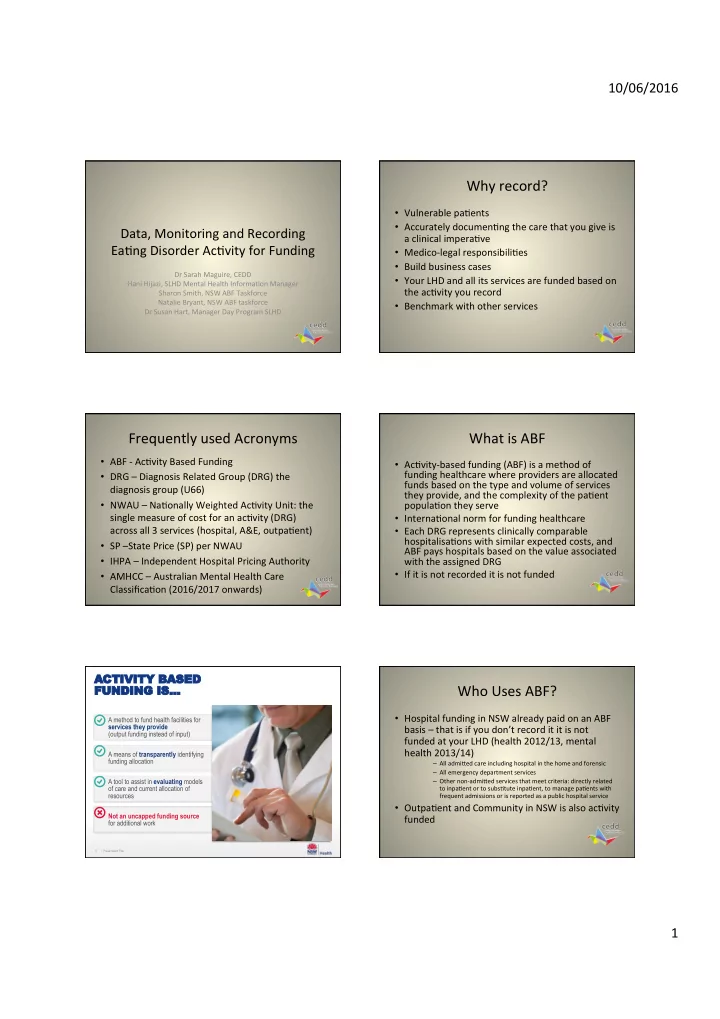
10/06/2016 Why record? Vulnerable pa6ents Accurately documen6ng the care that you give is Data, Monitoring and Recording a clinical impera6ve Ea6ng Disorder Ac6vity for Funding Medico-legal responsibili6es Build business cases


slide-1
SLIDE 1

10/06/2016 1 Data, Monitoring and Recording Ea6ng Disorder Ac6vity for Funding

Dr Sarah Maguire, CEDD Hani Hijazi, SLHD Mental Health Informa6on Manager Sharon Smith, NSW ABF Taskforce Natalie Bryant, NSW ABF taskforce Dr Susan Hart, Manager Day Program SLHD

Why record?

  • Vulnerable pa6ents
  • Accurately documen6ng the care that you give is

a clinical impera6ve

  • Medico-legal responsibili6es
  • Build business cases
  • Your LHD and all its services are funded based on

the ac6vity you record

  • Benchmark with other services

Frequently used Acronyms

  • ABF - Ac6vity Based Funding
  • DRG – Diagnosis Related Group (DRG) the

diagnosis group (U66)

  • NWAU – Na6onally Weighted Ac6vity Unit: the

single measure of cost for an ac6vity (DRG) across all 3 services (hospital, A&E, outpa6ent)

  • SP –State Price (SP) per NWAU
  • IHPA – Independent Hospital Pricing Authority
  • AMHCC – Australian Mental Health Care

Classifica6on (2016/2017 onwards)

What is ABF

  • Ac6vity-based funding (ABF) is a method of

funding healthcare where providers are allocated funds based on the type and volume of services they provide, and the complexity of the pa6ent popula6on they serve

  • Interna6onal norm for funding healthcare
  • Each DRG represents clinically comparable

hospitalisa6ons with similar expected costs, and ABF pays hospitals based on the value associated with the assigned DRG

  • If it is not recorded it is not funded

| Presentation Title 5

AC ACTIVITY BASED FUND FUNDING NG IS… …

A method to fund health facilities for services they provide (output funding instead of input) A means of transparently identifying funding allocation A tool to assist in evaluating models

  • f care and current allocation of

resources Not an uncapped funding source for additional work

Who Uses ABF?

  • Hospital funding in NSW already paid on an ABF

basis – that is if you don’t record it it is not funded at your LHD (health 2012/13, mental health 2013/14)

– All admiced care including hospital in the home and forensic – All emergency department services – Other non-admiced services that meet criteria: directly related to inpa6ent or to subs6tute inpa6ent, to manage pa6ents with frequent admissions or is reported as a public hospital service

  • Outpa6ent and Community in NSW is also ac6vity

funded

slide-2
SLIDE 2

10/06/2016 2

| Presentation Title 7

SCHE HEDULE ULE C

A B C D E F G H I SYD Target Volume (NWAU15) Volume (Admissions & Attendances) Indicative only State Price per NWAU15 LHD/SHN Projected Average Cost per NWAU15 Initial Budget 2015/16 ($ '000) 2014/15 Annualised Budget ($ '000) Variance Initial and Annualised ($ '000) Variance (%) Volume Forecast 2014/15 (NWAU15) Acute Admitted 150,511 140,060 $687,684 $663,801 $23,883 146,627 Acute - Highly Specialised Services*

  • Emergency Department

22,165 162,132 $101,274 $96,340 $4,934 21,573 Non Admitted Patients^ 49,590 815,921 $181,508 $174,048 $7,460 48,830 A Total 222,266 1,118,113 $970,466 $934,189 $36,277 3.9% 217,030 Sub-Acute Services - Admitted 10,132 6,633 $46,294 $42,330 $3,963 9,487 Sub-Acute Services - Non Admitted^ 2,009 $7,323 $7,162 $161 2,009 B Total 12,141 6,633 $53,617 $49,492 $4,124 8.3% 11,496 Mental Health - Admitted (Acute and Sub-Acute) 15,914 7,211 $4,569 $4,662 $72,710 $70,071 $2,639 15,686 Mental Health - Block Funded Hospitals $7,516 $7,351 $165 Mental Health - Non Admitted^ 13,057 225,670 $34,036 $32,276 $1,760 12,836 Mental Health - Transition Grant C Total 28,971 232,881 $114,262 $109,698 $4,564 4.2% 28,522 Block Funding Allocation Block Funded Hospitals (Small Hospitals) $76,890 $75,200 $1,690 Block Funded Services In-Scope

  • Teaching, Training and Research

$31,382 $30,692 $690

  • Other Non Admitted Patient Services

D Total $108,272 $105,892 $2,380 2.2% E State Only Block Funded Services Total $135,051 $132,082 $2,969 2.2%

XXX LHD - Budget 2015/16

2015/16 BUDGET Comparative Data $4,569 $4,662

How are prices calculated?

  • NSW Produces a State Price (SP) for:
  • Acute inpa6ent services
  • Emergency department services
  • Outpa6ent services
  • Sub-acute services
  • The federal body produces a weigh6ng for a par6cular

(IHPA) DRG, called the NWAU

  • The annual Service Agreement between LHD and

Ministry determines the volume and distribu6on of services within streams

  • Acute level ac6vity
  • Emergency ac6vity
  • Sub-acute ac6vity
  • Non-admiced ac6vity (all in NSW)
  • LHD and clinicians determine what services are

delivered within those streams

Price of an admitted acute ABF Activity = {[PW x APaed x (1 + ASPA) x (1 + AInd + AA + ART) + (AICU x ICU hours)]

  • [(PW + AICU x ICU hours) x APPS + LOS x AAcc]} x NEP

| Presentation Title 9

PRICING NG

Funding

Pricing Funding

State Price Price Weight (NWAU) Volume

Calcula6ng the NWAU for ea6ng disorder ac6vity

  • The average hospital service is worth one NWAU – the

most intensive and expensive ac6vi6es are worth mul6ple NWAUs, the simplest and least expensive are worth frac6ons of an NWAU

  • The NWAU is updated annually, and named to reflect

the year of its opera6on., In 2013-14, the NWAU was called NWAU(13), in 2016/17 it will be called NWAU(16)

  • Price of the NWAU is determined by the recorded
  • ccasions of care across the country
  • NWAU (15) for ea6ng disorders is $26,500 for 13-30

days without loadings, in excess gets per diem approx 1000 per day

| Presentation Title 11

WHA WHAT IS AN AN NWA NWAU

(National Weighted Activity Unit)?

The NWAU is the ‘currency’ used to express the price weights for all services funded on an activity basis

PSC: W Non-acute clinical/social = 0.0464 NWAU DRG U66A Eating disorders and

  • bsessive compulsive

disorders, major complexity = 8.2256

Ave = 1 NWAU Relative cost of hospital services

| CCLHD 12

ADJUS JUSTMENT NTS TO O PRICE WE WEIGHT GHTS

Adjustment Healthcare Setting/Context NWAU15 NWAU16 Indigenous Acute admitted Admitted subacute ED Non-admitted 4% é 5% Remoteness Outer Regional Remote Very remote Acute admitted Admitted subacute Acute admitted Admitted subacute . Acute admitted Admitted subacute. 8% 16% 22% = é é 8% 18% 23%

slide-3
SLIDE 3

10/06/2016 3

| 13

ADJUS JUSTMENT NTS TO O PRICE WE WEIGHT GHTS

Adjustment Healthcare Setting/Context NWAU15 NWAU16 Private Patient Service (Sub-acute) Maintenance Care Type Psychogeriatric Care Type Palliative Care Type 3.8% 3.5% 3.4% ê ê ê 1.6% 3.4% 3.1% Specialist Psychiatric Age >17 age NOT in MDC 19/20 ≤17 age in MDC 19/20 ≤17 age NOT in MDC 19/20 Acute Acute Specialised Children’s Hosp. Acute Specialised Children’s Hosp. 34% 15% 9% 22% 41% ê é é é é 32% 21% 10% 24% 45%

Ac6vity Price is calculated

  • Inpa6ent: At the conclusion of the encounter (once its closed ie.

discharged)

  • Ambulatory Care: At the processing of the entered ac6vity. Can have an
  • pen encounter with mul6ple occasions of service (i.e. contacts or

ac6vi6es) which you record in the EMR and that determines the ac6vity price

  • In the ambulatory context each 6me you see that pa6ent, make a phone

call about the pa6ent, write a lecer about the pa6ent, have a ward round

  • f mee6ng, each ac6vity acracts a payment
  • A pa6ent who is admiced through ED, to an acute medical ward, then

transi6oned to sub-acute service/bed/facility will acract three separate payments - the emergency ac6vity, the acute ac6vi6es and the sub-acute admission ac6vi6es

  • Or you can complete a change of care form/procedure while they in the

same ward/facility and the ac6vity will acract another payment

  • If they were then transferred to a day program or specialist inpa6ent unit

this would be another ac6vity for which they received payment

| Presentation Title 15

NWA NWAU U CALCULA ULATOR OR

The NWAU calculator is an education tool developed to assist clinicians and managers understand the factors that influence the calculation of NWAU for an episode of care or for a patient journey. http://nwaucalc.moh.health.nsw.gov.au/#/

Royal Price Alfred Hospital 16 year old Not indigenous Sydney Children’s Hospital 16 year old Not indigenous

Ac6vi6es within Hospitals Not Under ABF

  • Teaching Training and Research
  • Small rural hospital under about 32-34 beds
  • Some specialist hospitals like Tresillian

F codes and ABF

  • All F Codes fit into the same DRG
  • 50 Ea6ng Disorders
  • 50.0 Anorexia Nervosa

– 50.00 unspecified – 50.01 restric6ng type – 50.02 binge ea6ng/purging type

  • 50.1 Atypical Anorexia Nervosa
  • 50.2 Bulimia Nervosa
  • 50.3 Atypical Bulimia Nervosa
  • 50.8 Other Ea6ng Disorders
  • 50.9 Ea6ng Disorder Unspecified
  • For monitoring the success of the service plan recording

right F code macers

Ea6ng Disorder F Codes and DRG

  • All ea6ng disorder F codes fall under AR-U66Z DRG, i.e. Ea6ng & Obsessive

Compulsive Disorders

  • AR denotes mental health, Z denotes ‘no split’
  • Currently paid as a level 6 NWAU
  • Same NWAU for all of U66Z (all F codes) , i.e. for all ea6ng disorders
  • As of July 1 2016 this DRG will be split - U66

– Ea6ng & Obsessive with MINOR complica6ons (paid 4) – Ea6ng & Obsessive with MAJOR complica6ons (paid 8)

  • July 2016 roll-out of the AMHCC will begin and it will eventually replace

DRGs in mental health (medical vs mental)

  • Under AMHCC you must do a HONOS to receive payment
slide-4
SLIDE 4

10/06/2016 4

| Presentation Title 19

ABM ABM POR ORTAL L

The ABM Portal is a tool to assist in evaluating the efficiency and efficacy of health service delivery in order to review and improve care, leading to better patient outcomes https://abmportal.moh.health.nsw.gov.au/qlikview/FormLogin.htm

Recording Inpa6ent Care

  • Keep good clinical notes
  • Document the diagnosis (for alloca6on to DRG) and what you do with and

to the pa6ent (procedures)

  • Coders in medical records extract and enter the relevant data to

determine the payments for ac6vi6es

  • They review the documenta6on
  • They are trained in how to code
  • 2 year training
  • Strict rules about how you code and what you can and can’t code
  • Coders are not DOCTORS or clinicians (even if they are they are not

allowed to make assump6ons about the typical care expected for a condi6on)

  • Specialist facili6es have to be careful to assume nothing in notes,

document everything e.g. if a test result reveals a diagnosis and necessitates a treatment put BOTH in the notes – the CODER is not allowed to interpret test results

  • E.g. must write Hypo or Hyper not the K level or it won’t be coded, and

document the treatment provided

Recording Inpa6ent Ac6vity

  • Ea6ng disorders (U66Z) has a heavily weighted NWAU so recording the diagnosis

in the notes at mul6ple points will help this get accurately assigned

  • Principal diagnosis in discharge summary influences the DRG (ac6vity payment)
  • But coders do also look at the notes to determine diagnosis – they need the

discharge diagnosis to correspond with the notes

  • Coders are coding the principal ac6vity (or diagnosis), but complexi6es can drive

the payment up

  • They need know that not only did the pa6ent have that diagnosis BUT that it was

the reason for care i.e. the pa6ent received treatment for it, e.g. if a pa6ent came in with anorexia nervosa but there are no notes regarding the treatment for it, it won’t be recorded as principal, at best it will be an ancilliary (U Code)

  • In ward round or similar mee6ngs have an issues list married to an ac6on list:

things that you are currently providing treatment for (procedures) e.g. renal, electrolyte, malnutri6on

  • Ideally all presen6ng problems that received some form of treatment are listed on

the discharge summary (and then reflected in notes, issues lists and ac6on lists)

Recording Inpa6ent Ac6vity

  • Diagnoses must be stated as anorexia nervosa or

bulimia nervosa, not just anorexia

  • The more specific the becer, anorexia nervosa becer

than ea6ng disorder

  • Record the severity of malnutri6on and treatment

provided, this is perhaps necessary for new DRG

  • With a split DRG (major vs minor complexi6es) very

important to document every complica6on especially if they are being treated, but also if the pa6ent had a history of severe illness or malnutri6on that history would be important to document as it might determine which code, this will drive the higher level

  • f payment

Recording Inpa6ent Ac6vity

  • You can change a pa6ents care type during their stay

(on the same ward).

  • Care type can be Acute (e.g. medical stabilisa6on),

Rehabilita6on (e.g. refeeding), Pallia6ve, or Maintenance

  • E.g. SLHD SWSLHD has a care type change order on

CERNER, this also has to be clearly documented in the notes e.g. ACUTE Care type no longer required and changing to rehabilita6on, or pallia6ve etc.

  • AND this would usually accompanied by a new

treatment plan in the notes (except if you change to a Maintenance care type)

Recording Ambulatory Data

  • Ambulatory or non-admiced ac6vi6es don’t

use DRG to calculate payment

  • They use the Principal Service Category to

determine price

  • In the system non-specific categories have a

lower price (e.g. mental health unspecified), the more specific category have a higher price (e.g. emergency clinical, extended clinical)

slide-5
SLIDE 5

10/06/2016 5

Recording Ambulatory Ac6vity

  • Make sure you complete a record in the EMR
  • Every ac6vity you perform should have a corresponding

electronic record

  • Don’t fill in a record without a diagnosis, even if field not

compulsory

  • Find the F code 50 in the list and try to be specific BUT an

unspecific diagnosis becer than none (e.g. 50.9)

  • Always select a Principal Service Category and the nature of

this clinical ac6vity must be reflected elsewhere in the notes

  • If you have dis6nct service events involving different

clinicians doing different things with the pa6ent, need different Principal Service Categories

| Presentation Title 26

A NE NEW W APPROACH H – – AMHC HCC

IHPA have developed a new mental health care classification that will be implemented for pricing admitted mental health services from 1 July 2017

| NSW Implementation of the AMHCC 27

IMPLE LEMENT NTATION ON OF OF THE HE AMHC HCC IN N NS NSW

Mental Health Phase of Care

  • Requires a clinical decision
  • Reflects the prospective goal of care
  • Defines the collection points for clinical outcome measures
  • Current status: not collected

| NSW Implementation of the AMHCC 28

HONOS HONOS COM OMPLE LEXITY

HoNOS complexity

  • Final variable within the admitted branch of the AMHCC
  • HoNOSCA, HoNOS or HoNOS65+ used as clinically appropriate
  • Weighted individual scores based on age group and MHPoC
  • Required at admission and then change of MHPoC
  • This is no change from the existing MH-OAT protocol for HoNOS
  • It is expected that end-classes with unknown HoNOS will have the lowest price weights

| Presentation Title 29

A NE NEW W APPROACH H – – AMHC HCC

IHPA have developed a new mental health care classification that will be implemented for pricing admitted mental health services from 1 July 2017

| NSW Implementation of the AMHCC 30

IMPLE LEMENT NTATION ON OF OF THE HE AMHC HCC IN N NS NSW

Mental Health Phase of Care

  • Requires a clinical decision
  • Reflects the prospective goal of care
  • Defines the collection points for clinical outcome measures
  • Current status: not collected
slide-6
SLIDE 6

10/06/2016 6

| NSW Implementation of the AMHCC 31

HONOS HONOS COM OMPLE LEXITY

HoNOS complexity

  • Final variable within the admitted branch of the AMHCC
  • HoNOSCA, HoNOS or HoNOS65+ used as clinically appropriate
  • Weighted individual scores based on age group and MHPoC
  • Required at admission and then change of MHPoC
  • This is no change from the existing MH-OAT protocol for HoNOS
  • It is expected that end-classes with unknown HoNOS will have the lowest price weights

| Presentation Title 32

COUNT OUNTING NG

Just remember… Electronic patient data is the invoice to the Ministry of Health If activity data isn’t recorded in an

  • rganisational

system, it can not be used in the funding formula It will be as if the data didn’t exist at all!

IF IT ISN’T IN THE SYSTEM, IT DOESN’T COUNT!

........A misnomer

Dr Susan Hart Accredited Practising Dietitian Program Manager The Peter Beumont Day Program, RPA

1.

Data entry is not “ad hoc”

2.

It is necessary to have a planned and systematic data entry plan/strategy

¡ How to ensure that “data entry” works for your clinicians and your

service?

¡ To ensure it is not a meaningless exercise ¡ To maximise the benefit of ABF funding structure for your service 3.

Accurate data = the future of your service

¡

Ensure that your clinicians understand this

  • 4. Data entry captures and describes the hard work of your service

¡

It demonstrate how busy you are

¡

How do you accurately describe /represent /communicate /capture your teams clinical activity?

¡

How does it reflect the clinical interventions that you are providing?

¡

You feel that you are very busy, but data entry will demonstrate to you and others just how busy you are

¢

“where did I spend my time today”

ž Getting feedback on your monthly activity is helpful as a manager ž It is a process ž Taken a while to work out how to best “describe” my teams

clinical activity.

ž Taken a while to get the team on board, and to make it part of

their daily routine

ž Making time initially to develop your plan ¡ Prioritising time for it each day ¡ Get quicker at it with practice i.e. practice makes perfect! ¡ When you have a plan it is much easier

slide-7
SLIDE 7

10/06/2016 7

ž Communicate with your local data expert to get advice and check

that what you are doing is correct.

ž Lots of reminders to my team “have you entered your clinical

activity”

ž Doing it in “real time”. ¡ The closer it is to real time the more accurate the data is

going to be

ž Clear instructions on how to enter data for your team. ž Easier when using CHOC or electronic medical records as the file

is already open. More difficult when using paper notes.

ž A culture in your team where everyone does it ž Not being familiar with the software ž Not being clear on how to enter it ¡ Having ambiguous instructions ž Not being aware of the value or purpose of this information ž Not having enough support and instructions initially ž Being a busy clinician ¡ Easy to get bogged down in clinical business that data entry is

forgotten

ž It does take time (more in the beginning) ž 4 days per week, 6 hours per day ž Intensive treatment, closer to inpatient intervention

where people don't sleep than an outpatient intervention where patients might present for 1 session per fortnight.

ž Mainly group work, a minimum of 4 hours of face to face

for each day for the patient

ž Some individual work on top of this ž Highlights the challenge of describing “group”

interventions

Outpatients DAY PROGRAM

P Counted as “ambulatory” or non

admitted

P Non admitted patients = the

same process

P A multi-disciplinary intervention

¡

Multiple clinicians may see patients at each visit i.e. dietitian & doctor Î Often individual treatment Î Lower intensity of treatment per

patient but greater numbers of patients are seen

ü Counted as “ambulatory” or non

admitted

ü Non admitted patients = the

same process

ü A multi-disciplinary intervention

¡

Multiple clinicians may see patients at each visit i.e. dietitian & doctor Î Usually group intervention Î High intensity of treatment per

patient, but for fewer patients seen i.e. 6 -8 at a time

ž If your outpatient service = ¡ 1 patients sees 1 clinician then leaves (straightforward) ž BUT multi-disciplinary care is best practice in eating disorders. In

ambulatory setting patients may be seeing multiple clinicians at each visit

ž i.e. Seeing the doctor and dietitian in same day. ž In outreach, likely to see multiple clinicians ž have to think realistically how this activity gets captured

There are several ways to capture the information:

1.

Enter group activity in way that is similar to individual activity

2.

OR enter it via scheduling books

3.

OR send your occasions of service to your LHD data person to collate (felt this under-represented day program activity)

slide-8
SLIDE 8

10/06/2016 8

ž Learn and know the

definitions of each PSC.

ž If you are unsure consult

your local data expert.

ü YES ü YES ü YES

ž It is important to reflect on which PSC (Principle Service

Category) your service is delivering

¡ How does the PSC apply to the intervention/activity that you

are providing

ž Weightings for each PSC are different ¡ Gives the value of once service contact ¡ Some activities are more “expensive than others” ž Must accurately reflect the type of care being provided

“Acute Clinical Reason”

ž “Treatment is focused on clinical

symptom reduction with a reasonable expectation of substantial improvement in the short term”

ž “No previous history or ....acute

exacerbation of clinical symptoms”

ž This is the core reason why patients

admit i.e. Newly diagnosis with an eating disorder or exacerbation of previous symptoms such as binge eating, vomiting and/or restricting present to our service.

ü YES

ž A typical Monday ž Our busiest day of the

week

ž All staff are working i.e.

ward rounds, team meetings

ž 6 patients attending ž In a 6 hour day only 2 X 30

mins breaks

Monday

9.45 WEIGH IN 10.15 AM SNACK 10.30 WEEKEND DEBRIEF & CBT GROUP 12.00 Free %me 12.30 LUNCH 1.00 NUTRITION or OT GOAL SETTING 2.30 Free %me 3.00 PM SNACK 3.15 WARD ROUND 3.15 to 5.00 pm

slide-9
SLIDE 9

10/06/2016 9

ü YES ü YES ü YES ž Matching intervention to PSC ž Clearly greater than one

clinical activity to be counted.

ž 6 patients attending this day ž 2-4 clinicians delivering face to

face (6 clinicians in total in our team)

ž Planned group therapy ž Planned ward round and weigh-

in (both individual contacts)

ž Other unplanned occasions of

service

Monday

9.45 WEIGH IN Extended Clinical 10.15 AM SNACK RehabilitaQon Social 10.30 WEEKEND DEBRIEF & CBT GROUP Acute Clinical Reason 12.00 Free %me 12.30 LUNCH RehabilitaQon Clinical 1.00 NUTRITION or OT GOAL SETTING Acute Social Reason 2.30 Free %me 3.00 PM SNACK RehabilitaQon Social 3.15 WARD ROUND Non Acute Clinical

ž If the PSC is the same on multiple client contact forms in

  • ne day, only one service event will be counted

ž Enter 5 separate activity forms ¡ I.e. 5 separate groups each with 5 patients ž The amount of face to face activities (or “client present”)

is important

ž “Client present” activities are the only ones that are

funded by ABF

ž Learn what face to face activities are? ¡ This might surprise you ž For one FTE ¡ 65% of time should be of clinically related work ¡ Face to face should be a large amount (but not all). ž When there is 2 way dialogue between clinician and

patients

¡ Including phone calls, emails ¡ Assessments, intake, group therapy and other individual sessions ¡ Ward round ¡ Meal supervision ¡ Time spent by clinician on self monitoring diaries (when it is

providing feedback to the patient)

ž Research intervention at Day Program ¡ Previously had not any clinical activity relating to our research

assistant

¡ Realised a significant amount of work was 2 way intervention

slide-10
SLIDE 10

10/06/2016 10

ž Always make sure that an eating disorder diagnosis is entered. ž Consider “eating disorder unspecified” F50.9 as your default

diagnosis, when unsure of the exact diagnosis

ž EDNOS/OSFED – is the most common eating disorder in the

community (gives no indication of behaviours present i.e. vomiting)

ž In eating disorder services

meal support is GROUP THERAPY

Monday

9.45 WEIGH IN

Individual Client Contact form

10.15 AM SNACK Group Therapy 10.30 WEEKEND DEBRIEF & CBT GROUP

Group Therapy

12.00 Free %me 12.30 LUNCH Group Therapy 1.00 NUTRITION or OT GOAL SETTING

Group Therapy

2.30 Free %me 3.00 PM SNACK Group Therapy 3.15 WARD ROUND Care Conference - Individual 3.15 to 5.00 pm

ž

How do these activities apply to the service/ intervention that you are providing

ž

Some are “client present” and some are not.

ž

Learn the definitions of what each activity is

ž

Consult with your data expert when unsure

ž Activities of daily

living = the provider is involved in doing the activity with the client

ž Each activity incurs

some “administration”

  • r “documentation

and report writing”

ž Education (psycho-

education is core aspect of eating disorder treatment)

Monday

9.45 WEIGH IN 10.15 AM SNACK AcQviQes of daily living, EducaQon 10.30 WEEKEND DEBRIEF & CBT GROUP Clinical Review Psychotherapies 12.00 Free %me 12.30 LUNCH AcQviQes of daily living, EducaQon 1.00 NUTRITION or OT GOAL SETTING Skills training OR Counselling and EducaQon 2.30 Free %me 3.00 PM SNACK AcQviQes of daily living, EducaQon 3.15 WARD ROUND 3.15 to 5.00 pm

slide-11
SLIDE 11

10/06/2016 11

Clinician time = 90 minutes 5 patients about 15 to 20 mins per patient of clinician time ž The time recorded for an activity reflects the

clinician time

ž This is a challenge for reflecting the clinician

time involved in group therapy

1.

Clinician time for group = 90 minutes

¡ 5 patients ¡ Equates to about 15 to 20 mins

per patient of clinician time

¡ Time allocated to each patient

cannot exceed 90 minutes

2.

Clinician time for meals = 30 minutes

¡ 5 patients ¡ about 5-10 mins per patient of

clinician time

3.

Clinician to use judgement about the time spent with each patient at a meal and in a group.

¡

Time allocated to each patient cannot exceed 30 minutes

Monday

9.45 WEIGH IN About 5 mins per paQent 10.15 AM SNACK 15 mins of clinician Qme 10.30 WEEKEND DEBRIEF & CBT GROUP 90 mins of clinician Qme 12.00 Free %me 12.30 LUNCH 30 mins of clinician Qme 1.00 NUTRITION or OT GOAL SETTING 90 mins of clinician Qme 2.30 Free %me 3.00 PM SNACK 15 mins of clinician Qme 3.15 WARD ROUND 3.15 to 5.00 pm About 20 mins per paQent

1.

Data entry is not “ad hoc”

2.

It is necessary to have a planned and systematic data entry plan/strategy

3.

Accurate data = future of your service

4.

Data entry captures and describes the hard work of your service

5.

Communicate regularly with your local data expert

6.

Capturing group interventions accurately posses some challenges.

7.

Understanding your “principle reason for service contact” and “principle service category” is essential

8.

Appropriately capturing “client present” or “face to face” activities is important

9.

Entering data correctly and accurately affects the future of your service.