
SLIDE 1
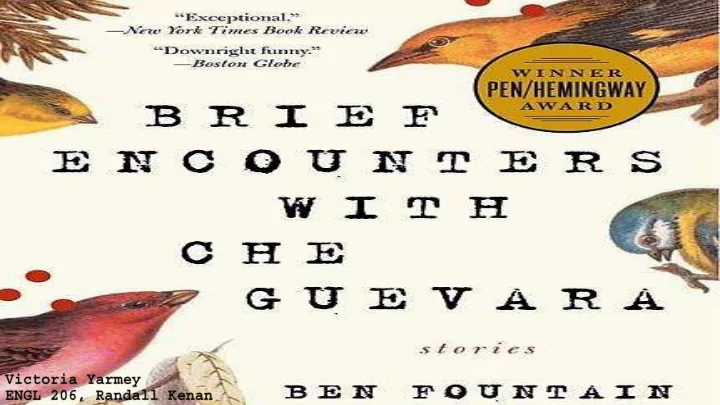
Ben Fountain Notable works: Billy Lynn's Long Halftime Walk Brief - - PowerPoint PPT Presentation
Ben Fountain Notable works: Billy Lynn's Long Halftime Walk Brief Encounters with Che Guevara Beautiful Country Burn Again Education: BA in English from UNC in 1980 law degree from Duke in 1983 Quit law at 30 years
– Billy Lynn's Long Halftime Walk – Brief Encounters with Che Guevara – Beautiful Country Burn Again
– BA in English from UNC in 1980 – law degree from Duke in 1983
Image credit: Thorne Anderson
– Image Credit:
– Anderson, Thorne. "Ben Fountain." 2019. Web. 10 March 2019. <https://www.harpercollins.com/author/cr- 102471/ben-fountain/>. – Harper Collins Publishing. Brief Encounters with Che Guevara. 2019. Web. 10 March 2019. <https://www.harpercollins.com/9780060885601/brief-encounters-with-che-guevara/>.
–
<https://www.bookbrowse.com/biographies/index.cfm/author_number/3132/ben-fountain>. – Crain, Zac. "How Ben Fountain Overcame Being Called a Genius." D Magazine May 2012. Web. March 3, 2019 <https://www.dmagazine.com/publications/d-magazine/2012/may/how-ben- fountain-overcame-being-called-genius/>. – Fountain, Ben. Brief Encounters with Che Guevara. New York: Harper Collins, 2006. Print. – Salamon, Jeff. "Ben Fountain Undoes Dallas." Texas Monthly May 2012. Web. March 3, 2019 <https://www.texasmonthly.com/articles/ben-fountain-undoes-dallas/>.
Yarmey, Short Story Presentation 1 Victoria Yarmey yarmey@live.unc.edu ENGL 206, Randall Kenan Biographical Essay – Ben Fountain, Brief Encounters with Che Guevara Ben Fountain is the author of Billy Lynn’s Long Halftime Walk, Brief Adventures of Che Guevara, Beautiful Country Burn Again, and other short stories, novels, and essays. Fountain was born in Chapel Hill, NC and earned a B.A. in English from the UNC Chapel Hill in 1980 and a law degree from Duke University in 1983 (Crain). Fountain quit his promising law career in 1988 to become a writer, at which time he wrote everyday from 7:30 AM until lunchtime, after which he would continue to write again for a few hours (Salamon). Most of Fountain’s work during this time were short stories, until in 2006 when Fountain published Brief Encounters with Che Guevara. The book was successful and earned Fountain several honors and awards while also prompting Malcom Gladwell to write about Fountain as his main example in a story for The New Yorker in 2008 (Salamon). The article solidified Fountain’s literary celebrity and later prevented him from publishing his first novel The Texas Itch as his editor did not believe the work lived up to the author’s image at the time. In 2012 he wrote Billy Lynn’s Long Halftime Walk which followed a soldier’s return home and being used in a performance for the 2004 Thanksgiving Day football game. This novel was a commercial and literary success, winning the National Book Critics’ Circle Award and later being adapted into a feature film (BookBrowse). Fountain currently lives in Dallas with his wife and children while continuing to write.
Yarmey, Short Story Presentation 2 Works Cited
<https://www.bookbrowse.com/biographies/index.cfm/author_number/3132/ben- fountain>. Crain, Zac. "How Ben Fountain Overcame Being Called a Genius." D Magazine May 2012.
magazine/2012/may/how-ben-fountain-overcame-being-called-genius/>. Salamon, Jeff. "Ben Fountain Undoes Dallas." Texas Monthly May 2012. Web. March 3, 2019 <https://www.texasmonthly.com/articles/ben-fountain-undoes-dallas/>.
Yarmey, Short Story Presentation 3 Victoria Yarmey yarmey@live.unc.edu ENGL 206, Randall Kenan 3 Short Story Summaries – Brief Encounters with Che Guevara “Brief Encounters with Che Guevara” follows the story of a man through separate points
When he was a young boy he had a crush on a professor’s wife who had an affair with Che. Later on, he’s grown and living on his own after dropping out of college. He works for a moving company where he learns that one of the other movers was the man who killed Che during the military operation to capture him. The man, Gus, tells him the story about the event and how Che became a martyr from the picture they took as proof of his death. Some years later, he works as a journalist and often visits Haiti because it is ripe with sociopolitical and natural disaster. During his visits he stays at his friend Ponce’s apartment, where many other people come and go. One of these other guests is a mulatto named Laurent who used to be an aspiring political figure but fell into insanity and has trouble recognizing reality. On the narrator’s last visit to Haiti he and Ponce decide to visit Laurent one last time, but the man never comes to the door and they realize that he’s dead. “Near-Extinct Birds of the Central Cordillera” tells the story of John Blair, an
stopped by revolutionists and he gets taken for a spy and held captive in their camp. The soldiers do not necessarily believe he is a spy but they place a five-million-dollar ransom for him
Yarmey, Short Story Presentation 4
tries to blow his head off. The next morning Blair convinces the commandante to let him continue his work in studying the birds. They allow him to go outside the compound with a guard, Hernan. On one of these excursions the two find a rare species of parrot thought to have gone extinct. Blair becomes committed to studying the birds, even though he knows there is a chance that his work will be in vain. After over a year, Americans visit the revolutionaries’ base. Blair thinks that it may be for his release, but learns that they are actually there to make a deal to the log the area, which will ultimately kill the parrots. Blair tries to convince the commandos to go against the deal, but the commandante agrees and tells the Americans to take Blair with them
home with the other Americans and cries for the birds. In “Bouki and the Cocaine” two brother fishermen, Syto and Lulu, are out fishing and watching the ‘go-fasts’ speed by. Syto tells Lulu that he’s seen where the go-fasts drop off drugs in duffle bags and the two decide to take a stand against the drug problem. They grab the bags, which are filled with cocaine, and bring them to the local police thinking it is the right thing to
the drugs for themselves. Some time later, Syto and Lulu find more drugs and decide to take them to the Senator. Again, they find that their authority figure is corrupt and has sold the drugs for themselves. Enraged, Lulu stands outside the Senator’s home and the police station and yells the truth, prompting the guards and policemen to beat him within an inch of his life. Syto finds drugs yet again, and decides to finally sell them himself to help his poor community. He hatches an elaborate scheme with Lulu and the rest of the community to get the cocaine to Port-au-Prince where they can sell it, as the police know that Syto has the drugs and are watching him closely.
Yarmey, Short Story Presentation 5 So, during a festival they sew the drugs into their clothing and use the Gédé dancers as cover. The endeavor is successful, and Syto’s community is able to survive now with running water and electricity. References Fountain, Ben. Brief Encounters with Che Guevara. New York: Harper Collins, 2006. Print.
Yarmey, Short Story Presentation 6 Victoria Yarmey yarmey@live.unc.edu ENGL 206, Randall Kenan Craft Analysis – Brief Encounters with Che Guevara In Ben Fountain’s Brief Encounters with Che Guevara, his first published collection of short stories, each of the main characters somehow comes to terms with the realist idea that doing the right thing does not necessitate benefits for their efforts. Whether it is Syto in “Bouki and the Cocaine” trying to turn in illegal drugs to the police or Melissa in “The Good Ones are Already Taken” trying to stay loyal to her husband while he is deployed, the characters find that their environment or corrupted authority render their actions in vain. Syto realizes that the police have sold the drugs for themselves, and Melissa finds herself rewarded with her husband returning spiritually married to a voodoo goddess. It should not be surprising, then, to find that these experiences eventually alter their world views in some form; Syto sells the last cocaine deposit he finds to save his community from poverty and starvation, while Melissa reevaluates her ideas of marriage and religion but ultimately decides to support her husband. For all save one story out of the collection Fountain uses the third person limited
thoughts somehow, whether expressing through first person or telling directly through third. However, for "Fantasy for Eleven Fingers", Fountain does not allow us to know the thoughts about the main character, Anna, rather the thoughts of those around her. “Brief Encounters with Che Guevara” is also unique in relation to the rest because it is told in first person from the
Yarmey, Short Story Presentation 7 perspective of the main character though it does still allow the reader to see into his thoughts and
stories as it allows the readers to focus on the character of interest and understand what is
information. A large benefit of the chosen point of view is the style in which the story is portrayed. Fountain’s style is similar to that for Stream of Consciousness, reflecting everything that happens to the character of focus as well as revealing their thoughts and personality. His diction is casual, using slang, vulgarity, and common vernacular that would be expected out of these characters. However, Fountain adopts a logical and distant tone as if the narrator is relating the experiences candidly but as an objective observer. While it is easy for such a tone to be monotonous and make some stories indistinguishable from another, Fountain has successfully created independent voices across his works by his word choice alone. He utilizes common words that can be expected from the character themselves. For example, in “Near-Extinct Birds of Central Cordillera” Fountain uses combinations jargon, Spanish, and casual English for Blair, who is addicted to ornithology and studied Spanish. “Brief Encounters with Che Guevara” has casual and formal English for the man who dropped out of college and works as a writer. “Bouki and the Cocaine” has casual English interlaced with French and Haitian words for Syto's perspective, who is a poor Haitian fisherman. The word choice is not only in the dialogue and character’s thoughts, but carries throughout the entire narration itself. A consequence of Fountain’s style is that the sentence structure varies between long run-
narration consisting of lengthy sentences that tend to tangent, though these portions are brought
Yarmey, Short Story Presentation 8 to a close by short, impactful sentences that keep the reader attentive. An early example of this is in “Near-Extinct Birds of Central Cordillera” after the narrator has taken a large tangent from John Blair’s arrest by revolutionaries to speak of his fervor to study the birds in Columbia and prove himself when closing with "It could be done; it would be done; it had to be done." (Fountain 2). The sentence serves to remind the reader of the urgency of the situation at hand while also pulling them from the stupor of Blair’s ornithological fascination. Within the narrations itself he has also scattered some humor, as evident in “Blair hunched over, trying to blend in with the compact Indians, but a tall skinny gringo with a big back-pack might as well have had a turban on his head.” (Fountain 2). Fountain takes turns between narration and dialogue, for which the narration serves as transition between actions and the dialogue presents the actions. He also uses conversations or segments of dialogue to break up long areas of narration or for effect. However, sometimes rather than telling the conversation he chooses to merely state what was said, as in “When I asked what happened to the group, she said, I quit. I got scared.” though he may insert quotes into the actual narration when there is not enough for a conversation (Fountain 198). The dialogue itself sounds like the real characters talking and reflects their intelligence, region of
gendarmes,” [Syto] said with goofy formality, walking over to the truck. “This is certainly an honor.” " accurately demonstrates how Syto is expected to speak as a Haitian fisherman to the chief of police, however the manner in which he speaks displays his lack of respect (Fountain 133). Fountain rarely uses dialogue scenes without purpose and their function is mainly to provide more information about the character speaking and keep the story moving forward.
Yarmey, Short Story Presentation 9 A large benefit of the combination of perspective and style is that the characterization plays into the speech of the narration. Though the perspective may not be first person, Fountain's word choice and sentence structures reflect those of the main character and provide a great deal
Cordillera” where nearly every page is filled with mention of birds. Since the story is from Blair's perspective it enforces his almost manic dedication to ornithology. The very idea of birds consumes his thoughts to such a degree that they extend into the narration itself. This is critical in understanding Blair’s character but also the events that unfold within the story. While the information provided about the main characters is largely provided through the narration’s style, Fountain also does well in describing secondary characters. A character’s physical appearance and mannerisms are largely reflective of their personality within these stories, such as Officer Michelet’s curling mustache or Starkey’s “embarrassing taste for gold accessories” (Fountain 150) . However, he also describes aspects of their personality directly, such as with Kara Coleman, the assistant to the businessman in “Near-Extinct Birds of Central Cordillera” that encounters Blair after he has spent over a year as a captive. Fountain says “she wasn’t heartless… but rather the kind of person who might cry at movies, or toss bites of her bagel to stray dogs.” (Fountain 24). This serves to explain to the reader why she does not jump to act on Blair’s behalf to rescue him, as it is not because she is insensitive but rather she has not been exposed to a situation which required intense levels of compassion. While Fountain’s characters may not be entirely developed outside of the protagonists, similar insertions like these allow those secondary characters to feel more realistic. Fountain has a very vivid sense of place, from the dense Columbian jungles thrumming with the voices of rare parrots to an ocean so blue that it appears as if a boat is sailing through
Yarmey, Short Story Presentation 10 the sky. His descriptions are not extensive in detail, but rather romantic. For example, “Through the woodsmoke and dust and swirl of car exhaust the late sun took on an ocherous radiance, the red light washing over the grunged and pitted streets. Dunes of garbage filled out the open spaces, eruptions so rich in colorful filth that they achieved a kind of abstraction.” (Fountain 36). Though he is describing a decrepit street filled with refuse, he does so in such a manner that the reader feels a need to be there. This is a recurring pattern in these works, as by describing the imperfections of a place he draws the reader to it. Each of the stories have some connection to a war-torn and chaotic environment, whether it being the forest-base of the Columbians MURCs, the poor streets of Haiti, the explosive fields
roles in defining the action of the stories or the impact on the characters themselves. However, while Fountain serves to provide enough action and thought-provoking elements for each tale to keep the reader interested, the works do not have a punch ending that the reader is lead to expect. The endings are anticlimactic and while they do provide a resolution they do not satisfy. For example, “The Good Ones are Already Taken” concludes with Melissa declaring she can manage sharing her husband with the voodoo goddess Erzulie, but it leaves the reader questioning as to whether the goddess was real or not without providing enough hints or concrete evidence for either case. In “Rêve Haitian” a man works with a mulatto to sell Haitian art to fund a revolution, but when the mulatto dies he is left with a drum filled with cash and somberly regrets that he now has no one to give it to in order to continue the dream. The way these stories end so abruptly, as if there is a final event yet to occur, feels as if the reader is meant to savor some last thought-provoking message, however the execution merely leaves the reader confused.
Yarmey, Short Story Presentation 11 Works Cited Fountain, Ben. Brief Encounters with Che Guevara. New York: Harper Collins, 2006. Print.