
SLIDE 1
1
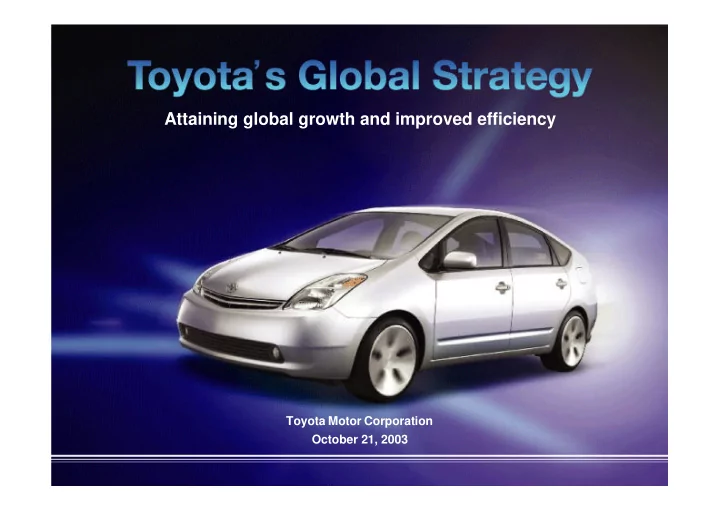
Attaining global growth and improved efficiency
Toyota Motor Corporation October 21, 2003
Attaining global growth and improved efficiency Toyota Motor - - PowerPoint PPT Presentation
Attaining global growth and improved efficiency Toyota Motor Corporation October 21, 2003 1 Cautionary Statement with Respect to Forward-Looking Statements This presentation contains forward-looking statements that reflect Toyotas plans and
1
Toyota Motor Corporation October 21, 2003
2
Cautionary Statement with Respect to Forward-Looking Statements
This presentation contains forward-looking statements that reflect Toyota’s plans and expectations. These forward-looking statements are not guarantees of future performance and involve known and unknown risks, uncertainties and other factors that may cause Toyota’s actual results, performance, achievements or financial position to be materially different from any future results, performance, achievements or financial position expressed or implied by these forward-looking statements. These factors include: (i) changes in economic conditions affecting, and the competitive environment in, the automotive markets in Japan, North America, Europe and other markets in which Toyota operates; (ii) fluctuations in currency exchange rates, particularly with respect to the value of the Japanese yen, the U.S. dollar, the euro and the British pound; (iii) Toyota’s ability to realize production efficiencies and to implement capital expenditures at the levels and times planned by management; (iv) changes in the laws, regulations and government policies affecting Toyota’s automotive operations, particularly laws, regulations and policies relating to environmental protection, vehicle emissions, vehicle fuel economy and vehicle safety, as well as changes in laws, regulations and government policies affecting Toyota’s other operations, including the outcome of future litigation and other legal proceedings; (v) political instability in the markets in which Toyota operates; (vi) Toyota’s ability to timely develop and achieve market acceptance of new products; and (vii) fuel shortages or interruptions in transportation systems, labor strikes, work stoppages or other interruptions to, or difficulties in, the employment of labor in the major markets where Toyota purchases materials, components and supplies for the production of its products or where its products are produced, distributed or sold. A discussion of these and other factors which may affect Toyota’s actual results, performance, achievements or financial position is contained in the “Operating and Financial Review and Prospects” and “Information on the Company” sections and elsewhere in Toyota’s annual report on Form 20-F, which is on file with the United States Securities and Exchange Commission.
3
4
Global Manufacturing and Marketing in 2002
North America, Europe, Asia, China, and Japan
Production Systems
5
6
1,500 3,000 4,500 6,000
CY92 CY98 CY00 CY02 Projections for CY03 Overseas production Overseas sales
Number of vehicles (thousands of units) Number of vehicles (thousands of units)
* Total units including Toyota/Lexus, Daihatsu, and Hino brands
Domestic production Domestic sales
~ ~ ~ ~ ~ ~
764 764 764 2,412 2,412 1,467 1,467 1,467 2,930 2,930 1,779 1,779 1,779 3,480 3,480 2,175 2,175 2,175 3,949 3,949 2,570 2,570 2,570 4,240 4,240
6,314 6,167 6,730 6,550
7
FY92 FY94 FY96 FY98 FY99 FY00 FY01 FY02 FY03
Operating income(US GAAP*2)
500 1,000
(Billions of yen)
131 yen/$ 122 yen/$
(Thousands of units)
2,000
Overseas production volume (calendar year) *1 Exchange rate (yen/dollar)
*1. Output including Toyota, Daihatsu, and Hino brands *2. FY92-96 : Japan GAAP
650
2,175 1,271
8
9
500 1,000 1,500 2,000
1998 1999 2000 2001 2002
Units manufactured in North America Units imported from Japan
Target for 2003–2004 Projection for 2005
Number of vehicles (thousands of units) Number of vehicles (thousands of units)
8.7 8.7 9.3 10.1 10.4 *
*
2,000 2,000 2,000
* Market share in the US (%)
10
5 5 10 10 15 15 Passenger vehicle market Passenger vehicle market
Lexus RX330 (from March 2003) Tundra Double Cab (scheduled launch: fall 2003)
1990 1990 2002 2002
Corolla Camry
Scion
(from June 2003)
Next-generation Prius (from October 2003)
in 2002 passenger vehicle sales
in 2002 passenger vehicle sales Number of vehicles (millions of units) Number of vehicles (millions of units)
Commercial vehicle (light truck) market Commercial vehicle (light truck) market Commercial vehicle (light truck) market
11
Renewal of strategic core models completed
2.9% 2.9% 3.4% 3.9% 4.5%
200 400 600 800
1998 1999 2000 2001 2002 2.0 3.0 4.0 5.0
Toyota sales units Market share
Market share (%)
Avensis Corolla Yaris European core models Target for 2005
Number of vehicles (thousands of units) Number of vehicles (thousands of units)
800 800 800
12
100 200
1998 2001 2002
*Diesel sales ratio
16% 22% 31%*
Diesel Engines
Rapid expansion of local production From Jan.03: TMUK 50,000 units TMMF 30,000 units From 2005: Poland 150,000 units
DPNR/launch in 2003 DPNR: Diesel Particulate
Number of vehicles (thousands of units) Number of vehicles (thousands of units)
Sales units of diesel-powered vehicles
13
→ Expand faster than the market
100 200 300 400
1998 1999 2000 2001 2002 10 20 30
Toyota sales units Year-on-year growth: market Year-on-year growth: Toyota Year-on-year growth (%) * excluding China
Passenger vehicles ratio: 47% Market share: 22% Market Market share: share: 22% 22% Number of vehicles (thousands of units) Number of vehicles (thousands of units)
Projection for 2005
14
Manufacturing and marketing to be strengthened in response to market growth
2002 2003 2004 2005 2006 2007 2008 2009 2010 Establish full product lineup Establish Toyota brand Product lineup Production capacity
Daihatsu (compact) VIOS 25,000 units/Year →115,000 units/Year 50, 000 units/Year Large & luxury Luxury SUV 50,000 units/Year
Several hundred thousand units/Year
30,000 units/Year Compact
Aggressive introduction of models Aggressive introduction of models Aggressive introduction of models
Crown Corolla
Land Cruiser/Prado
15
2,000 4,000
1998 1999 2000 2001 2002 20 40
Total market excluding minivehicles Toyota’s share (%)
Toyota’s share: maintaining and expanding high-level over 40% Toyota’s share: maintaining and expanding high-level over 40%
Market share (%) Number of vehicles (thousands of units) Number of vehicles (thousands of units)
Projection for 2005
16
Toyota’s share (overall) : January to September, 2003:
37.7 78.6
41.8 45.8 76.5
57.2
30 40 50 60 70 80
Toyota’s share: for the year 2002 Toyota’s share: January to September, 2003 Market share (%)
3 Box Large & Luxury 2 BOX Minivan, Cab Wagon
Vitz Alphard
~ ~ ~ ~
Wish Celsior Celsior
(*changes year-on-year)
17
Toyota dealers: Luxury vehicles Toyopet dealers: Medium-sized vehicles Corolla dealers: Compact vehicles New Netz: Develop new market segment
(from spring of 2004) From August 2005, 180 dealers / 4 models
Price range Tradition Advanced /
Areas to be changed
18
Region-specific models Region-specific models Core models Core models
Camry Camry Corolla Corolla Yaris/Vitz Previa/Estima Hilux Avensis Avensis Tacoma Tacoma
19
Global network through linkage between Japan (core technology) and regional bases (local needs)
Toyota Technical Center in the US
TMEM R&D Group
Higashifuji Technical Center
★ ★
Japan Core technology development Japan Core technology development
Development Development Collaboration Collaboration Collaboration Collaboration Collaboration Collaboration CALTY (Design Center in the US) Development Development
Development Development
ED2 (Design Center in France) Toyota Technical Center/ Design Headquarters (Head Office)
★New R&D Centers in Asia and Australia
(Thailand and Australia)
★New R&D Centers in Asia and Australia
(Thailand and Australia)
20
1,779 2,570 2,175 764 1,051 1,346 1,467
1,500 3,000 4,500 6,000
1992 1994 1996 1998 2000 2002 Projection For 2003
Domestic production Overseas production
* Total output including Toyota/Lexus, Daihatsu and Hino brands * Total output including Toyota/Lexus, Daihatsu and Hino brands
6,314 6,314
Maintaining Domestic production Maintaining Domestic production Maintaining Domestic production
~ ~ ~ ~ ~ ~ ~ ~ ~ ~
UK plant Kentucky plant expansion, USA Canadian plant expansion West Virginia plant, USA Chengdu plant, China French plant Polish plant Tianjin plant, China
6,730 6,730
Indiana plant, USA
Number of vehicles (thousands of units) Number of vehicles (thousands of units)
21
5 5 25 25 < North America > < Europe > < China >
New factory in Texas (from 2006) Local production expansion of engines
(from April 2003) and capacity expansion (from 2005)
first 3 work-shifts in the UK and French factories
2005)
Diesel-powered engine production at the new factory in Poland (from early 2005) Production in cooperation with China FAW Group (from the fall of 2003) (tens of thousands of units) Present Plan
22
South Africa To South America To Europe / Africa
Thailand: global production base Other Asian countries: Engines and main components production bases
Thailand Thailand
The Philippines Other countries India
: Pickup truck / multipurpose vehicles : Engines and main components
A network base for manufacturing and export of pickup trucks and multipurpose vehicles. Consolidating production output on a global scale and creating a mutual supply network
Argentina
South Africa / Argentina : Interregional production bases Japan Indonesia
23
Attain “cost reductions,” “quality improvement” & global deployment through standardization and simplification Example: Process innovation in engine development – the use of digital engineering –
Existing Process: 32 months ⇒After innovation: 16 months After innovation: 16 months
Goals :
① Development ~ production preparation process ② Product structure, production facilities ③ Next-generation production method
Innovation
designs
Product design Product design
Preparing production Preparing production Start of commercial Start of commercial manufacturing manufacturing Reduce number of Reduce number of initial initial design changes design changes Shorten lead time for Shorten lead time for production preparation production preparation Reduce the Reduce the man man-hour hour of
es
line and creation of data base
24
The U.S. market expansion Growing population The U.S. market expansion Growing population Advances in the Eastern & Central European and Russian markets Advances in the Eastern & Central European and Russian markets Strong growth
Strong growth
25
TECHNOLOGY DEVELOPMENT
Leading-edge technologies Leading-edge technologies Next-generation technologies Next-generation technologies Existing technologies Existing technologies
Comfort Kindness Excitement
Nanotechnology Materials technology Biotechnology Energy technology Engine Body Electronics Transmission Chassis IT Safety Environment
MARKETING
Assessing customer needs Propose visions
26
Fuel cell hybrid vehicle
(limited marketing launched since December 2002)
27
Improvement of real safety performance
New Avensis)
Radar /PreCrash safety system (commercialized in Japan in February 2003)
PSB Image sensor Brake Radar sensor
without AFS with AFS
The world's first The world's first
VSC, Navigation/Telematic etc.
* AFS:Adaptive Front-lighting System
The world's first The world's first
28
Growth potential of auto industry in the diversified society Growth potential of auto industry in the diversified society
driving performance
Optimum production and development systems Continuous cost reductions
Speed and diversification
Market creation Adapting to the markets Sustainability
Social responsibility / building trust
Passion
Enthusiasm and conviction
Value chain
ITS / Finance, etc.
Improve customer satisfaction and realize growth
29
30
31
5.6% 7.7% 6.1% 6% 8.2% 8.3%(1Q)
ROE
(%)
(%)
6 9 10 7
~ ~
500 1,000 FY99 FY00 FY01 FY02 FY03 FY04 (forecast) Target
1Q
( ROE: 12.3%)
IF: Forex rates in FY04 = Forex rates in FY03 *1Q=1st Quarter (Billions of yen)
(US GAAP)
Operating income ratio 6.8% 7.1% 9.6% 7.8% 10.4%
Operating income Operating income ratio ROE
1Q
32
FY99 FY00 FY01 FY02 FY03 FY04
Unconsolidated Subsidiaries
300
(forecast)
Billions of yen
200 100
* FY99 – FY02: Japan GAAP
(US GAAP)
33
2 4
FY94 FY96 FY98 FY00 FY02
20 80 140 200
Accumulated net income EPS (net income per share)
Trillions of yen * FY94 – FY97: Japan GAAP (yen/share)
(US GAAP)
34
Free cash flow Dividends & share buybacks
FY99 FY00 FY01 FY02 FY03
Capital expenditures R&D
*1. Free cash flow = Current net income + Depreciation costs - Capital expenditures See Annex Ⅰfor a reconciliation of free cash flow to net cash provided by operating activity *2. R&D Expenses for FY99 – FY02: JAPAN GAAP
(US GAAP)
(Billions of yen)
1,000 500
35
[March 31, 2003 ] [Sept. 30, 1999]
Dramatic drop
Shareholdings
by banks
Shareholdings
by banks
Increase in foreign shareholders
(listed on NY and London Stock Exchanges in September 1999)
Increase in foreign shareholders
(listed on NY and London Stock Exchanges in September 1999)
Increase in individual shareholders
(reduction in stock unit in August 2000)
Increase in individual shareholders
(reduction in stock unit in August 2000)
34% 15%
36
Social Contribution Program Committee Social Contribution Program Committee Corporate Ethics Committee Corporate Ethics Committee Stock Option Committee Stock Option Committee NY/London stock listing
London and Tokyo
NY/London stock listing
London and Tokyo
General shareholders’ meeting General shareholders’ meeting
International Advisory Board International Advisory Board Labor-Management Council & Forum Labor-Management Council & Forum
Board of directors Board of directors
Monitoring Monitoring Monitoring
<Monitoring>
<Internal information management>
Disclosure Committee Disclosure Committee
Accounting audits based on US & Japan auditing standards Accounting audits based on US & Japan auditing standards
Monitoring Monitoring
<Internal/external auditing>
Monitoring Monitoring Monitoring Monitoring
Monitoring Monitoring Monitoring
President Managing Officers Board of statutory auditors More than half are external auditors Board of statutory auditors More than half are external auditors
37
38
Toyota Motor Corporation October 21, 2003