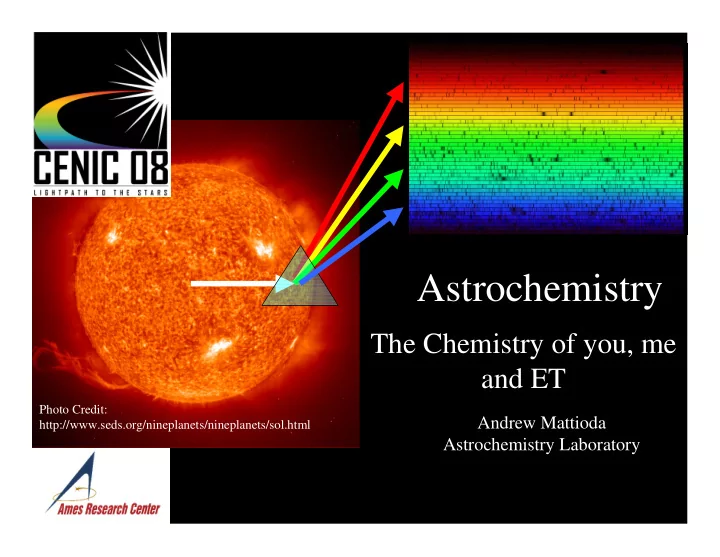
Astrochemistry The Chemistry of you, me and ET Photo Credit: - - PowerPoint PPT Presentation

astrochemistry
SMART_READER_LITE
LIVE PREVIEW

Astrochemistry The Chemistry of you, me and ET Photo Credit: - - PowerPoint PPT Presentation

Astrochemistry The Chemistry of you, me and ET Photo Credit: Andrew Mattioda http://www.seds.org/nineplanets/nineplanets/sol.html Astrochemistry Laboratory Outline of the Talk Background on Astrochemistry and its relevance to Space


slide-1
SLIDE 1

Photo Credit: http://www.seds.org/nineplanets/nineplanets/sol.html

The Chemistry of you, me and ET

Astrochemistry

Andrew Mattioda Astrochemistry Laboratory
slide-2
SLIDE 2

Outline of the Talk

  • Background on Astrochemistry and its

relevance to Space Science.

  • How the measurements are made.
  • How is the information utilized?
  • Where do we go from here?
slide-3
SLIDE 3

What is Astrochemistry?

  • Tries to understand the chemistry that can take place in

extraterrestrial and astrobiologically interesting environments such as: – Planetary surfaces

  • Tries to understand the chemistry that can take place in

extraterrestrial and astrobiologically interesting environments such as: – Planetary surfaces – Other solar system objects

  • Tries to understand the chemistry that can take place in

extraterrestrial and astrobiologically interesting environments such as: – Planetary surfaces – Other solar system objects – Interstellar clouds

  • Tries to understand the chemistry that can take place in

extraterrestrial and astrobiologically interesting environments such as: – Planetary surfaces – Other solar system objects – Interstellar clouds

  • Concerned with the production, distribution, and fate of

the chemical precursors of life

slide-4
SLIDE 4

A little context… A little context…

  • Space was considered chemically barren for most of

the 20th Century

  • The spell was broken in the 1960’s and 1970’s with

these discoveries: OH (early 60’s) NH3 (1968) H2CO (1969)* CO (1970) 11.3 µm emission (1973)

* …polyatomic molecules containing at least 2 atoms other than H can form in the interstellar medium.” Snyder, Buhl, Zuckerman, Palmer

slide-5
SLIDE 5

Why Study Astrochemistry?

  • It tells us about the “chemical inventory”

available for the origin of life

  • It provides a record of processes billions of

years old

  • It gives us markers to search for in

exploration of extraterrestrial environments

slide-6
SLIDE 6

ase.jpl.nasa.gov/

Search for Life in the Solar System:

We might get lucky

slide-7
SLIDE 7

OH OH O O R

Aloe-Emodin

  • Arch. Pharm. 247, 81 (1909)

Rhein (extract of chinese rhubarb)

  • Ann. 50, 196 (1844)

O O OH

Juglone (in walnut & pecan shells)

  • Bull. Soc. Chim. 1, 800 (1907)

O H HO H HO H OH OH H H OH

Sugars

N N N H N NH2

Nucleobases

Nitrogen containing heterocycles

Substituted aromatics

O OH

Fatty acids

…but the search for life in the Solar System is far more likely to be the search for organic biomarkers

Amino acids

slide-8
SLIDE 8

How is Astrochemistry Studied?

  • Three main approaches:
  • Three main approaches:

– Remote astronomical measurements

  • Three main approaches:

– Remote astronomical measurements – Laboratory simulations

  • Three main approaches:

– Remote astronomical measurements – Laboratory simulations – Study of actual samples

  • Three main approaches:

– Remote astronomical measurements – Laboratory simulations – Study of actual samples

  • We must use a combination of all three

methods to get a full story

slide-9
SLIDE 9

The constellation of Orion The constellation of Orion

slide-10
SLIDE 10

The constellation of Orion The constellation of Orion

slide-11
SLIDE 11
slide-12
SLIDE 12

There is a class of molecules that has been found in

  • meteorites. . .

. . . In fact, you might even know what they taste like...

slide-13
SLIDE 13

Allamandola, L.J., Astrophysical Journal, 381(1991)181.

slide-14
SLIDE 14

H H H H H H H H

PAH PAH Aliphatic Carbon Molecule Aliphatic Carbon Molecule Propane Propane Propane Anthracene Anthracene Anthracene C3H8 C C3

3H

H8

8

C14H10 C C14

14H

H10

10

Polycyclic Aromatic Hydrocarbons (PAHs) Polycyclic Polycyclic Aromatic Hydrocarbons ( Aromatic Hydrocarbons (PAHs PAHs) )

H H H H H H H H H H

They are stable, made mostly

  • f carbon, and are everywhere.

These sooty molecules may take up 10-15% of the galactic carbon! They are also carcinogens

slide-15
SLIDE 15

How to Pump Up PAHs How to Pump Up PAHs

U VUV

slide-16
SLIDE 16

Mid Mid-

  • IR Frequency Ranges Characteristic of

IR Frequency Ranges Characteristic of PAHs PAHs

Wavelength (µm) 3 5 4 6 7 8 9 10 15 CHstr CCstr/CHip CCstr CHoop

Vibration - S. Langhoff Orion ISO Spectrum - E. Peeters

slide-17
SLIDE 17

What’s the next step?

  • The devil is in the details – use this

information as a probe of the interstellar environment.

  • Create an online, accessible, database for

use by astronomers, environmental scientists & educators.

slide-18
SLIDE 18
slide-19
SLIDE 19
slide-20
SLIDE 20

Cami, 2006

Least squares fit of the spectra in the database to the ISO SWS spectrum of the HII Region IRAS 23133

May, 2006

slide-21
SLIDE 21

Cami, 2007

Breakdown of large and small PAHs in the astronomical objects from the Least Squares Fit

September, 2007

slide-22
SLIDE 22

M16 - The Eagle Nebula M16 - The Eagle Nebula

Visible Light

NOAO Photo

Visible Light

NOAO Photo

Near Infrared

2MASS Image

Near Infrared

2MASS Image

Middle Infrared

ISO/ESA Image

Middle Infrared

ISO/ESA Image

slide-23
SLIDE 23

Origin of Life

"All we are is dust in the wind..."

Kansas, The Point of No Return

Presentation made possible by the Ames Astrochemistry group, Lou, Jamie, Max, Christiaan, & others

  • Complex organic molecules form in space.
  • Complex organic molecules form in space.

Complex organic molecules form in space.

  • Delivered to planetary surfaces via meteors,

comets & dust.

  • Delivered to planetary surfaces via meteors,

Delivered to planetary surfaces via meteors, comets & dust. comets & dust.

  • The spectroscopic changes allows us to understand

the chemical changes.

  • The spectroscopic changes allows us to understand

The spectroscopic changes allows us to understand the chemical changes. the chemical changes.