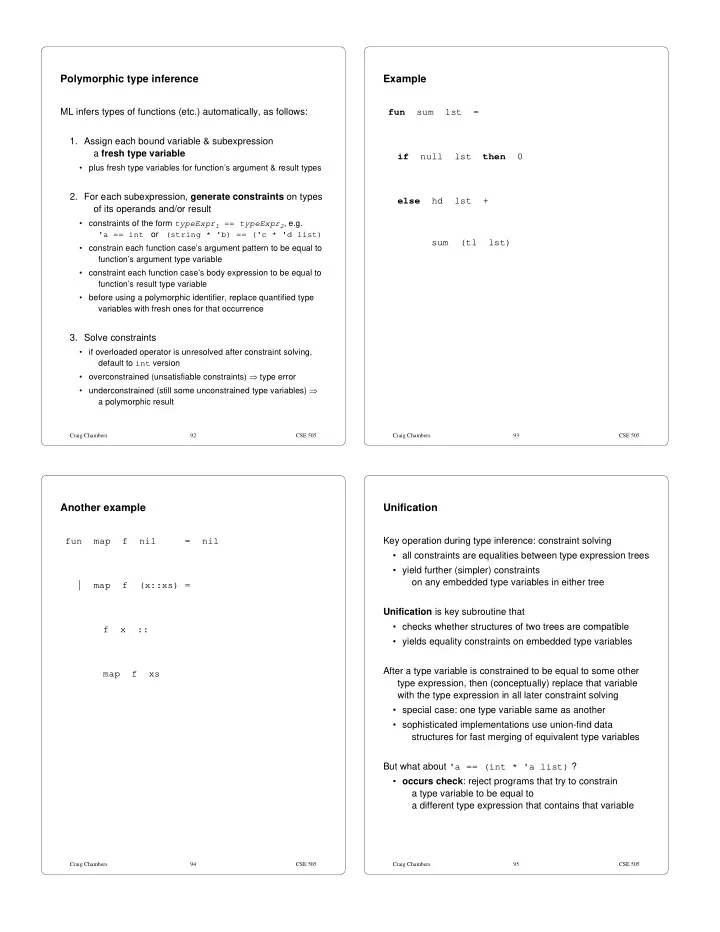
Polymorphic type inference Example fun sum lst = ML infers types - - PDF document

polymorphic type inference example
SMART_READER_LITE
LIVE PREVIEW

Polymorphic type inference Example fun sum lst = ML infers types - - PDF document

Polymorphic type inference Example fun sum lst = ML infers types of functions (etc.) automatically, as follows: 1. Assign each bound variable & subexpression a fresh type variable if null lst then 0 plus fresh type variables for


slide-1
SLIDE 1

Craig Chambers 92 CSE 505

Polymorphic type inference

ML infers types of functions (etc.) automatically, as follows:

  • 1. Assign each bound variable & subexpression

a fresh type variable

  • plus fresh type variables for function’s argument & result types
  • 2. For each subexpression, generate constraints on types
  • f its operands and/or result
  • constraints of the form typeExpr1 == typeExpr2, e.g.

'a == int or (string * 'b) == ('c * 'd list)

  • constrain each function case’s argument pattern to be equal to

function’s argument type variable

  • constraint each function case’s body expression to be equal to

function’s result type variable

  • before using a polymorphic identifier, replace quantified type

variables with fresh ones for that occurrence

  • 3. Solve constraints
  • if overloaded operator is unresolved after constraint solving,

default to int version

  • verconstrained (unsatisfiable constraints) type error
  • underconstrained (still some unconstrained type variables)

a polymorphic result

Craig Chambers 93 CSE 505

Example

fun sum lst = if null lst then 0 else hd lst + sum (tl lst)

Craig Chambers 94 CSE 505

Another example

fun map f nil = nil | map f (x::xs) = f x :: map f xs

Craig Chambers 95 CSE 505

Unification

Key operation during type inference: constraint solving

  • all constraints are equalities between type expression trees
  • yield further (simpler) constraints
  • n any embedded type variables in either tree

Unification is key subroutine that

  • checks whether structures of two trees are compatible
  • yields equality constraints on embedded type variables

After a type variable is constrained to be equal to some other type expression, then (conceptually) replace that variable with the type expression in all later constraint solving

  • special case: one type variable same as another
  • sophisticated implementations use union-find data

structures for fast merging of equivalent type variables But what about 'a == (int * 'a list) ?

  • occurs check: reject programs that try to constrain

a type variable to be equal to a different type expression that contains that variable

slide-2
SLIDE 2

Craig Chambers 96 CSE 505

Let-bound polymorphism

ML type inference supports only let-bound polymorphism

  • only val- or fun-declared names can be polymorphic,

not names of formals

  • implies that all implicit quantifiers of polymorphic variables

are at outer level (“prenex form”)

  • fun id(x) = x;

val id = fn : 'a -> 'a (* with explicit quantifier: val id = fn : ∀'a.'a->'a *)

  • fun g(f) = (f 3, f "hi");

(* type error in ML; f cannot be given a polymorphic type *) (* this (legal) ML type wouldn’t allow the two different f calls: val g = fn : ∀'a.(('a->'a) -> int*string) *) What if ML allowed explicitly quantified polymorphic types for formals?

  • fun g(f:∀'a.'a->'a) = (f 3, f "hi");

val g = fn : (∀'a.'a->'a) -> int*string

  • g(id);

val it = (3, "hi") : int * string Type inference precludes first-class polymorphic values

Craig Chambers 97 CSE 505

Polymorphic vs. monomorphic recursion

When analyzing the body of a polymorphic function, what do we do when we encounter a recursive call? fun f(lst) = ... f(hd(lst)) ... f(tl(lst)) ... If support polymorphic recursion, then f is considered polymorphic in its body, and each recursive call uses a fresh instantiation (like any call to a polymorphic function) If support only monomorphic recursion, then treat f as having a non-polymorphic type in its body, which forces recursive call to pass same argument types as formals Type inference under polymorphic recursion is undecidable (but only in obscure cases)

  • and hard to implement since don’t know what type variables

f will have when recursive reference encountered ML uses monomorphic recursion

Craig Chambers 98 CSE 505

Nested polymorphic functions

After doing type inference for a function, if any type variables remain in its type, then make the function polymorphic over them But what about a nested function? fun f(x) = let fun g(u, v) = ([x,u], [v,v]) in ... g(x, 5) ... (* does this work? *) ... g([x], true) ... (* does this? *) end Type of f: 'a -> '... Type of g: 'a * 'b -> 'a list * 'b list

  • but 'a and 'b are not equally flexible for callers...

'a inside f is a non-generalizable type variable

  • don’t replace with a fresh type variable when g called

Monomorphic recursion restriction implied as a special case

Craig Chambers 99 CSE 505

Properties of ML type inference

A.k.a. Hindley-Milner type inference

  • allows let-bound polymorphism only
  • universal unconstrained parametric polymorphism
  • SML: hacks for overloading, equality types

Type inference yields principal type for expression

  • single most general type that can be inferred

Worst-case complexity of type inference: exponential time Average case complexity: linear time

slide-3
SLIDE 3

Craig Chambers 100 CSE 505

References

Allow side-effects through explicit reference values: type 'a ref val ref : 'a -> 'a ref val ! : 'a ref -> 'a val (op :=) : 'a ref * 'a -> unit

  • val v = ref 0;

val v = ref 0 : int ref

  • v := !v + 1;

val it = () : unit

  • !v;

val it = 1 : int (ML also has arrays: efficiently indexable, mutable locations) Language design principles:

  • must say which things are mutable
  • mutation is compartmentalized

Craig Chambers 101 CSE 505

References to polymorphic values?

  • fun id(x) = x;

val ID = fn : 'a -> 'a

  • val fp = ref id;

(* type error in real SML... *) val fp = ref fn : ('a -> 'a) ref

  • (!fp true, !fp 5);

(true, 5) : bool * int

  • fp := not;

hmmmm...

  • !fp 5

CRASH!!! Cannot allow refs containing polymorphic values In general, val can bind to polymorphic values (e.g. fn..., []), but not polymorphic expressions (e.g. ref...)

  • “type vars not generalized because of value restriction”

error otherwise

  • SML’90 had “weakly polymorphic types” instead

Craig Chambers 102 CSE 505

Functors

Can parameterize structures by other structures

  • signature MAP = sig

= type (''a,'b) T = val empty: (''a,'b)T = val store: (''a,'b)T * ''a * 'b -> (''a,'b)T = val fetch: (''a,'b)T * ''a -> 'b = end;

  • structure Assoc_List :> MAP = ...;
  • structure Hash_Table :> MAP = ...;
  • functor MapUser(M:MAP) = struct

= ... M.T ... M.store ... M.fetch ... = end; Instantiate functors to build regular structures:

  • structure MU1 = MapUser(Assoc_List);
  • structure MU2 = MapUser(Hash_Table);

Can typecheck MapUser separately from its instantiations

  • unlike C++ templates,

parameterized modules of most other languages

Craig Chambers 103 CSE 505

Functors for “bounded parametric polymorphism”

Want to write polymorphic code that’s still able to perform

  • perations like =, <, print, etc. on its data
  • can use first-class functions for this (as we saw)
  • can use functions for this (as we’ll now see)

Define a signature representing the operations needed signature ORDERED = sig type T val eq: T * T -> bool val lt: T * T -> bool end Define polymorphic algorithms as elements of functors parameterized by required signature functor Sort(O:ORDERED) = struct fun min(x,y) = if O.lt(x,y) then x else y fun sort(lst) = ... O.lt(x, y) ... end

slide-4
SLIDE 4

Craig Chambers 104 CSE 505

An instantiation of Sort

Create specialized sorter by instantiating functor with appropriate operations

  • structure IntOrder:ORDERED = struct

= type T = int; = val lt = (op <); = val eq = (op =); = end; ...

  • structure IntSort = Sort(IntOrder);

...

  • IntSort.sort([3,5,~2,...]);

... Aside: use IntOrder:ORDERED, not IntOrder:>ORDERED

  • Using : instead of :> allows type binding (T=int) to bleed

through to users of IntOrder

  • IntOrder is a view/extension of an existing type, int;

it isn’t creating a new ADT w/ only 2 operations

  • transparent (vs. opaque) signature ascription

Craig Chambers 105 CSE 505

Another instantiation of Sort

Can create nested, multiply parameterized functors: functor PairOrder( structure First:ORDERED; structure Second:ORDERED):ORDERED = struct type T = First.T * Second.T; (* lexicographic comparison *) fun lt((x1,x2),(y1,y2)) = First.lt(x1,y1) andalso Second.lt(x2,y2); fun eq((x1,x2),(y1,y2)) = ...; end; structure IntStringSort = Sort( PairOrder(structure First = IntOrder; structure Second = StringOrder));

  • IntStringSort.sort(

= [(3,”hi”),(3,”there”),(2,”bob”)]); val it = [(2,”bob”),(3,”hi”),(3,”there”)] : ...

Craig Chambers 106 CSE 505

Signature “subtyping”

Signature specifies a particular interface Any structure that satisfies that interface can be used where that interface is expected

  • e.g. in functor application

Doesn’t have to be an exact match: structure can have

  • more operations
  • more polymorphic operations
  • more details of implementation of types

than required by signature

Craig Chambers 107 CSE 505

Some limitations of ML modules

Structures are not first-class values

  • must be named or be argument to functor application
  • must be declared at top-level or

nested inside another structure or functor Functors are not first-class values

  • must be named
  • must be declared at top-level

No type inference for functor arguments Cannot use structures as data Cannot instantiate functors at run-time to create “objects” cannot simulate classes and object-oriented programming just using structures and functors These constraints are (in part) to enable type inference of core

slide-5
SLIDE 5

Craig Chambers 108 CSE 505

Modules vs. classes

Classes (abstract data types) implicitly define a single type, with associated constructors, observers, and mutators Modules can define 0, 1, or many types in same module, with associated operations over several types

  • a module defining 0 types is useful

if adding operations to existing type(s)

  • e.g. a library of integer or array functions
  • cleaner than dummy class containing static fields & methods
  • a module defining multiple types is useful

if need to share private data & operations across types

  • cleaner than friend declarations in C++

“Module + type” is more orthogonal, flexible than “class=type”

  • perhaps less convenient for common case

Functors similar to parameterized classes C++’s public/private is simpler than ML’s separate signatures, but C++ doesn’t have a simple way of describing just an interface

Craig Chambers 109 CSE 505

Scheme

Shares many features with ML:

  • functional
  • functions are first-class values
  • largely side-effect free
  • strongly typed
  • expression-oriented, recursion-oriented
  • garbage-collected heap
  • highly regular and expressive

Unlike ML:

  • dynamically typed, not statically typed
  • lacks
  • pattern matching (but some Scheme extensions have this)
  • exceptions (but has continuations)
  • modules (but some Scheme extensions have this)
  • syntax blends data and program
  • good macro system

Lisp designed by McCarthy in late 50’s Scheme dialect introduced by Steele and Sussman in mid 70’s as “executable lambda calculus”

Craig Chambers 110 CSE 505

Syntax

Program ::= { Definition | Expr } Definition ::= (define id Expr) | (define (idfn idformal1 ... idformalN) Expr) Expr ::= id | Constant | SpecialForm | (Exprfn Exprarg1 ... ExprargN) Constant ::= int | float | string | symbol | (lambda (idformal1 ... idformalN) Expr) | ... SpecialForm ::= (if Exprtest Exprthen Exprelse) | ...

Craig Chambers 111 CSE 505

Uniform prefix “calls”

Examples: (+ 3 4) → 7 (+ (* 3 8) (/ 8 2))→ 28 (define seven (+ 3 4)) seven → 7 (+ seven 8) → 15 (define (square n) (* n n)) (square seven) → 49 (define (fact n) (if (<= n 0) 1 (* n (fact (- n 1))))) (fact 20) → 2432902008176640000 Treating all operators & function calls in prefix syntax uniformly is simple, regular, and unambiguous, but not “traditional”

  • don’t have to define precedence and associativity!
  • can have 0, 1, 2, or many arguments to a “binary” operator
slide-6
SLIDE 6

Craig Chambers 112 CSE 505

Special forms

Regular call expressions evaluate all argument exprs (including function expr) then invoke function value passing argument values

  • all user-defined procedures work this way

Special forms are special “functions” where arguments aren’t all treated as expressions to be evaluated first

  • can define new special forms using macros

Example: (define x 0) (define y 5) (if (= x 0) 0 (/ y x)) → 0 (define (my-if test then else) (if test then else)) (my-if (= x 0) 0 (/ y x)) → error! (define-syntax my-if (syntax-rules () ((my-if test then else) (if test then else)))) (my-if (= x 0) 0 (/ y x)) → 0

Craig Chambers 113 CSE 505

Other special forms

cond: like if-elseif-...-else chain: (cond ((> x 0) 1) ((= x 0) 0) (else -1)) Short-circuiting and and or (like ML’s andalso and orelse) (or (= x 0) (> (/ y x) 5) ...) let: “simultaneous” local variable bindings: (define x 1) (define y 2) (define z 3) (let ((x 5) (y (+ 3 4)) (z (+ x y z))) (+ x y z)) → 5+7+(1+2+3)=18 let*: “sequential” local variable bindings (like ML’s let): (let* ((x 5) (y (+ 3 4)) (z (+ x y z))) (+ x y z)) → 5+7+(5+7+3)=27

Craig Chambers 114 CSE 505

Lists

Translation between ML and Scheme Examples: (define lst (list 5 6 7 8)) → (5 6 7 8) (define lst2 (cons 4 lst)) → (4 5 6 7 8) (+ (car lst) (car lst2)) → 9 (define lst3 (cdr lst)) → (6 7 8)

  • lst, lst2, and lst3 have shared subpieces

ML Scheme nil () x :: xs (cons x xs) [x, y, z] (list x y z) hd(lst) (car lst) tl(lst) (cdr lst) null(lst) (null? lst)

Craig Chambers 115 CSE 505

Dynamic typing

There are no static types, neither explicit nor inferred Any variable, and any data structure, can hold any type of value Values have (run-time) types, variables are typeless Typechecking is performed only when absolutely necessary E.g.

  • car & cdr check that argument is a cons cell, and
  • + checks that arguments are numbers, but
  • cons and list check nothing!

Lists can be heterogenous: (list 3 4.5 () "hi" (list 3 5)) → (3 4.5 () "hi" (3 5))

  • lists in Scheme subsume both tuples and lists in ML

E.g. an association list of key-value pairs: (define Zips (list (list "Seattle" 98195) (list "Boston" 02115) (list "Reston" 22091))) → (("Seattle" 98195) ("Boston" 02115) ("Reston" 22091))

slide-7
SLIDE 7

Craig Chambers 116 CSE 505

Type testing

Programs can test the type of values at run-time Some type-testing predicates: null? pair? symbol? boolean? number? integer? ... string? ...

Craig Chambers 117 CSE 505

Quoting

List literals via quote or ' special form: (list 3 (list 4 5) 6) → (3 (4 5) 6) (quote (3 (4 5) 6)) → (3 (4 5) 6) '(3 (4 5) 6) → (3 (4 5) 6) Quoted identifiers are symbol constants: 'positive → positive (car '(if (> a b) 3 4)) → if Programs and data share same regular syntax Makes it very easy to write programs that build, take apart, and transform programs