Lecture 2: CMB data Larissa Santos University of Science and - - PowerPoint PPT Presentation

lecture 2 cmb data
SMART_READER_LITE
LIVE PREVIEW

Lecture 2: CMB data Larissa Santos University of Science and - - PowerPoint PPT Presentation

Lecture 2: CMB data Larissa Santos University of Science and Technology of China, USTC 05/06/2015 Outline The Interactive Data Languague Hierarchical Equal Area isoLatitude Pixelation Planck maps Foregrounds Masks Code


slide-1
SLIDE 1

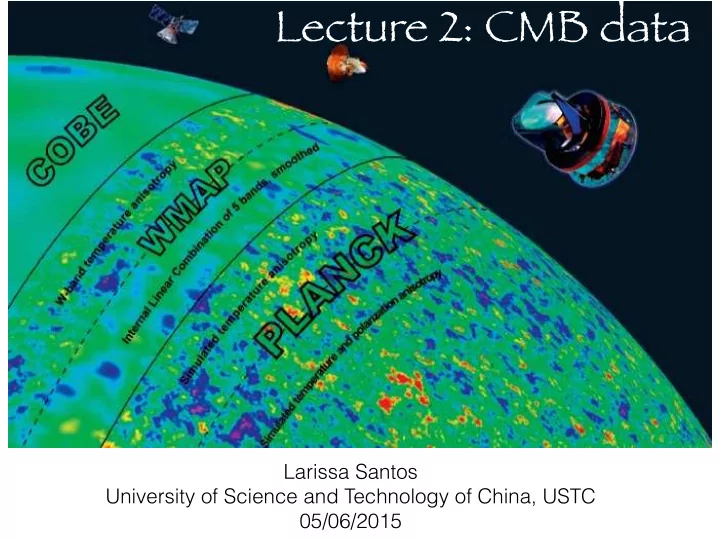
Lecture 2: CMB data

Larissa Santos University of Science and Technology of China, USTC 05/06/2015
slide-2
SLIDE 2

Outline

  • The Interactive Data Languague
  • Hierarchical Equal Area isoLatitude Pixelation
  • Planck maps
  • Foregrounds
  • Masks
  • Code for Anisotropies in the Microwave Background
  • Simulations
slide-3
SLIDE 3

Very short CMB timeline

SPT BOOMERANG Planck WMAP COBE

slide-4
SLIDE 4

IDL

  • The Interactive Data Language (IDL) is a proprietary

system distributed bu Exelis Visual Information Solution, inc

  • It can be downloaded from

http://www.exelisvis.com/ProductsServices/IDL.aspx

  • IDL is currently available in LINUX, Windows and

Macintosh versions

  • Programming language usually used for CMB data

analysis

slide-5
SLIDE 5

Screenshot

slide-6
SLIDE 6
  • HEALPix: Hierarchical Equal Area isoLatitude

Pixelation

  • Produces a subdivision of a spherical surface in

which each pixel covers the same surface area as every other pixel

  • The lowest resolution partition is comprised of 12

base pixels

  • The resolution increases by 3 steps from the base

level

Gorski et al. (2005)

slide-7
SLIDE 7

Definitions

  • Nside
  • Expresses the resolution of

the grid

  • Npix
  • Denotes the total number of
  • pixels. Npix=12*Nside*Nside
  • In the figure, the sphere is

partitioned, respectively, into 12, 48, 192 and 768 pixels (Nside = 1, 2, 4 and 8)

the ~N scaling for the non-iso-latitude sampling distributions

slide-8
SLIDE 8
  • Pixel numbering schemes:
  • RING: counting the pixels

moving down from the north to the south pole along each iso- latitude ring.

  • NESTED: arranging the pixel

indices in twelve tree structures, corresponding to base-resolution pixels

slide-9
SLIDE 9

Visualization (IDL)

slide-10
SLIDE 10

Planck satellite

  • The Planck satellite was

launched on May14th of 2009

  • The low frequency instrument

(LFI) covers 3 frequency bands

  • 30, 44 and 70GHz
  • The high frequency instrument

(HFI) detectors cover 6 frequency bands

  • 100, 143, 217, 353, 545 and

857GHz

slide-11
SLIDE 11

Planck maps

  • Nside: 2048
  • Npix= 5.03316e+07!!!
  • Ordering: NESTED
  • Format: fits file
  • FITS (Flexible Image Transport System) is the data

format most widely used within astronomy for transporting, analyzing and archiving scientific data files

  • They can be downloaded from

http://pla.esac.esa.int/pla/

slide-12
SLIDE 12

Useful HEALPix subroutines

  • MAPS: read_fits_map, read_fits_s, read_tqu,

write_fits_map, write_tqu

  • Down-grading and NESTED/RING pixel reordering:

ud_grade

  • Example:
  • map = ‘/Users/larissasantos/Documents/Dados_Planck/'

map_ilc= "COM_CompMap_CMB-smica_2048_R1.20.fits"

  • read_fits_map, map+map_ilc, smica

ud_grade, smica, a1, nside_out=8, order_in='nested', order_out='ring'

slide-13
SLIDE 13

Planck frequency maps

slide-14
SLIDE 14

Example of a degraded CMB map

slide-15
SLIDE 15

Examples of CMB visualization

slide-16
SLIDE 16

Foregrounds

  • Light coming from foreground sources in our

galaxy or other galaxies must be measured accurately, so as to separate out this light from the CMB signal

slide-17
SLIDE 17

Foreground overview

  • Synchrotron radiation:

emission of relativistic electrons gyrating in a magnetic field

  • Free-Free: emission of

electrons when deflected by massive ions

10 30 100 300 1000

Frequency (GHz)

10

  • 1

10 10

1

10

2

Rms brightness temperature (µKRJ)

C M B T h e r m a l d u s t Free-free S y n c h r

  • t

r

  • n

30 44 70 100 143 217 353 545 857 Spinning dust

CO 1-0

Sum fg

slide-18
SLIDE 18
  • Thermal dust: emission from interstellar dust grains

mostly made of graphites, silicates and polycyclic aromatic hydrocarbons (PAHs)

  • Spinning dust: the most plausible candidate is tiny

PAH particles spinning with dipole moment

  • CO molecular clouds: Rotational transitions of

carbon monoxide

slide-19
SLIDE 19
  • Extragalactic point sources: some point sources

can emit in the radio-millimetric domain

slide-20
SLIDE 20

The microwave sky as seen by Planck

Anisotropies of the CMB and of the cosmic infrared background Free-free (Gum nebula) Galatic dust

slide-21
SLIDE 21

Planck HFI maps- CMB removed

100 GHz 857 GHz 353 GHz 143 GHz 545 GHz 217 GHz

Planck collaboration, arXiv: 1101.2048

slide-22
SLIDE 22

Synchrotron emission at 23 GHz estimated in the WMAP 9-year analysis Thermal dust emission map at 353 GHz estimated by Planck experiment

α

Free-free (Dickinson et al., 2003; Finkbeiner, 2003)

slide-23
SLIDE 23

Estimate map for spinning dust in the WMAP K band First estimate map for CO line emission by Planck

slide-24
SLIDE 24

Noise power spectra in the HFI sky maps

  • Noise power spectra on the

full sky (solid line) and after masking the Galactic plane (dotted line)

  • The biggest difference is seen

for high frequency maps as expected since the Galactic signal is larger

Noise Power Spectra in the HFI Sky Maps

slide-25
SLIDE 25
  • Diffuse foregrounds consist of several distinct

emission processes which dominate on large angular scales

  • It is important to understand the foreground

emission in order to achieve the most precise CMB maps and cosmological information

  • They are os astrophysical interest and consideres

foregrounds only for CMB studies!!!

slide-26
SLIDE 26

Foreground-cleaned temperature maps

slide-27
SLIDE 27
  • The Planck team used four methods to separate

CMB from diffuse foreground emission

  • The methods can be dived in two types
  • Foreground are removed by combining the

multifrequency data to minimize the variance of the CMB component

  • A parameterized model of the CMB an

foreground is constructed and the CMB component is obtained by sampling from the posterior distribution of parameters

slide-28
SLIDE 28
slide-29
SLIDE 29

Multipole expansion: do you remember?

ΔT T θ,φ

( ) =

alm

m=−l m=l

l=2 lmax

Ylm θ,φ

( )

Ylm θ,φ

( ) = λlm(cosθ)eimφ

λlm x

( ) =

2l +1 4π l − m

( )!

l + m

( )!P

lm x

( )

λlm x

( ) = −1 ( )

m λl m

λlm x

( ) = 0

m ⩾ m<0 m=0

θ ∈ 0,π

[ ]

φ ∈ 0,2π

[

)

slide-30
SLIDE 30

Decomposing the CMB map: quadrupole

=

  • L=2

m=0 m=1,-1 m=2,-2

+ +

slide-31
SLIDE 31

Octopole

L=3

= +

+ +

m=0 m=1,-1 m=2,-2 m=3,-3

slide-32
SLIDE 32

HEALPix program: Anafast

  • This program performs

harmonic analysis of the HEALPix maps up to a specified maximum spherical harmonic order lmax

  • Anafast reads a file containing

the map and produces a file containing the temperature power spectrum and, if requested, also the polarization power spectra

  • The alm coefficients computed

during the execution also can be written to a file if requested

slide-33
SLIDE 33

HEALPix routine: Synfast

  • This program can be used to

create HEALPix maps

  • Temperature only
  • Temperature and

polarization

  • The map resolution, Gaussian

beam and random seed for the simulation can be selected by the user

slide-34
SLIDE 34

Masks

  • Even the multifrequency CMB maps are not

completely free of foregrounds

  • Remove possible contaminated pixels from CMB

maps

  • Planck released 3 main temperature masks with

different sky cuts and 1 polarization mask

slide-35
SLIDE 35

fsky = 83.65 fsky = 78.67 fsky = 74.83

slide-36
SLIDE 36

Masked CMB temperature map

slide-37
SLIDE 37

CAMB Lewis Challinor and Lasenby (2000)

  • Code for

Anisotropies in the Microwave Background

  • CAMB Web

interface: http:// lambda.gsfc.nasa.go v/toolbox/ tb_camb_form.cfm

slide-38
SLIDE 38

INPUT OUTPUT

  • Cosmological parameters:

and so on h,h2Ωb,h2Ωc,h2Ωµ,Ωk,w

  • CMB power spectra:
  • Matter power spectrum
  • Matter transfer functions

CTT ,C EE,C BB,CTE

slide-39
SLIDE 39

CMB simulations

TRUE UNIV. Known only by Mother Nature Statistically realized

OBSERVABLE UNIV.

Measurements

Measured data

Analysis

Our Univ.

h

h2Ωb h2Ωc

h2Ωµ Ωk Cosmological model Interpretation What we want!!

slide-40
SLIDE 40
  • From the cosmological parameters

that we extract from the data we do NOT have a unique realization

  • f the universe!
  • Based on our cosmological model

we can generate infinitely realizations

  • Each one of them generated with

the best fit parameters that we found

  • For a statistical analysis compare

the realizations from your model with the measured data.

slide-41
SLIDE 41

–Marcelo Gleiser

“The map of what we call reality is an ever-shifting mosaic of ideas.”