Assoc. Prof. Mustafa F NE Afyon Kocatepe University Head of the - - PowerPoint PPT Presentation

assoc prof mustafa f ne afyon kocatepe university head of
SMART_READER_LITE
LIVE PREVIEW

Assoc. Prof. Mustafa F NE Afyon Kocatepe University Head of the - - PowerPoint PPT Presentation

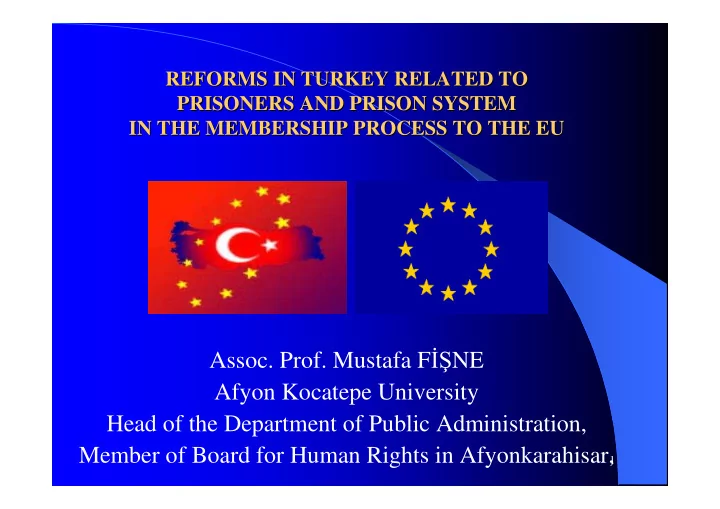
REFORMS IN TURKEY RELATED TO REFORMS IN TURKEY RELATED TO PRISONERS AND PRISON SYSTEM PRISONERS AND PRISON SYSTEM IN THE MEMBERSHIP PROCESS MEMBERSHIP PROCESS TO TO THE EU THE EU IN THE Assoc. Prof. Mustafa F NE Afyon Kocatepe


slide-1
SLIDE 1

1

REFORMS IN TURKEY RELATED TO REFORMS IN TURKEY RELATED TO PRISONERS AND PRISON SYSTEM PRISONERS AND PRISON SYSTEM IN THE IN THE MEMBERSHIP PROCESS MEMBERSHIP PROCESS TO TO THE EU THE EU

  • Assoc. Prof. Mustafa FİŞNE

Afyon Kocatepe University Head of the Department of Public Administration, Member of Board for Human Rights in Afyonkarahisar,

slide-2
SLIDE 2

2

AIM OF THE AIM OF THE PRESENTATION PRESENTATION

“It aims to discuss the reforms and improvements related to prisoners and prison system in Turkey during its membership process to the European Union (EU)”

slide-3
SLIDE 3

3

RELATED RELATED F FEATURES OF THE EU EATURES OF THE EU

A SUPRANATIONAL NATURE

(It requires transfer of power (authority) by the member states in certain fields to the common decision-making mechanisms of the EU)

A SUPERIOR LAW

(The EU law is above all kinds of the national

  • laws. Therefore, member states have to

ensure the compliance of their laws with the EU legislation

slide-4
SLIDE 4

4

MAIN STAGES IN THE MEMBERSHIP PROCESS MAIN STAGES IN THE MEMBERSHIP PROCESS and TURKEY and TURKEY

ASSOCIATED COUNTRY (Turkey 1963) CANDIDATE COUNTRY (Turkey 1999) ACCESSING COUNTRY(Turkey 2005) MEMBER STATE (Turkey is not expected to

be earlier than 2020)

slide-5
SLIDE 5

5

IMPORTANT DATES IN EU – TURKEY RELATIONS

Country Partner Candidate Accessing Member Duration Turkey 1963 1999 2005 ???? 52 + Malta 1970 1997 2000 2004 34

  • S. Cyprus

1972 1997 1998 2004 32 Hungary 1991 1997 1998 2004 13 Poland 1991 1997 1998 2004 13 Czech Rep. 1993 1997 1998 2004 11 Slovakia 1993 1997 2000 2004 11 Romania 1993 1997 2000 2007 14 Bulgaria 1993 1997 2000 2007 14 Estonia 1995 1997 1998 2004 9 Latonia 1995 1997 2000 2004 9 Lithuania 1995 1997 2000 2004 9 Slovenia 1996 1997 1998 2004 8 Croatia 2001 2004 2005 2013 12

slide-6
SLIDE 6

6

NECESSITY OF REFORMS IN TURKEY NECESSITY OF REFORMS IN TURKEY

The recognition of Turkey as a candidate

for accession at the Helsinki European Council in 1999 marked the beginning of Turkey – EU relations with a perspective of full membership.

From that day on, a comprehensive reform

process started in Turkey to fulfill the EU’s membership criteria, commonly known as Copenhagen Political criteria.

slide-7
SLIDE 7

7

MEMBERSHIP CRITERIA MEMBERSHIP CRITERIA

In the political field:

Stability of institutions guaranteeing;

  • Democracy,
  • The Rule of Law,
  • Human Rights
  • Respect for and Protection of Minorities
slide-8
SLIDE 8

8

IMPORTANCE OF THE IMPORTANCE OF THE POLITICAL CRITERIA POLITICAL CRITERIA

Its components are closely inter-connected

with each other, requiring a unified reform process rather than partial improvements.

Owing to these criteria, reform attempts in

the applicant countries become more integrated, comprehensive, and coherent, resulting in the achievement of a remarkable transformation

slide-9
SLIDE 9

9

ACHIEVEMENTS IN TURKEY ACHIEVEMENTS IN TURKEY REGARDING HUMAN RIGHTS REGARDING HUMAN RIGHTS

Turkey was one of the first countries that ratified

Universal Declaration of Human Rights prepared by the United Nations in 1948.

In the Preamble of the Constitution, adopted in

Turkey in 1982, it is stated that every Turkish citizen has the right to exercise the fundamental rights and freedoms according to requirements of equality and social justice.

In the subsequent articles of the Constitution, it is

stressed that the Republic of Turkey is a state which respects human rights.

slide-10
SLIDE 10

10

ACHIEVEMENTS IN TURKEY ACHIEVEMENTS IN TURKEY REGARDING HUMAN RIGHTS REGARDING HUMAN RIGHTS

However, human rights have always been the hot

issues for Turkey’s EU membership as the country came under allegations of these rights violations especially after the military intervention in 1980.

In other words, Turkey’s record on human rights

has long continued to attract scrutiny by the EU.

But, considerable achievements and progress has

been made since 1999, when Turkey was declared as canditate country to the EU membership.

slide-11
SLIDE 11

11

ACHIEVEMENTS IN TURKEY ACHIEVEMENTS IN TURKEY REGARDING HUMAN RIGHTS REGARDING HUMAN RIGHTS

To this end, 6 Constitutional Amendments (in 2001,

2002, 2004, 2005, 2007 and 2010) were realised, changing nearly one third of the present Constitution.

Besides adoption of 9 Harmonisation Packages

(in 2002, 2003, 2004, 2006), 5 Judicial Reform Packages were adopted, which were prepared to strengthen compliance with EU political criteria.

slide-12
SLIDE 12

12

ACHIEVEMENTS IN TURKEY ACHIEVEMENTS IN TURKEY REGARDING HUMAN RIGHTS REGARDING HUMAN RIGHTS

In addition, some important laws were renewed,

including Civil Code and Criminal Code.

Finally, 187 primary and 147 secondary legislative

arrangements have been realised within the scope of the Copenhagen Political Criteria.

slide-13
SLIDE 13

13

SEEKING FOR A NEW CONSTITUTION SEEKING FOR A NEW CONSTITUTION

Through these amendments, the judicial and

political system of Turkey attained modern standards and became further aligned with universal principles and EU membership criteria.

However, preparing a new constitution based upon

universal norms and social consensus has recently been the main item on Turkey’s agenda.

slide-14
SLIDE 14

14

SEEKING FOR A NEW CONSTITUTION SEEKING FOR A NEW CONSTITUTION

The drafting of the new constitution started as of

May 2012 within the framework of a consultation period with a broad participation

A Conciliation Committee was founded within the

the TGNA based on equal representation of all political parties in the TGNA.

Unfortunately, the Comittee became unable to

complete its task and abolished as of 2014.

The process is expected to be restarted after the

elections in June.

slide-15
SLIDE 15

15

REFORMS IN TURKEY REFORMS IN TURKEY RELATED TO PRISONERS AND PRISON SYSTEM RELATED TO PRISONERS AND PRISON SYSTEM

A summary of the reforms in Turkey related to the

prisoners and prison system since 1999 is provided below:

slide-16
SLIDE 16

16

ABOLISHMENT OF DEATH PENALTY ABOLISHMENT OF DEATH PENALTY

Death penalty has been abolished in many steps: Although it had existed legally, it was not

executed in Turkey since 1987.

First, it was partially abolished in 2002 in line

with Protocol 6 to the European Convention on Human Rights.

Secondly, it was completely removed from the

Constitution in 2004.

Finally, all references to death penalty in every

law was deleted in 2004.

slide-17
SLIDE 17

17

UNIVERSALISATION UNIVERSALISATION IN THE FIELD OF HUMAN RIGHTS IN THE FIELD OF HUMAN RIGHTS

The ratification of international human rights instruments

increased significantly,

The supremacy of the ratified international treaties over

domestic legislation was established,

The amendment to the Article 90 of the Constitution

provides for the supremacy of international agreements regarding fundamental rights and freedoms over national legislation.

slide-18
SLIDE 18

18

UNIVERSALISATION UNIVERSALISATION IN THE FIELD OF HUMAN RIGHTS IN THE FIELD OF HUMAN RIGHTS

The execution of the European Court of Human Rights

(ECtHR) judgments were accelerated

The opportunity for the retrial of convictions that are

contrary to the European Convention on Human Rights (ECHR) was recognized,

In case where an ECtHR ruling determines that a decision

  • f non-prosecution has been taken in the absence of an

effective investigation, an investigation may be launched again upon request by relevant parties.

slide-19
SLIDE 19

19

FIGHT AGAINST TORTURE AND ILL TREATMENT FIGHT AGAINST TORTURE AND ILL TREATMENT

A “zero-tolerance” approach was adopted for the

prevention of misconducts, such as torture, ill- treatment, disappearances, extra-judicial executions etc.

The permission procedure for the prosecution of

civil servants and public employees for allegations

  • f torture and ill treatment has been abolished.
slide-20
SLIDE 20

20

FIGHT AGAINST TORTURE AND ILL TREATMENT FIGHT AGAINST TORTURE AND ILL TREATMENT

It has been made impossible for sentences for

torture and ill treatment to be converted into fines

  • r any other measures or to be suspended.

In other words, the penalties imposed on civil

servants for offences of torture and mistreatment could no longer be delayed or turned into fines.

The length of time that a convict or detainee may

be taken out of prison or a detention house by the security forces has been reduced.

slide-21
SLIDE 21

21

FIGHT AGAINST TORTURE AND ILL TREATMENT FIGHT AGAINST TORTURE AND ILL TREATMENT

The investigation and prosecution of cases of

torture and ill treatment has been declared as urgent matters and as priority cases to be treated without delay.

The maximum period allowed for replies to

applications to the Human Rights Investigation Commission related to human rights violations has been decreased.

slide-22
SLIDE 22

22

FIGHT AGAINST TORTURE AND ILL TREATMENT FIGHT AGAINST TORTURE AND ILL TREATMENT

The compensation paid by the state in compliance

with judgements of the European Court of Human Rights (ECHR) has been allowed to be returned to the personnel responsible for cruel, inhuman or degrading treatment.

The compensation paid in accordance with the

ECHR has been exempted from stamp duties.

Statute of limitations is lifted for crimes of torture.

slide-23
SLIDE 23

23

CONDITIONS IN PRISONS AND DETENTION HOUSES CONDITIONS IN PRISONS AND DETENTION HOUSES

The prisons system was reformed through

the modernization of the infrastructure and establishment of a new administrative system,

Legal provisions on the rights of prisoners

and detainees has been expanded.

slide-24
SLIDE 24

24

Improving Conditions for Persons in Custody Improving Conditions for Persons in Custody (Suspect (Suspect’ ’s Rights) s Rights)

A new “Regulation on Apprehension,

Detention and Statement Taking” was issued in 2005 and detailed provisions were made on the mode of implementation and conditions for guarantees envisaged under fundamental rights and freedoms such as the authority of apprehension, informing relatives and detention room procedures.

slide-25
SLIDE 25

25

Improving Conditions for Persons in Custody Improving Conditions for Persons in Custody (Suspect (Suspect’ ’s Rights) s Rights)

Moreover, physical conditions in detention

rooms were improved and interrogation rooms were made compatible with human rights norms.

slide-26
SLIDE 26

26

Providing Detainees and Convicts the opportunity Providing Detainees and Convicts the opportunity to Attend their Relatives to Attend their Relatives’ ’ Funerals and Visit them in Funerals and Visit them in case of a Serious Illness case of a Serious Illness

In 2012, it was made possible to provide

detainees and convicts with 2 days leave excluding for travel time to attend the funerals of a blood relatives including second degree relatives or spouses thereof and to provide them with a 1 day leave excluding travel time to visit first degree relatives in the case of severe illness.

slide-27
SLIDE 27

27

Closure of Prisons that do not meet UN and Council Closure of Prisons that do not meet UN and Council

  • f Europe Standards
  • f Europe Standards

In the past, many prisons were far from

meeting standards in terms of physical conditions and personnel levels.

This situation caused convicts and detainees

to lodge complaints and waste the resources and personnel.

slide-28
SLIDE 28

28

Closure of Prisons that do not meet UN and Council Closure of Prisons that do not meet UN and Council

  • f Europe Standards
  • f Europe Standards

In the last decade, 208 penal institutions that did not

meet UN and Council of Europe standards were closed down.

During the same period, 68 penal institutions with a

total capacity of about 15,000 people, all in compliance with standards, were opened.

slide-29
SLIDE 29

29

Closure of Prisons that do not meet UN and Council Closure of Prisons that do not meet UN and Council

  • f Europe Standards
  • f Europe Standards

In 2012, a total of 13 new penal institutions were

  • pened and 7 additional buildings were constructed.

In 2014, the government constructed 10 new

prisons; however, overcrowding remained a concern in many of them.

slide-30
SLIDE 30

30

Reporting on Conditions Reporting on Conditions of Prisons

  • f Prisons

Besides Prison Monitoring Boards, the National

Human Rights Institution visits prisons with the intention of reporting on conditions.

In a report published in May, it outlined number of

recommendations to modify the legal framework and its implementation with regard to ensure improved prison conditions.

Parliamentary Human Rights Inquiry Committee

members also hold inquiries from time to time.

slide-31
SLIDE 31

31

CONCLU CONCLUDING REMARKS DING REMARKS

In the light of the given explanation, we are in a

better position to assess the quality of democracy in Turkey for the time being.

Turkey is now greatly different when compared to a

decade ago, especially in terms of political and judicial system as well as socio-economical standards.

The achieved reforms are so radical or drastic that

they are commonly regarded as “silent revolutions”.

slide-32
SLIDE 32

32

THANK YOU FOR YOUR PARTICIPATION Contact E-mail: fisne@aku.edu.tr