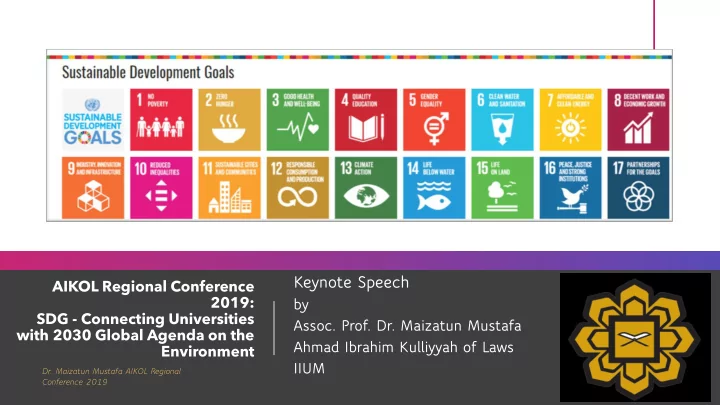
Keynote Speech AIKOL Regional Conference 2019: by SDG - - - PowerPoint PPT Presentation

keynote speech
SMART_READER_LITE
LIVE PREVIEW

Keynote Speech AIKOL Regional Conference 2019: by SDG - - - PowerPoint PPT Presentation

Keynote Speech AIKOL Regional Conference 2019: by SDG - Connecting Universities Assoc. Prof. Dr. Maizatun Mustafa with 2030 Global Agenda on the Ahmad Ibrahim Kulliyyah of Laws Environment IIUM Dr. Maizatun Mustafa AIKOL Regional


slide-1
SLIDE 1

AIKOL Regional Conference 2019: SDG - Connecting Universities with 2030 Global Agenda on the Environment

Keynote Speech

by

  • Assoc. Prof. Dr. Maizatun Mustafa

Ahmad Ibrahim Kulliyyah of Laws IIUM

  • Dr. Maizatun Mustafa AIKOL Regional

Conference 2019

slide-2
SLIDE 2
  • Dr. Maizatun Mustafa AIKOL Regional Conference 2019
slide-3
SLIDE 3

From

Sustainable Development

  • Dr. Maizatun Mustafa AIKOL Regional

Conference 2019

To

Sustainable Development Goals (SDG)

slide-4
SLIDE 4

The beginning..

  • Dr. Maizatun Mustafa AIKOL Regional Conference 2019

 The UN Conference on the

Human Environment held in Stockholm in 1972.

 The first major international

conference on the environment.

 Attended by 113 nations and

  • ver 400 non-governmental
  • rganizations (NGOs).
slide-5
SLIDE 5

After Stockholm...

  • Dr. Maizatun Mustafa AIKOL Regional Conference 2019

 1983: the UN Commission on Environment

and Development was created.

 1987: The Brundtland Report highlighted

that equity, growth, and environment are simultaneously possible.

 The Report introduced the term sustainable

development.

 Definition of sustainable development:  “development which meets the needs of the

present without compromising the ability of future generations to meet their own needs.”

Gro Harlem Brundtland, Prime Minister of Norway, addressing the UN General Assembly on Environment and Development 1987.

slide-6
SLIDE 6

The 2030 Agenda for Sustainable Development

  • In 2015, all UN members adopted the 2030

Agenda for Sustainable Development.

  • It is a 15-year global framework centred on 17

SDG.

  • It is universal in nature, developing and

developed countries alike will implement the Agenda.

  • The principle of ensuring that no one is left

behind in the achievement of the SDGs:

  • A a commitment to end extreme poverty in all

forms and to ensure that those who have been left behind can catch up to those who have experienced greater progress.

slide-7
SLIDE 7

The 2030 Agenda for Sustainable Development

  • Dr. Maizatun Mustafa AIKOL Regional

Conference 2019

  • Over the next 11 years, with the SDG universally apply to

all, countries will mobilize efforts to end all forms of poverty, fight inequalities and tackle climate change.

  • It envisions a world free of poverty and hunger, with

productive employment, access to quality education and health coverage, gender equality, and an end to environmental degradation.

slide-8
SLIDE 8

All 17 Goals are interconnected Success in one affects success for others.

  • Example:
  • Dealing with the threat of climate change

impacts how we manage our fragile natural resources

  • Climate Change requires nations to cooperate

to reduce GHG emissions in the energy, transport, industry, agriculture, and forestry sectors.

  • These correspond to SDG 7 (energy), SDG 11

(cities), SDG 9 (industrialisation), SDG 2 (agriculture), and SDG 15 (forests).

  • DR. MAIZATUN MUSTAFA AIKOL REGIONAL CONFERENCE 2019
slide-9
SLIDE 9

.

All 17 Goals are interconnected Success in one affects success for others

 Example:  Nations must cooperate with

respect to biomass, forests and oceans, coastal and marine ecosystems.

 These correspond to SDG 14

(oceans, seas and marine resources) and SDG 15 (terrestrial ecosystems, forests, desertification, land degradation and biodiversity).

slide-10
SLIDE 10

All 17 Goals are interconnected Success in one affects success for others.

  • DR. MAIZATUN MUSTAFA AIKOL REGIONAL CONFERENCE 2019
  • Example:
  • SDG 3 relates to reducing the

number of deaths and illnesses from hazardous chemicals and air, water and soil pollution and contamination.

  • SDG 16 Role of law on

environmental pollution.

slide-11
SLIDE 11

What Are Our Roles as Universities towards the SDG? Roles of Students?

`

  • DR. MAIZATUN MUSTAFA AIKOL REGIONAL CONFERENCE 2019

In the quest for the SDGs within the next 11 years, significant involvement from all sectors, including that of higher learning institutions, are necessary.

slide-12
SLIDE 12

`

  • DR. MAIZATUN MUSTAFA AIKOL REGIONAL CONFERENCE 2019
slide-13
SLIDE 13

`

  • DR. MAIZATUN MUSTAFA AIKOL REGIONAL CONFERENCE 2019
  • Universities can support SDG by disseminating

knowledge through teaching and learning, research, innovation, governance and leadership.

  • Universities can help boost students with

education and skill, and develop their leadership and capacity building to meet global challenges.

  • Externally, advocating the SDGs means that

universities should strengthen engagement with a wide range of stakeholders, from the government to the local community.

  • Such engagement could be in various forms from

initiating cross-sectoral discourse to involving in the design of related national policies and guidelines.

slide-14
SLIDE 14

`

  • DR. MAIZATUN MUSTAFA AIKOL REGIONAL CONFERENCE 2019
  • Universities and students have a special influence

not only on the society but also within the industries and private sectors.

  • Due to their participation in governance at

national and regional levels, universities are at top position to promote the SDG.

  • Many of the universities already make

contributions towards the SDG through their current actions in related areas.

  • However, universities need to become champions

in the implementation of the SDG by leading the local, national, and international response to the SDG.

slide-15
SLIDE 15

Thank you!

  • Dr. Maizatun Mustafa AIKOL Regional

Conference 2019

slide-16
SLIDE 16
slide-17
SLIDE 17
  • Dr. Maizatun Mustafa AIKOL Regional

Conference 2019

slide-18
SLIDE 18

`

  • Over the next 11 years, with the SDG universally apply to all, countries will mobilize efforts to

end all forms of poverty, fight inequalities and tackle climate change.

  • The SDG tackles the urgent environmental, political and economic challenges facing the

world.

  • The principle of ensuring that no one is left behind in the achievement of the SDGs.
  • DR. MAIZATUN MUSTAFA AIKOL REGIONAL CONFERENCE 2019
slide-19
SLIDE 19

All 17 Goals are interconnected Success in one affects success for others.

  • DR. MAIZATUN MUSTAFA AIKOL REGIONAL CONFERENCE 2019
  • Example:
  • Nations must cooperate with

respect to biomass, forests and

  • ceans, coastal and marine

ecosystems.

  • These correspond to SDG 14

(oceans, seas and marine resources) and SDG 15 (terrestrial ecosystems, forests, desertification, land degradation and biodiversity).

slide-20
SLIDE 20

All 17 Goals are interconnected Success in one affects success for others. Examples:

  • Dealing with the threat of climate change impacts

how we manage our fragile natural resources,

  • Climate Change requires nations to cooperate to

reduce GHG emissions in the energy, transport, industry, agriculture, and forestry sectors.

  • These correspond to SDG 7 (energy), SDG 11

(cities), SDG 9 (industrialisation), SDG 2 (agriculture), and SDG 15 (forests).

  • DR. MAIZATUN MUSTAFA AIKOL REGIONAL CONFERENCE 2019
  • Nations must cooperate with respect to

biomass, forests and oceans, coastal and marine ecosystems.

  • These correspond to SDG 14 (oceans,

seas and marine resources) and SDG 15 (terrestrial ecosystems, forests, desertification, land degradation and biodiversity).

slide-21
SLIDE 21
  • Dr. Maizatun Mustafa AIKOL Regional

Conference 2019