ASIC accelerators 1 Part 2 serial codes out Part 1 due tomorrow, - - PowerPoint PPT Presentation

asic accelerators
SMART_READER_LITE
LIVE PREVIEW

ASIC accelerators 1 Part 2 serial codes out Part 1 due tomorrow, - - PowerPoint PPT Presentation

ASIC accelerators 1 Part 2 serial codes out Part 1 due tomorrow, 11:59PM Homework 3 Questions? 2 Consistent style easier to read even if your grammar is poor Usually better ofg rewriting completely have good habits Some


slide-1
SLIDE 1

ASIC accelerators

1

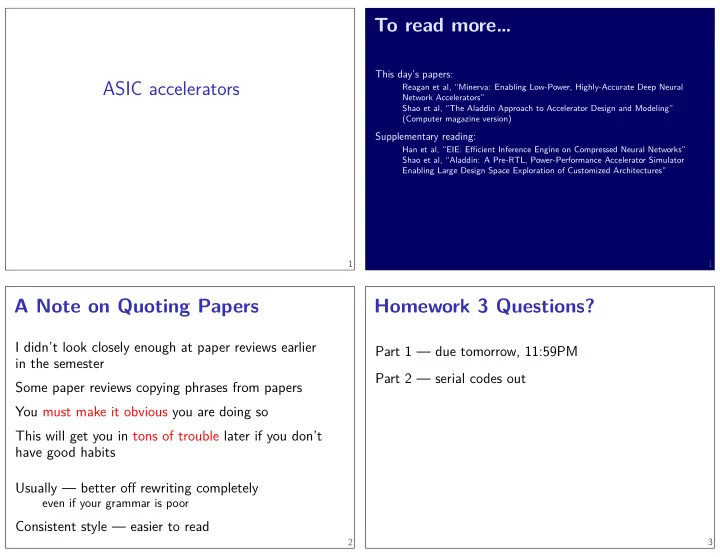
To read more…

This day’s papers:

Reagan et al, “Minerva: Enabling Low-Power, Highly-Accurate Deep Neural Network Accelerators” Shao et al, “The Aladdin Approach to Accelerator Design and Modeling” (Computer magazine version)

Supplementary reading:

Han et al, “EIE: Efficient Inference Engine on Compressed Neural Networks” Shao et al, “Aladdin: A Pre-RTL, Power-Performance Accelerator Simulator Enabling Large Design Space Exploration of Customized Architectures”

1

A Note on Quoting Papers

I didn’t look closely enough at paper reviews earlier in the semester Some paper reviews copying phrases from papers You must make it obvious you are doing so This will get you in tons of trouble later if you don’t have good habits Usually — better ofg rewriting completely

even if your grammar is poor

Consistent style — easier to read

2

Homework 3 Questions?

Part 1 — due tomorrow, 11:59PM Part 2 — serial codes out

3

slide-2
SLIDE 2

Accelerator motivation

end of transistor scaling specialization as way to further improve performance especially performance per watt key challenge: how do we design/test custom chips quickly?

4

Behavioral High-Level Synthesis

take C-like code, produce HW problem (according to Aladdin paper): requires lots of tuning… to handle/eliminate dependencies to make memory accesses/etc. efficient

5

Data Flow Graphs

int sum_ab = a + b; int sum_cd = c + d; int result = sum_ab + sum_cd;

a + b c + d + result

6

DFG scheduling

two add functional units:

  • ne add functional unit:

a b c d + + + result a b c d + + + result

7

slide-3
SLIDE 3

DFG realization — data path

MUX MUX a c b d ADD

ADD sum_ab sum_cd

result

plus control logic

selectors for MUXes, write enable for regs

8

Dynamic DDG

Aladdin trick:

use dynamic (runtime) dependencies assume someone will fjgure out scheduling HW

full synthesis:

actually need to make working control logic need to fjgure out memory/register connections

9

Dynamic Data Dependency Graph

10

full synthesis: tuning

11

slide-4
SLIDE 4

tuning: false dependencies

“the reason is that when striding over a partitioned array being read from and written to in the same cycle, though accessing difgerent elements of the array, the HLS compiler conservatively adds loop-carried dependences.”

12

Aladdin area/power modeling

functional unit power/area + memory power/area library of functional units

tested via microbenchmarks

memory model

select latency, number of ports (read/write units)

13

Missing area/power modeling

control logic accounting wire lengths, etc., etc.

14

Pareto-optimum

Pareto-optimum: can’t make anything better without making something worse

15

slide-5
SLIDE 5

design space example (GEMM)

16

Neural Networks (1)

I1 I2 I3 I4 a1 a2 a3 a4 b1 b2 b3 c1

  • ut

real world: outreal = F(I1, I2, I3, I4) compute approximation outpred ≈ ˆ F(I1, I2, I3, I4)

using intermediate values ais, bis

17

Neural Networks (2)

I1 I2 I3 I4 a1 a2 a3 a4 b1 b2 b3 c1

  • ut

a1 = K (wa1,1I1 + wa1,2I2 + · · · + wa1,4I4) b1 = K (wb1,1a1 + wb1,2a2 + wb1,3a3) ws — weights, selected by training

18

Neural Networks (3)

neuron: a1 = K (wa1,1I1 + wa1,2I2 + · · · + wa1,4I4) K(x) — activation function, e.g. 1 1 + e−x

close to 0 as x approaches −∞ close to 1 as x approaches +∞ difgerentiable

19

slide-6
SLIDE 6

Minerva’s problem

evaluating neural networks train model once, deploy in portable devices example: handwriting recognizer goal: low-power, low-cost (≈ area) ASIC

20

High-level design

21

Tradeofgs

mathematical — design of neural network

hardware — size of memory, number of calculations

mathematical — precision of calculations

hardware — size of memory, number of calculations

hardware — amount of inter-neuron parallelism

  • approx. cores

hardware — amount of intra-neuron parallelism

i.e. pipeline depth

22

Neural network parameters

23

slide-7
SLIDE 7

“intrinsic inaccuracy”

24

intrinsic inaccuracy assumption

don’t care if precision variation similar to training variation sensible?

25

HW tradeofgs (1)

26

HW tradeofgs (1)

27

slide-8
SLIDE 8

parameters varied

functional unit placement (in in pipeline) number of lanes

28

HW pipeline

29

Decreasing precision (1)

from another neural network ASIC accelerator paper:

30

Decreasing precision (2)

from another neural network ASIC accelerator paper:

31

slide-9
SLIDE 9

Pruning

short-circuit calculations close to zero statically — remove neurons with almost all zero weights dynamically – compute 0 if input is near-zero without checking weights

32

SRAM danger zone

33

Traditional reliability techniques

don’t run at low voltage/etc. redundancy — error correcting codes

34

Algorithmic fault handling

calculations are approximate anyways “noise” from imprecise training data, rounding, etc. physical faults can just be more noise

35

slide-10
SLIDE 10

round-down on faults

36

design exploration

huge number of variations: amount of parallel computations width of computations/storage size of models best power per accuracy

37

note: other papers on this topic

EIE — same conference

  • mitted zero weights in more compact way

noted: lots of tricky branching on GPUs/CPUs. solved general sparse matrix-vector multiply problem

38

design tradeofgs in the huge

next time: Warehouse-Scale Computers AKA datacenters — most common modern supercomputer no paper review reading on schedule: Barroso et al, The Datacenter as a Computer, chapters 1 and 3 and 6

39

slide-11
SLIDE 11

next week — security

general areas of HW security: protect programs from each other — page tables, kernel mode, etc. protect programs from adversaries — bounds checking, etc. protect programs from people manipulating the hardware next week’s paper: last category

40