Artery Dissection Diagnosis and Treatment in an Era of Uncertainty - - PDF document

artery dissection
SMART_READER_LITE
LIVE PREVIEW

Artery Dissection Diagnosis and Treatment in an Era of Uncertainty - - PDF document

4/4/2019 Spontaneous Visceral Artery Dissection Diagnosis and Treatment in an Era of Uncertainty James C. Iannuzzi MD, MPH, RPVI Assistant Professor of Surgery Division of Endovascular and Vascular Surgery Department of Surgery University of


slide-1
SLIDE 1

4/4/2019 1 Event Date

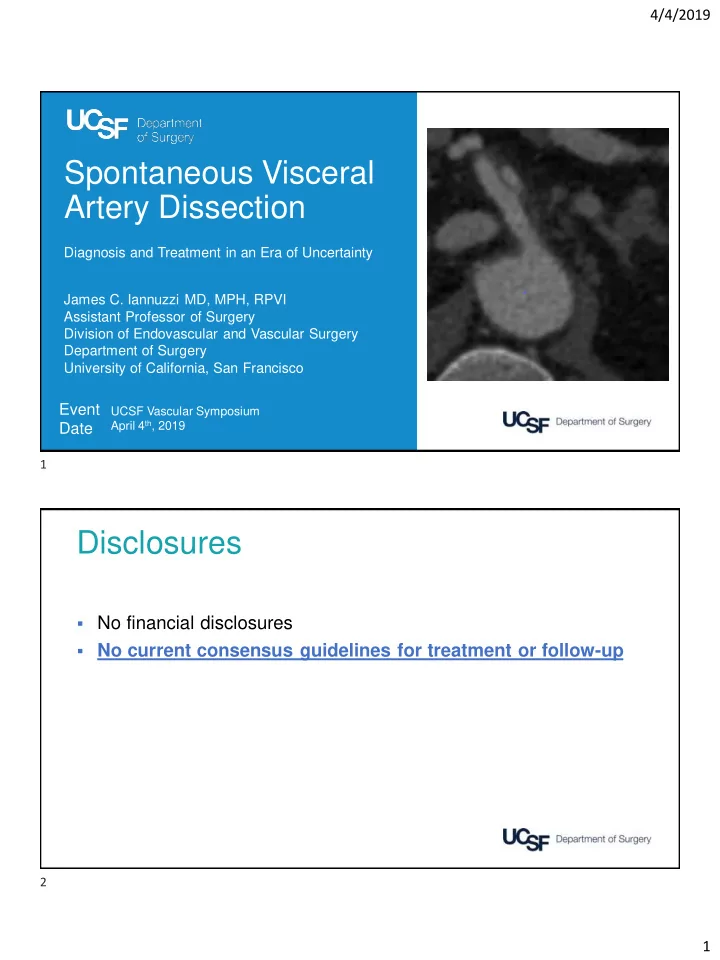
Spontaneous Visceral Artery Dissection

Diagnosis and Treatment in an Era of Uncertainty James C. Iannuzzi MD, MPH, RPVI Assistant Professor of Surgery Division of Endovascular and Vascular Surgery Department of Surgery University of California, San Francisco

UCSF Vascular Symposium April 4th, 2019

Disclosures

▪ No financial disclosures ▪ No current consensus guidelines for treatment or follow-up

1 2

slide-2
SLIDE 2

4/4/2019 2

Overview

Case Presentation

Symptomatic vs. Asymptomatic

Conservative treatment options

  • Anticoagulation/Antiplatelet/Observation

Intervention Options

  • Open vs. Endovascular

Surveillance

Case review

SMA Dissection

▪ 51 year old female ▪ Presented with abdominal and back pain ▪ Mild nausea, no emesis ▪ Benign abdominal exam

3 4

slide-3
SLIDE 3

4/4/2019 3

SS Case 1

▪ A. Observe ▪ B. Antiplatelet ▪ C. Anticoagulate & Antiplatelet ▪ D. Endovascular Stenting ▪ E. Open Repair

5 6

slide-4
SLIDE 4

4/4/2019 4

Spontaneous Combined CA Dissection

▪ 62 YO man with HTN, PSVT, OA ▪ Diffuse dull abdominal pain, worsened with eating ▪ SBP 190/100s ▪ Abdomen benign ▪ WBC 8.6, Lactate 0.4

7 8

slide-5
SLIDE 5

4/4/2019 5

9 10

slide-6
SLIDE 6

4/4/2019 6

Case 2: Combined SMA CA Dissection

▪ A. Imaging Surveillance ▪ B. Antiplatelet ▪ C. Anticoagulate & Antiplatelet ▪ D. Endovascular Stenting ▪ E. Open Repair

Case 3: Chronic CA Dissection

▪ 75 year old man with HTN AFIB (on Eliquis) ▪ Known celiac artery dissection (found incidentally on

hematuria work up)

▪ CA 1.4 cm in 2015 ▪ Denies abdominal and back pain.

11 12

slide-7
SLIDE 7

4/4/2019 7

Case 3: CA Dissection with Slow Growing Aneurysm

▪ A. Imaging Surveillance ▪ B. Antiplatelet ▪ C. Endovascular Stenting ▪ D. Open Repair

13 14

slide-8
SLIDE 8

4/4/2019 8

Mesenteric Artery Dissection

Risk Factors

Usually We Don’t Know

▪ Cystic medial degeneration (SAM) ▪ FMD ▪ Atherosclerosis ▪ Pregnancy ▪ Connective Tissue Disorders ▪ Trauma ▪ Idiopathic

Gobble et al. JVS 2009 Segmental Arterial Mediolysis

15 16

slide-9
SLIDE 9

4/4/2019 9

Incidence

Imaging

▪ 0.09% of all Contrast enhances

CT scans

▪ 0.68% of all abdominal CT scans

  • btained for abdominal

symptoms

Yamaguchi et al. Eur J Radiol Open. 2018

Early Management

Prior to Anticoagulation

▪ Bowel Rest and observation

  • 31/56 (55%) success rate
  • Surgical success in 12, 13 patients died

▪ Bowel Rest with Heparin GTT

  • 14/22 successful (63%)
  • 7/8 surgical cases successful

Gobble et al. JVS 2009

17 18

slide-10
SLIDE 10

4/4/2019 10

Morgan et al. JVS April 2018

19 20

slide-11
SLIDE 11

4/4/2019 11

Demographics

▪ 80.5% male ▪ Average Age 56 years ▪ 13% connective tissue disorder (FMD, SAM) ▪ 36% asymptomatic

Asymptomatic Management

▪ 33% observation alone ▪ 41% antiplatelet (aspirin, clopidogrel) indefinite ▪ 22% anticoagulation (3 months)

21 22

slide-12
SLIDE 12

4/4/2019 12

Symptomatic SMAD

▪ 8% required intervention ▪ 2% observation alone ▪ 24% antiplatelet (indefinite) ▪ 68% anticoagulation (5 months)

Symptomatic SMAD

23 24

slide-13
SLIDE 13

4/4/2019 13

Factors associated with Treatment

▪ SAM/FMD

  • OR 8.1 CI: 1.002-65.88, p=0.05

25 26

slide-14
SLIDE 14

4/4/2019 14

Zettervall et al. JVS 2017 Zettervall et al. JVS 2017

27 28

slide-15
SLIDE 15

4/4/2019 15

Treatment

Zettervall et al. JVS 2017

Outcomes

Zettervall et al. JVS 2017

29 30

slide-16
SLIDE 16

4/4/2019 16

Imaging Findings

▪ 67% of symptomatic patients had evidence of thrombosis ▪ 53% had evidence of inflammation ▪ Higher degree of stenosis

Gobble et al. JVS 2009

Stenting for Luminal Compression

31 32

slide-17
SLIDE 17

4/4/2019 17

Summary

▪ Majority Male ▪ Occurs in the 50’s ▪ 2/3rds are symptomatic ▪ Symptoms associated with inflammation and thrombosis on

imaging

Imaging Recommendations

  • At 1 month
  • Every 6 months for 2 years
  • U/S and CTA initially

▪ if concurrent results continue with ultrasound

Zettervall et al

33 34

slide-18
SLIDE 18

4/4/2019 18

Treatment In Practice

Gobble et al. (9 patients)

  • Asymptomatic: stent if progression on serial imaging
  • Symptomatic: stent

Zettervall et al. (25 patients)

  • Short term anticoagulation and lifelong aspirin for all patients

Morgan et al. (77 patients)

  • Asymptomatic: 33% observation, 41% antiplatelet, 22% anticoagulation

▪ No interventions

  • Symptomatic: 68% anticoagulation, 2% observation, 24% antiplatelet

▪ 8% operative intervention

Asymptomatic Treatment Summary

▪ Medical Management

  • Antiplatelet

▪ DAPT if lumen stenosis

  • Anticoagulation for thrombosis

▪ Intervention when rapid growth or Aneurysm >2cm ▪ Surveillance CTA vs. Ultrasound/MRA

35 36

slide-19
SLIDE 19

4/4/2019 19

Symptomatic Controversy

Stenting, Anti-coagulation, Antiplatelets, or Nothing?

Primary Treatment objective: limit the extension of dissection, preserve the blood flow distally through the true lumen, and to prevent the rupture of the SMA1

Min et al. JVS Aug 2011 Gobble et al. JVS 2009

37 38

slide-20
SLIDE 20

4/4/2019 20

Min et al. JVS Aug 2011

Zhu et al. J. Endovascular Therapy

39 40

slide-21
SLIDE 21

4/4/2019 21

Initial Treatment Approach

ICT 88% Open 4% ESP 8%

ICT Open ESP

Zhu et al. J. Endovascular Therapy

Value of Anticoagulation?

▪ ICT failure rate: 14.3% ▪ No anticoagulation failure rate: 10.1% ▪ Anti-coagulation failure rate: 17.8% (no statistical difference) ▪ Conclusion: Anticoagulation not beneficial

41 42

slide-22
SLIDE 22

4/4/2019 22 12.3 % Conversion

76% Endo

Stenting in Symptomatic SMA Dx

China vs. The World

▪ Overall 8.7% Rx with ESP ▪ China 33.6% Rx with ESP

  • Aimed at rapid symptom relief, shorter length of stay, lower in-hospital

severe AE

43 44

slide-23
SLIDE 23

4/4/2019 23

Treatment Indications

▪ Bowel Ischemia ▪ Persistent symptoms ▪ Rapid Growth ▪ Size >2 cm

Care Controversies

▪ Routine Antiplatelet use ▪ Anticoagulation?

  • Cases of luminal stenosis or thrombosis

▪ Role of Thrombolysis ▪ Symptomatic Stenting

  • Persistent symptoms

45 46

slide-24
SLIDE 24

4/4/2019 24

Case 1: SMA Dissection with Thrombosis

▪ 51 year old female ▪ Presented with abdominal and back pain ▪ Mild nausea, no emesis ▪ Benign abdominal exam

SS

47 48

slide-25
SLIDE 25

4/4/2019 25

Case 1: SMA Dissection & Thrombosis

▪ Heparin Gtt ▪ Serial abdominal exams ▪ Repeat CT scan ▪ Discharged home on Eliquis and ASA 81 mg daily

49 50

slide-26
SLIDE 26

4/4/2019 26

Case 2: Spontaneous CA Dissection

▪ 62 YO man with HTN, PSVT, OA ▪ Diffuse dull abdominal pain, worsened with eating ▪ BPO 190/100s ▪ Abdomen benign ▪ WBC 8.6, Lactate 0.4

51 52

slide-27
SLIDE 27

4/4/2019 27

Spontaneous Acute CA Dissection

▪ Discharged home on ASA 81 mg ▪ Improved blood pressure control ▪ 1 Month follow up CTA

Case 3: Chronic CA Dissection

75 year old man with HTN afib on Eliquis

Known celiac artery dissection

CA 1.4 cm in 2015

Denies abdominal and back pain.

53 54

slide-28
SLIDE 28

4/4/2019 28

55 56

slide-29
SLIDE 29

4/4/2019 29

Left Gastric Coil Embolization Splenic a. Coil Embolization

57 58