SLIDE 1
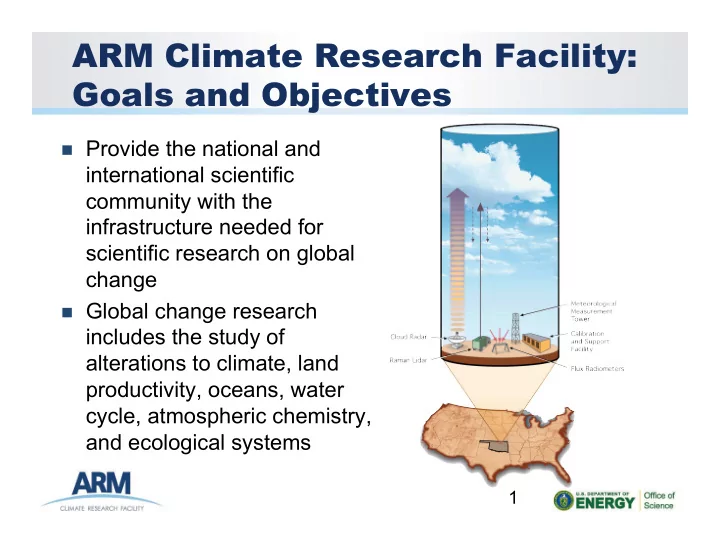
ARM Climate Research Facility: Goals and Objectives
Provide the national and
international scientific community with the infrastructure needed for scientific research on global change
Global change research
includes the study of alterations to climate, land productivity, oceans, water cycle, atmospheric chemistry, and ecological systems
1
SLIDE 2
Accomplishing the Mission
Maintain and augment the collection of comprehensive
and continuous long-term data sets that provide measurements of radiation, aerosols, clouds, precipitation, dynamics, and thermodynamics over a range of environmental conditions at several fixed and mobile sites situated in climatically diverse locations.
Supplement the long-term data sets with laboratory
studies and shorter-duration field campaigns, both ground-based and airborne, to target specific atmospheric processes under a diversity of locations and atmospheric conditions.
2
SLIDE 3
Accomplishing the Mission (cont.)
Use these data, together with models, to understand and
parameterize the processes that govern the atmospheric components and their interactions over all pertinent scales.
Develop integrated, scale-bridging testbeds for model
parameterizations that incorporate this process-level understanding of the life cycles of aerosols, clouds, and precipitation in numerical models.
3
SLIDE 4 Resolving the Most Critical Uncertainties of Climate Change
The three high-priority science questions that summarize
this critically needed research are:
- 1. What are the present deficiencies in cloud formulations and cloud
feedback representations in climate models, and how can they be eliminated?
- 2. What are the climatically relevant chemical and physical properties
- f aerosols that control their effects on the atmosphere's radiation
balance, and how can they be best represented in climate models?
- 3. What are the present deficiencies in terrestrial carbon cycle
feedback representations in climate models, and how can they be eliminated? 4
SLIDE 5
Facility Components
Research sites – permanent, mobile, and aerial Instruments and measurements Data processing, data quality, Data Archive Field campaigns – ground-based and airborne
5
SLIDE 6 ARM Research Sites
Southern Great Plains (1993) North Slope of Alaska: Barrow (1998) and Atqasuk (1999) Tropical Western Pacific: Manus (1996), Nauru (1998), and Darwin (2002) First ARM Mobile Facility (2005); Second ARM Mobile Facility (2010) ARM Aerial Facility (2007)
6
SLIDE 7 Cloud profiles: millimeter radar and lidar Temperature/relative humidity/wind
profiles: radiosondes
Column water: microwave radiometer Column aerosol: solar spectral
radiometer
In situ aerosol optical and cloud
nucleation properties
Surface radiation budget: solar and
terrestrial IR radiometers
Surface meteorology: T/RH/wind
Additional instruments being deployed through the Recovery Act
Categories of Measurements and Instruments
7
SLIDE 8 Data Products
Most instrument data are processed to a standard NetCDF format before being delivered to the Archive. When necessary, higher-
Products (VAPs) are
variety of purposes including:
Merging data from multiple instruments
Providing derived parameters
Adding QC/QA information
2 ¡T ¡Bytes ¡
8
SLIDE 9 Recovery Act: Introduction
$60M from DOE Office of Science for investments in
instrumentation and research infrastructure to support the instrumentation and the associated increase in data volume and complexity
3-dimensional measurements of cloud scale dynamics,
microphysics, and precipitation
Enhanced measurements of atmospheric aerosol
composition and chemistry
Enhance measurement base to bridge new knowledge
into, and improve, the predictive performance of climate models
http://www.arm.gov/about/recovery-act 9
SLIDE 10
SGP Original Configuration 1992
10
SLIDE 11
SGP Reconfiguration 2011
11
SLIDE 12
ARM Designated a DOE National Scientific User Facility in 2004
12
The Southern Great Plains ARM Site locale was chosen to take advantage of existing networks: the NOAA wind profiler demonstration network, the Oklahoma (and Kansas) mesonet, and others. Other networks have placed instruments/sites at ARM sites (BSRN, USDA UV-B, MPLnet, etc.): synergism not duplication.
http://www.arm.gov