What do mergers do to galaxies? Eric Bell Antonela Monachesi - - PowerPoint PPT Presentation

what do mergers do to galaxies
SMART_READER_LITE
LIVE PREVIEW

What do mergers do to galaxies? Eric Bell Antonela Monachesi - - PowerPoint PPT Presentation

What do mergers do to galaxies? Eric Bell Antonela Monachesi Richard DSouza Benjamin Harmsen Roelof de Jong, In Sung Jang, Adam Smercina, David Radburn-Smith, Jeremy Bailin + GHOSTS NGC 253; ESO Danish 1.5-meter telescope Galaxies with

slide-1
SLIDE 1

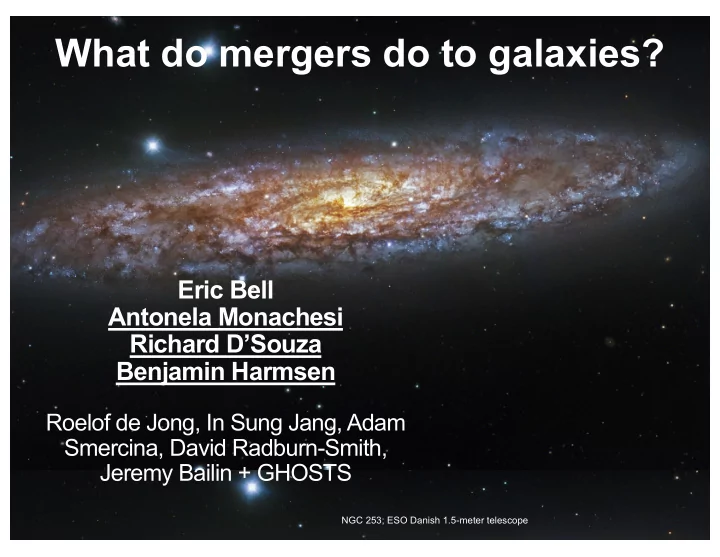
What do mergers do to galaxies?

Eric Bell Antonela Monachesi Richard D’Souza Benjamin Harmsen

Roelof de Jong, In Sung Jang, Adam Smercina, David Radburn-Smith, Jeremy Bailin + GHOSTS

NGC 253; ESO Danish 1.5-meter telescope

slide-2
SLIDE 2

Galaxies with masses like the Milky Way have a wide range of structures, star formation histories and gas content

Blanton & Moustakas 2009

slide-3
SLIDE 3

The merger and accretion history of a galaxy is predicted to be a key driver of its properties

Springel et al.

slide-4
SLIDE 4

Stellar halos hold the promise to be visible, collisionless tracers of merging and accretion

Eris; hydrodynamical model Pillepich et al. 2015

slide-5
SLIDE 5

Observational and theoretical challenges have prevented the use of stellar halos as quantitative measures of merger history

Eris; hydrodynamical model Pillepich et al. 2015 Rogelio Bernal Andreo

Halos are hard to detect and quantify What are we measuring – Accretion or in situ?

Bullock and Johnston 2005

How do I disentangle contributions from many satellites?

slide-6
SLIDE 6

These challenges have been circumvented and allow us to use stellar halos to quantitatively measure the most massive accretion

Illustris hydrodynamical model D’Souza & Bell 2018 Bell et al. 2017 HST/GHOSTS

slide-7
SLIDE 7

In MW-mass galaxies models predict that the minor axis at large distance is often accretion-dominated

Eris; hydrodynamical model Pillepich et al. 2015 For similar results from the Auriga hydrodynamical model; See also Monachesi et al. 2016, 2018

slide-8
SLIDE 8

To learn more we compare minor axis

  • bservations with model accreted and in situ stars

Eris; hydrodynamical model Pillepich et al. 2015 For similar results from the Auriga hydrodynamical model; See also Monachesi et al. 2016, 2018

slide-9
SLIDE 9

Illustris: D’Souza & Bell 2018

Accretion predictions along the minor axis agree with observations, while in situ halos vary but are often over-predicted.

For similar results from the Auriga hydrodynamical model; Recall Monachesi’s talk and Monachesi et al. 2016, 2018

slide-10
SLIDE 10

Halos including in situ stars appear to have excessive stellar masses and high metallicities

Harmsen, et al. 2017; D’Souza & Bell 2018; Monachesi et al. 2018

slide-11
SLIDE 11

Observations agree with both accretion only models and accreted part of hydro models

Harmsen, et al. 2017; D’Souza & Bell 2018; Monachesi et al. 2018

slide-12
SLIDE 12

Accreted halos rely only on merger trees, halo

  • ccupation and realistic satellites, so are robust

Moster et al. 2013; Behroozi et al. 2013 Lacey & Cole 1993

slide-13
SLIDE 13

It is good that in situ predictions disagree. They are sensitive to different physics that we want to understand – e.g., early star formation and assembly, SF at low densities.

HST NASA/ESA; Traci Johnson & Keren Sharon

slide-14
SLIDE 14

The agreement between minor axis observations and accreted halo predictions strongly suggests that such observations faithfully trace accreted stars

Harmsen, Monachesi, Bell et al. 2017

slide-15
SLIDE 15

Most accreted halos are predicted to have had a single dominant accretion, much larger than the others

While many dark matter halos are accreted, the larger halos have much higher stellar mass and dominate

Moster et al. 2013; Behroozi et al. 2013

Cooper et al. 2010 D’Souza & Bell 2018

slide-16
SLIDE 16

Because of the galaxy metallicity-mass relationship, the most massive satellite imprints a stellar halo mass-metallicity relation

The most massive satellite dominates mass and drives up metallicity of accreted halos

This is an iron-clad prediction of hierarchical galaxy growth – halos reflect most massive accretion

Harmsen, Monachesi, Bell et al. 2017 D’Souza & Bell 2018 Monachesi et al. 2018

slide-17
SLIDE 17

Bell et al. 2017, using Deason et al. 2016 models

Models quantify the relationship between dominant accretion event and halo properties…

slide-18
SLIDE 18

Bell et al. 2017, using Deason et al. 2016 models

…meaning that we can use stellar halo mass or metallicity to quantify dominant merger

slide-19
SLIDE 19

Observational and theoretical challenges have prevented the use of stellar halos as quantitative measures of merger history

Eris; hydrodynamical model Pillepich et al. 2015 Rogelio Bernal Andreo

Halos are hard to detect and quantify What are we measuring – Accretion or in situ?

Bullock and Johnston 2005

How do I disentangle contributions from many satellites?

slide-20
SLIDE 20

Minor axis observations of stellar halos in MW- mass galaxies characterize the most massive accretion

Illustris hydrodynamical model D’Souza & Bell 2018

Small samples of reliably measured stellar halos are available The minor axes of inclined Milky Way mass galaxies are accretion-dominated

Bell et al. 2017

Stellar halo properties are dominated by a single large accretion

HST/GHOSTS

slide-21
SLIDE 21

The merger and accretion history of a galaxy is predicted to be a key driver of its properties

Springel et al.

slide-22
SLIDE 22

The merger and accretion history of a galaxy is predicted to be a driver of its bulge and BH

Springel et al.

slide-23
SLIDE 23

Bell et al. 2017

Stellar halo mass (dominant accretion) correlates poorly with bulge/BH mass, even for ‘classical’ bulges

Hopkins+10 binary merger sims. classical bulges pseudobulges

The scatter is much larger than models in which mergers between established galaxies make bulges, indicating that at least this is not the only way to make bulges

slide-24
SLIDE 24

This blunt tool can be sharpened with ages, kinematics, metallicity gradients, morphology

Richard D’Souza’s talk yesterday, also Monachesi, Pillepich and others

slide-25
SLIDE 25

Minor axis studies of resolved stars in nearby MW-mass galaxies reveals diverse stellar halos. Comparison with robust accretion models strongly suggests MW minor axis at >10kpc is accretion-dominated. The most massive accretion dominates a halo’s properties, allowing us to quantify merger history. Mass of largest accretion correlates poorly with bulge and BH mass; merging between established galaxies is not the only path to bulge growth. Stellar populations, gradients and morphologies characterize merger history and properties.