+ Are Gravitational Wave Standard- Hendry & Woan 07 Sirens - - PowerPoint PPT Presentation

are gravitational wave standard hendry woan 07 sirens
SMART_READER_LITE
LIVE PREVIEW

+ Are Gravitational Wave Standard- Hendry & Woan 07 Sirens - - PowerPoint PPT Presentation

+ Are Gravitational Wave Standard- Hendry & Woan 07 Sirens Ruined by Gravitational Lensing? Charles Shapiro Institute of Cosmology & Gravitation, Portsmouth Collaborators: David Bacon (ICG), Ben Hoyle (ICG), Martin Hendry


slide-1
SLIDE 1

+

Charles Shapiro

Institute of Cosmology & Gravitation, Portsmouth Collaborators: David Bacon (ICG), Ben Hoyle (ICG), Martin Hendry (Glasgow)

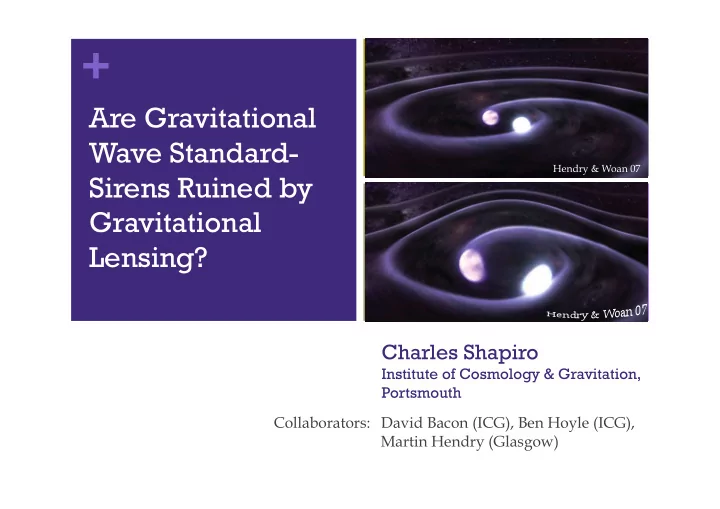
Are Gravitational Wave Standard- Sirens Ruined by Gravitational Lensing?

Hendry & Woan 07
slide-2
SLIDE 2

+ The Problem of Lensed

Gravitational Wave Sirens

 Binary black holes (BBH) are precise “standard sirens.” Gravitational

waves (GW) measured by LISA could determine BBH distances to < 1%.

 If redshifts of EM counterparts are found, we can constrain

cosmological parameters with the distance-redshift relation.

 But large-scale structure lenses GWs! From a (de)magnified signal, we

can only measure

DL

  • bs =DL

true µ-1/2

 Lensing blows up distance uncertainty to ~5% at z=2.

slide-3
SLIDE 3

+ BBH distances are uncertain due to an

unknown GW magnification

 Holz & Hughes (2005)  All parameters fixed

except 2

 Expect ~few BBH/year  Oh, cruel Universe!

z = 1.5

slide-4
SLIDE 4

+ Solution: Can We Map

the Magnification?

 Not a new idea  A map of µ can be reconstructed from

weakly lensed galaxy images (µ ≈ 1-2)

 Measure shear and flexion  Flexion is the weak “arc-iness” or

“bananification” of lensed galaxies

 Maps are noisy due to intrinsic galaxy

shapes and finite sampling (we must smooth)

 Dalal et al. (2006): The fraction of µ

2 that

can be removed by mapping µ is

HST/COSMOS, Massey et al. (2005)

slide-5
SLIDE 5

+

I’m so sensitive! Wow, a talking banana!

The Power of Flexion

 Flexion is (informally)

F ~ grad(  ) or G ~ grad(  )

 High S/N galaxies have small intrinsic

flexion

int = 0.2 – 0.4 Fint < 0.1/arcmin

 Flexion is more sensitive to substructure

than shear is

 Shape noise in µ map is independent of

flexion smoothing scale (unlike shear):

Cp(θ) = γ2

int

π θ2 ngal Cp(θ) = F 2

int

π ngal

slide-6
SLIDE 6

+ How well can we remove magnification

uncertainty? Assumptions:

 Follow up on each BBH with pointed

  • bservations (we’ll want to anyway!)

Say, with an ELT:

RMS = 0.2 FRMS = 0.04/arcmin

 Assume images similar to Hubble

Ultra Deep Field:

ngal=1000/arcmin2 zmed=1.8

 Assume lensing fields are weak and

Gaussian; no intrinsic correlations

 Concordance CDM, 8=0.8, ns=0.96,

nonlinear power from Smith et al. fitting formula

Coe et al. (2006)

slide-7
SLIDE 7

+ How well can we remove magnification

uncertainty? z = 1, (DL)lens=2%

10 galaxies/tophat Smoothing scale

Cp(θ) = γ2

int

π θ2 ngal Cp(θ) = F 2

int

π ngal (DL)corrected / (DL)lens

shear flexion

slide-8
SLIDE 8

+ How well can we remove magnification

uncertainty? z = 2, (DL)lens=4%

10 galaxies/tophat Smoothing scale

(DL)corrected / (DL)lens

Cp(θ) = γ2

int

π θ2 ngal Cp(θ) = F 2

int

π ngal

shear flexion

slide-9
SLIDE 9

+ How well can we remove magnification

uncertainty? z = 3, (DL)lens=5.2%

10 galaxies/tophat Smoothing scale

(DL)corrected / (DL)lens

Cp(θ) = γ2

int

π θ2 ngal Cp(θ) = F 2

int

π ngal

shear flexion

slide-10
SLIDE 10

+ Impact on Dark Energy Parameters

2 BBHs unlensed 2 BBHs lensed 2 BBHs corrected 10 BBHs corrected

 All parameters fixed except 2  2 BBHs are still not

competitive with SNAP supernovae, but we have made good progress!

slide-11
SLIDE 11

+ Summary

 Binary black holes are precise

standard sirens, but gravitational lensing hampers distance measurements.

 Using deep images of BBH

neighborhoods to make weak lensing maps, we can remove some uncertainty in BBH distances.

 Flexion maps from images like the

from Hubble Ultra Deep Field could reduce distance errors by factors of 2 or 3.

2 BBHs unlensed 2 BBHs lensed 2 BBHs corrected 10 BBHs corrected