
SLIDE 1
1
Gravitational waves from Extreme mass ratio inspirals
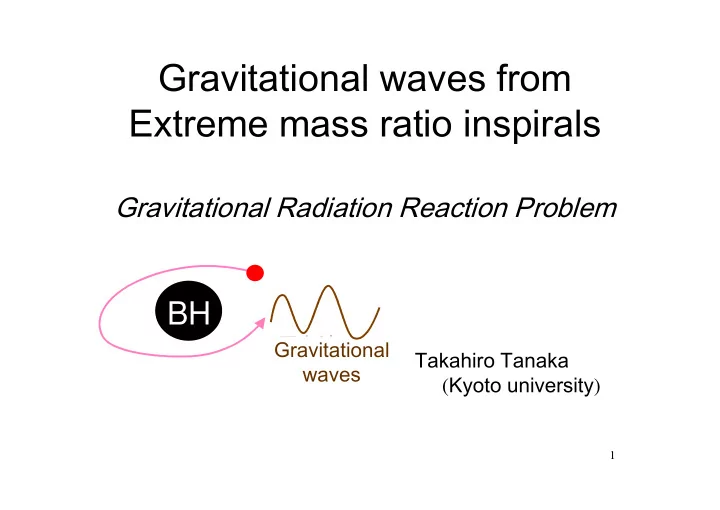
Gravitational Radiation Reaction Problem
Takahiro Tanaka (Kyoto university)
BH
重力波
Gravitational waves
Gravitational waves from Extreme mass ratio inspirals Gravitational - - PowerPoint PPT Presentation
Gravitational waves from Extreme mass ratio inspirals Gravitational Radiation Reaction Problem BH Gravitational Takahiro Tanaka waves ( Kyoto university ) 1 Various sources of gravitational waves Inspiraling binaries
1
Takahiro Tanaka (Kyoto university)
重力波
Gravitational waves
2
– Binaries with large separation (long before coalescence)
distance information
– Pulsars
– supernovae ‒γ- ray burst
– GWs from the early universe – Unresolved foreground
3
In general, binary inspirals bring information about – Event rate – Binary parameters – Test of GR
– Target of ground based detectors – NS equation of state – Possible correlation with short γ-ray burst – primordial BH binaries (BHMACHO)
– Formation history of central super massive BH
– Probe of BH geometry
4
Merging phase -
Ringing tail -
for precision test of general relativity Clean system Negligible effect of internal structure
(Cutler et al, PRL 70 2984(1993))
for detection
(Berti et al, PRD 71:084025,2005)
for parameter extraction Accurate prediction of the wave form is requested
5
white dwarfs (=0.6M◎), neutron stars (=1.4M◎) BHs (=10M◎,~100M◎)
– star cluster is formed – large angle scattering encounter put the body into a highly eccentric orbit – Capture and circularization due to gravitational radiation reaction ~last three years: eccentricity reduces 1-e →O(1)
a few ×102 events for 3 year observation by LISA
◎ ◎
M M M
6 5
10 5 10 ~
GW
(Gair et al, CGQ 21 S1595 (2004))
although still very uncertain.
(Amaro-Seoane et al, astro-ph/0703495)
6
– Central BH will be rotating: a~0.9M
Large number of cycles N before plunge in the strong field region Roughly speaking, difference in the number of cycle N>1 is detectable.
重力波
7
yr 10 10 10 10 5 . 4
1 2 1 6 12
M m M M M & &
◎ ◎
(Narayan, ApJ, 536, 663 (2000))
df
t T f f
t T fT T f N
due to interaction Change in number of cycles ,assuming almost spherical accretion (ADAF)
rel df
m G v t
2 3
log 4
~ 1yr
8
We know how higher expansion proceeds.
f i
e f A f h
/ 7
u u f t f
c c
4 11 331 743 9 20 1 128 3 2
3 / 2 3 / 5
M D A
L
, 20 1
5 2 5 3 6 / 5 3
for quasi-circular orbit ⇒Only for detection,
higher order template may not be necessary? We need higher order accurate template for precise measurement of parameters (or test of GR).
parameter estimate ∝ signal to noise ratio 1PN c.f.
9
Test of GR Scalar-tensor type
L u u u f
g
3 128 9 55 756 3715 1 128 3
3 / 2 3 / 2 3 / 5
BD>140, (600) 4U 1820-30(NS-WD in NGC6624)
Dipole radiation = -1 PN (Will & Zaglauer, ApJ 346 366 (1989))
3
v O f M u
Mass of graviton
BD
Decigo1.4M◎NS+10M◎BH:BD >5×10⁹ ?
(Berti & Will, PRD71 084025(2005))
a M
g g
2 2
LISA 107M◎BH+107M◎BH: graviton compton wavelength g > 1kpc
(Berti & Will, PRD71 084025(2005))
Constraint from future observation: Constraint from future observation:
10
1
BH
重力波
1
8 GT G
Linear perturbation
1 1
4 T g L
waves Regge-Wheeler formalism (Schwarzschild) Teukolsky formalism (Kerr)
Mano-Takasugi-Suzuki’s method (systematic PN expansion)
T e Y r R x d g W x Z x
t i in s up up
' 1
4
11
Teukolsky equation First we solve homogeneous equation
i
e Y r R
Angular harmonic function
r
2nd order differential operator
i h & & & & 2 1 ~
Z dt dE
at r →∞
in s r up s s
R R W
Wronskian
projected Weyl curvature
Z m dt dLz
: angular momentum loss rate
,m l
12
GW
self-force effect
13
We need to directly evaluate the self-force acting on the particle, but it is divergent in a naïve sense.
Schwarzschild “constants of motion” E, Li ⇔ Killing vector Conserved current for GW corresponding to Killing vector exists.
gw
conserved quantities E, Lz ⇔ Killing vector Q ⇔ Killing vector
In total, conservation law holds.
GW
14
the radiative field, instead of the retarded field, to calculated the long time average of E,Lz,Q.
adv ret rad
h F d Q
u Q T
T T T
1 1 lim
&
which differs from energy balance argument.
At the lowest order, we assume that the trajectory of a particle is given by a geodesic specified by E,Lz,Q.
:radiative field
(Mino Phys. Rev. D67 084027 (’03))
Radiative field is not divergent at the location of the particle. Regularization of the self-force is unnecessary!
15
u h h h u u g f
; ; ;
2 1
u K d dQ 2
Killing tensor associated with Q
*
for metric reconstruction from the master variable.
r n m l
m l m l r r
Z n dt dL r aP dt dE r P a r dt dQ
, ,
, , 2 , , 2 2
2 2 2
a r E r P
2
n m
r r n n m
r ,
Only discrete Fourier components exist after several non-trivial manipulations
u K Q
2 2
2 a Mr r
16
(Ganz, Hikida, Nakano, Sago, Tanaka, Prog. Theor. Phys. (’07))
Use of systematic PN expansion of BH perturbation. Small eccentricity expansion General inclination
17
Adiabatic radiation reaction for the Carter constant has been computed.
O dt dE orbit
geodesic
O df dE orbit
leading order
Direct computation of the self-force at O() is also almost ready in principle. However, to go to the second order, we also need to evaluate the second order self-force. Among various sources of GWs, E(I)MRI is the best for the test of GR. For high-precision test of GR, we need accurate theoretical prediction