- B. Swinkels – Experimental GW detection
1
Experimental detection
- f gravitational waves
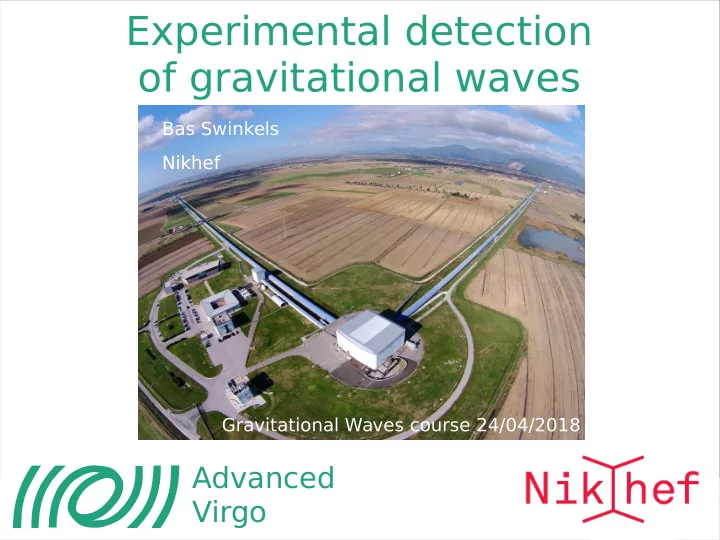
Gravitational Waves course 24/04/2018 Bas Swinkels Nikhef
Experimental detection of gravitational waves Bas Swinkels Nikhef - - PowerPoint PPT Presentation
Experimental detection of gravitational waves Bas Swinkels Nikhef Gravitational Waves course 24/04/2018 Advanced Virgo B. Swinkels Experimental GW detection 1 Outline Historic attempts to measure GW Detecting GW with
1
Gravitational Waves course 24/04/2018 Bas Swinkels Nikhef
2
don’t know a lot about GR. I worked for many years at the Virgo site.
3
4
–
missing technology: lasers, modern electronics, ...
–
missing observational evidence for astronomical sources of GW (black holes, neutron stars, pulsars, ...)
–
theory was not yet mature, not immediately clear if GW are observable at all, if they carry energy
so GW carries energy
5
pioneer of experimental GW detection
6
transducers (SQUIDs), using amplification by a small mechanical resonator
narrow-band, and even at resonance have lower sensitivity than interferometers NAUTILUS mini-GRAIL ALLEGRO
7
radio telescopes (1974)
showed that orbits get shorter
gravitational waves
8
Microwave Background
9
to measure difference in the speed of light based on the direction of travel (movement of Earth around Sun)
could be rotated in bath of mercury
famous null-results, which was at basis of Lorentz transformations, Special Relativity
10
(but note sign flip to conserve energy, see Stokes relations)
Laser Laser Photodiode BS ETMX ETMY Ly Lx
11
To achieve the best SNR, you therefore want to be close to 'dark fringe'
12
differential change of arm length:
dependency on source distance is 1/R instead of 1/R^2
13
mirror movements along the optical axis
14
GW: sensitive to GW coming perpendicular to the plane, insensitive to the some directions in the plane. Leads to ‘blind spots’ (see GW170817 for Virgo)
arguments are redundancy, coincident detection and sky localization)
15
the wavelength itself change by a passing GW? It does ...
a step, but you could imagine some slowly oscillating signal as composed of several steps
interferometer, but interference condition does initially stays the same
16
meanwhile fills with light of the original frequency
17
18
19
many times up and down arm cavities
ETMY ETMX ITMY ITMX
20
lengths by a factor Neff , but without the extra zeros in frequency domain
21
power by a factor ~37
PRM
22
23
24
2x LIGO USA INDIGO India Virgo, Italy GEO, Germany KAGRA, Japan LISA, space 4 km 4 km 3 km 600 m 3 km, cryog., underground 106 km Operational 2015 Planned 2022 Operational 2017 Operational Planned 2022 Planned 2034
25
Hungary, Spain
26
and position sensors) and passive multi-stage pendulums and blade springs
mechanical losses
27
inside large vacuum tubes
28
laser and photodiodes
29
to control 4 degrees-of-freedom
Modulater, demodulate photodiode/quadrant signals
30
–
quantum noise (shot noise, radiation pressure)
–
thermal noise: suspensions, coatings
–
residual pressure
coatings, larger beams, better vacuum, cryogenics, ...
31
–
coupling to environmental noise (magnetic, acoustic, seismic)
–
scattered light: non-linear process!
–
ADC/DAC/electronics noise, ...
32
baseline, bigger beams, squeezing
will costs O(1e9 $/Eu)
33
spacecraft, amplify it, send it back, measure round-trip phase. GW signal reconstructed in post-processing.
0.03 mHz to 100 mHz
cm distance. Performance better than expected
34
–
rotation of earth, orbit of Earth, movement of Solar system
35
36
since around 50 years
detections of BBH and BNS
more sensitive and have different bandwidths. Note: sensitivity improvement increases detection rate with cube!
dedicated course on GW instrumentation, possibility to do thesis in the GW group at Nikhef
37